

Kinetic energy (KE), is the energy an object possesses because of its motion. Every moving object — from a rolling football to a speeding rocket — carries kinetic energy. The faster an object moves, the more kinetic energy it has. This form of energy exists everywhere in everyday life and is one of the most fundamental concepts in physics. A moving bicycle, flowing river water, flying birds, moving trains, spinning turbines, and even microscopic particles all possess KE because they are in motion.
The formula for kinetic energy is:
K.E = 1/2 m v2
Where:
The equation shows that kE depends on both mass and velocity. Heavier objects generally have more kinetic energy, but speed has a much greater effect because velocity is squared in the formula. This means that doubling the speed of an object increases its kE four times. That is why high-speed vehicles and projectiles can become extremely dangerous.
Kinetic energy is one of the most important concepts in physics because it explains motion, collisions, work, energy transfer, vehicle safety, machines, and even planetary motion. It also plays a major role in engineering, transportation, sports science, and modern technology.
Quick Answer: What Is KE?
|
Property |
Description |
|---|---|
|
Definition |
Energy possessed due to motion |
|
Formula |
KE = ½mv² |
|
SI Unit |
Joule (J) |
|
Depends On |
Mass and velocity |
|
Quantity Type |
Scalar |
|
At Rest |
Zero kinetic energy |
What Is Kinetic Energy? — Definition
The energy possessed by an object because it is moving. Any object with mass that is in motion has kE.
Examples include:
An object at rest has zero KE because its velocity is zero.
The word “kinetic” comes from the Greek word kinētikos, meaning “motion.” The modern concept of kinetic energy was developed through the work of Gaspard-Gustave de Coriolis and later refined using the laws developed by Isaac Newton.
Everyday Examples
Kinetic energy exists everywhere in daily life.
Common real-life examples
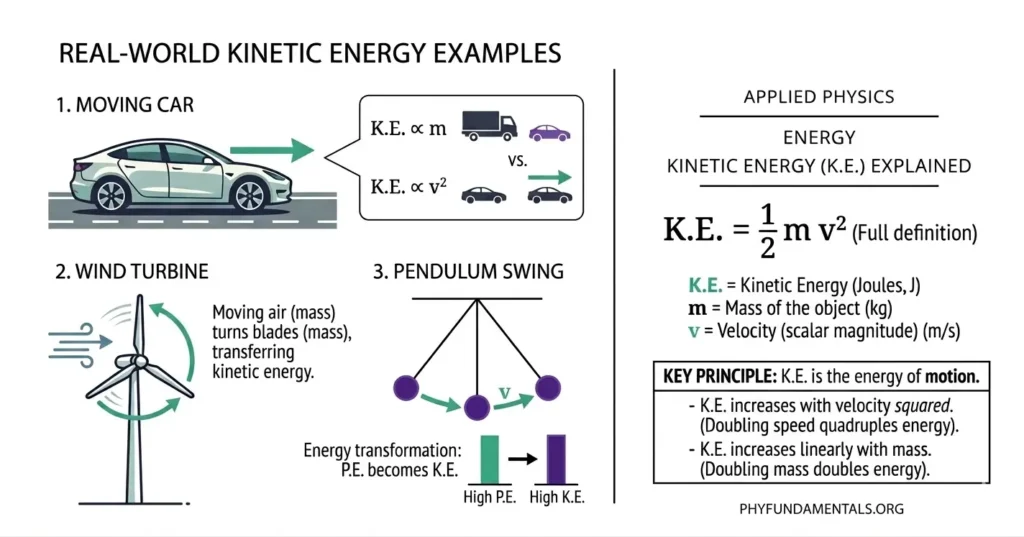
Even microscopic particles such as molecules and electrons possess kinetic energy due to their motion.
What Is the Formula for KE?
The KE equation is:
K.E = 1/2 m v2
This formula shows that KE depends on:
- mass
- velocity
However, the relationship is not equal.
Important Concept
Doubling the mass doubles the KE.
But doubling the speed increases KE four times because velocity is squared.
Example
A car moving at 60 mph has four times more KE than the same car moving at 30 mph.
This is why high-speed collisions are dramatically more dangerous
Variables in the Energy of Motion Formula
|
Symbol |
Meaning |
SI Unit |
|---|---|---|
|
KE |
Kinetic energy |
Joule (J) |
|
m |
Mass |
Kilogram (kg) |
|
v |
Velocity/speed |
m/s |
Why Does KE Depend on Velocity Squared?
Many students wonder why energy of motion depends on v² instead of v.
The answer comes from the Work–energy theorem.
When a force accelerates an object, the work done increases with both:
Using Newtonian mechanics leads directly to:
K.E = 1/2 m v2
The square relationship means speed has a much larger effect on KE than mass.
Key Take away
Small increases in speed create very large increases in KE.
Derivation of the KE Formula
Formula can be derived from several fundamental principles of classical mechanics. These derivations show that the equation is not arbitrary; it naturally emerges from the laws of motion and the definition of work. The most common derivation uses Newton’s laws of motion together with the work-energy principle.
Start with Newton’s Second Law:
F=ma
Work done by a force is defined as:
W=Fs
where:
Using the kinematic equation:
v2=u2+2as
For an object starting from rest, the initial velocity u = 0, so:
v2= 2as
Rearranging gives:
S = v2/2a
Substituting F = ma and the value of s into the work equation:
W = ma x v2/2a
The acceleration terms cancel:
W=1/2 mv2
Since work done equals the energy transferred to the object, the kinetic energy becomes:
K.E = 1/2 m v2
Another derivation comes directly from the Work–energy theorem using calculus. Work is defined as the integral of force over displacement:
W = ∫F ds
Using Newton’s Second Law:
F=ma
Acceleration can also be written as:
a = v dv/ds
Substituting into the work equation:
W=\int mv\frac{dv}{ds}ds
The displacement terms simplify:
W = ∫ m v dv/ds
Integrating gives:
W = m (v2/2)
Therefore:
W = 1/2 m v2
which again leads to the kinetic energy equation.
A third method uses momentum. Momentum is defined as:
P = m v
The relationship between momentum and kinetic energy is:
K.E = p2/2m
Substituting p = mv:
K.E = (mv)2/2m
Simplifying:
K.E = m2v2/2m
which reduces to:
K.E = 1/2 m v2
All these derivation methods lead to the same final equation, proving the consistency and universality of classical mechanics. The formula demonstrates that kinetic energy depends directly on mass and on the square of velocity. This squared relationship explains why speed has such a dramatic effect on motion, impacts, and energy transfer in the real world.
Rearranged Equations
The formula can also be rearranged.
To find mass
m = 2 K.E/v2
To find velocity
v = √2 K.E/m
These equations are widely used in mechanics, engineering, and exam calculations.
What Is the SI Unit of KE?
The SI unit of KE is the joule (J).
One joule equals:
1 J= 1 kg . m2/s2
The unit is named after James Prescott Joule.
Larger units include:
Examples & Values
|
Object |
Speed |
Kinetic Energy |
|---|---|---|
|
Walking person |
1.5 m/s |
~79 J |
|
Tennis ball |
63 m/s |
~113 J |
|
Car at 30 mph |
13.4 m/s |
~134 kJ |
|
Car at 60 mph |
26.8 m/s |
~538 kJ |
|
Rifle bullet |
900 m/s |
~1,620 J |
|
Passenger airplan |
250 m/s |
Several GJ |
Notice how doubling the car’s speed from 30 mph to 60 mph quadruples the kinetic energy.
Difference Between Kinetic and Potential Energy
|
KE |
Potential Energy |
|---|---|
|
Energy of motion |
Stored energy |
|
Depends on velocity |
Depends on position |
|
Formula: ½mv² |
Formula: mgh |
|
Zero at rest |
Can exist at rest |
|
Increases with speed |
Increases with height |
KE and potential energy together form mechanical energy.
Kinetic Motion and Conservation of Energy
In a frictionless system:
K.E + P.E = constant
This means energy continuously changes form.
Example
When a ball falls:
Just before impact, almost all the energy becomes kinetic energy.
This principle explains:
Kinetic Motion and Momentum
KE and momentum are related but different.
|
Property |
KE |
Momentum |
|
Formula |
½mv² |
mv |
|
Type |
Scalar |
Vector |
|
Depends on |
v² |
v |
|
Conserved Always? |
No |
Yes |
Relationship:
K.E = p2/2m
Momentum depends on direction, while KE does not.
Motion Energy in Collisions
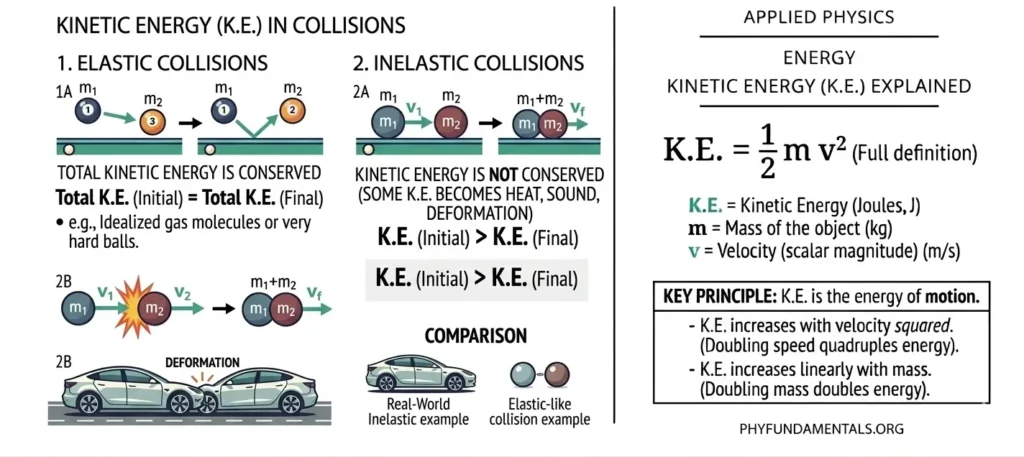
Motion energy plays a central role in understanding collisions because collisions involve the transfer, conservation, or transformation of energy during impact. In physics, collisions are classified according to what happens to kinetic energy when two or more objects interact. To understand collisions correctly, it is essential to distinguish between kinetic energy and momentum, since the two quantities behave differently during impacts.
In every collision, momentum is conserved provided no significant external forces act on the system. Kinetic energy, however, is conserved only in certain special types of collisions. This distinction is extremely important because many students incorrectly assume that kinetic energy is always conserved whenever objects collide. In reality, kinetic energy is often transformed into other forms of energy such as heat, sound, vibration, or deformation.
Elastic Collisions
In elastic collisions:
Examples:
In a perfectly elastic collision, both momentum and kinetic energy remain conserved before and after impact. This means that the total KE of the system remains exactly the same. The objects bounce off each other without losing mechanical energy. Perfectly elastic collisions are rare in everyday life, but some systems approximate them closely. Examples include collisions between billiard balls, steel balls in Newton’s cradle, and collisions between gas molecules at the atomic level.
The equations governing elastic collisions are derived from the simultaneous conservation of momentum and kinetic energy. For two objects of masses m₁ and m₂ moving initially with velocities v₁ and v₂, the final velocities after collision are:
v1’= m1– m2+2m2v2/m1+ m2
and
v1’= m2– m1+2m1v2/m1+ m2
These equations show how the masses and initial velocities determine the motion after impact. In the special case where the two masses are equal, the equations simplify dramatically. The objects simply exchange velocities. This behavior can be observed clearly in Newton’s cradle, where one steel ball strikes another identical ball. The incoming ball nearly stops while the outgoing ball moves away with almost the same speed. The total KE and momentum remain essentially unchanged.
Elastic collisions are particularly important in microscopic physics. Gas pressure, for example, arises from billions of molecular collisions with container walls. Since these molecular collisions are approximately elastic, KE remains nearly conserved, allowing the molecules to continue moving continuously without rapidly losing energy.
Inelastic Collisions
In inelastic collisions:
Some energy converts into:
Car crashes are examples of inelastic collisions.
In contrast, most real-world collisions are inelastic collisions. In an inelastic collision, momentum is still conserved, but kinetic energy is not fully conserved as mechanical energy. Some of the original KE transforms into heat, sound, internal vibrations, or permanent deformation of the colliding objects. A perfectly inelastic collision is the extreme case in which the objects stick together after impact and move as a single combined body.
For perfectly inelastic collisions, conservation of momentum gives:
m1v1+ m2v2=m1+ m2 vf
where vf is the common final velocity after impact.
Car crashes provide one of the clearest examples of inelastic collisions. During a collision, a vehicle’s kinetic energy does not disappear; instead, it transforms into deformation of metal, sound waves, heat, and internal structural damage. Modern vehicles intentionally use crumple zones to absorb KE safely. By increasing the time and distance over which the collision occurs, the force experienced by passengers is reduced. This principle comes directly from the work-energy theorem and impulse concepts in mechanics.
Sports also involve inelastic collisions. When a football player catches a moving ball, the ball and player move together briefly after impact. Some kinetic energy converts into sound, heat, and muscular deformation. Similarly, when clay strikes a surface and sticks to it, almost all the KE transforms into deformation energy.
Common Misconception
One of the most common misconceptions in mechanics is misunderstanding the meaning of “conserved.” Many learners think that if kinetic energy is not conserved, it somehow vanishes completely. In reality, energy can never be destroyed according to the law of conservation of energy. Instead, energy changes from one form into another. Mechanical KE may decrease, but the total energy of the system remains constant when all forms of energy are included. Thermal energy, sound energy, and deformation energy must all be considered.
Motion Energy and Energy Conservation
Motion energy is also closely linked with the broader principle of conservation of mechanical energy. In an ideal frictionless system, KE and PE continuously convert into one another while the total mechanical energy remains constant. This relationship is written as:
K.E + P.E = Etotal = constant
This principle explains many natural and engineering systems. Consider a ball dropped from height h. Initially, the ball possesses gravitational potential energy:
V = √2gh
At the top, KE is nearly zero because the object is initially at rest. As the ball falls, gravitational potential energy decreases while kinetic energy increases. Just before impact, almost all the energy has converted into KE:
1/2 m v2= mgh
Solving for velocity gives:
v = 2gh
Interestingly, the mass cancels from the equation completely. This demonstrates that the speed of free fall depends only on gravitational acceleration and height, not on mass. This same principle explains why heavy and light objects fall at the same rate in the absence of air resistance.
The continuous interchange between kinetic and potential energy powers roller coasters, pendulums, hydroelectric systems, and orbital motion. Roller coasters rely on a large initial drop to generate kinetic energy that carries the cars through loops and hills. Hydroelectric dams convert the gravitational potential energy of water into kinetic energy as the water flows downward, which then rotates turbines to generate electricity. Pendulum clocks continuously exchange kinetic and potential energy as the pendulum swings back and forth.
Moving Objects under Friction
In real systems, however, friction cannot usually be ignored. Friction converts mechanical KE irreversibly into thermal energy. The work done against friction is:
Wfriction= μmgd
Wfriction= μmgd
where:
This equation represents the energy lost as heat due to frictional forces. For example, when car brakes are applied, friction between the brake pads and wheels converts the car’s KE into thermal energy. The brakes become hot because enormous amounts of KE are transformed during stopping.
Even though friction reduces mechanical energy, the work-energy theorem still remains valid because the net work done on the object equals the change in kinetic energy. Friction simply contributes negative work to the system.
Rotational Motion Energy
Objects that rotate possess rotational kinetic energy in addition to any translational KE they may have. While the familiar kinetic energy formula applies to straight-line motion, rotating bodies store energy because of their angular motion around an axis. The rotational KE formula is:
K.Erot= 12/ ω2
Where:
The moment of inertia is the rotational equivalent of mass in linear motion. It measures how difficult it is to change the rotational motion of an object. Objects with larger moments of inertia require more torque and more energy to rotate at the same angular velocity. The value of the moment of inertia depends not only on mass but also on how the mass is distributed around the axis of rotation. For example, a hollow cylinder has a larger moment of inertia than a solid cylinder of equal mass because more of its mass lies farther from the axis.
Angular velocity, represented by ω, describes how rapidly an object rotates and is measured in radians per second. Since angular velocity is squared in the equation, rotational kinetic energy increases dramatically as rotational speed increases. Doubling the rotational speed causes the rotational KE to become four times larger.
Rolling objects can simultaneously possess both translational and rotational KE. A rolling football, bicycle wheel, or bowling ball moving along a surface not only travels forward but also spins around its axis. In such cases, the total kinetic energy is the sum of both forms:
K.Etotal= 1/2 m v2+1/2Iω2
Examples of rotational KE are found throughout daily life and engineering systems. Wheels in vehicles rotate continuously while moving forward, turbines convert the KE of steam or wind into rotational motion, spinning tops demonstrate stable rotational dynamics, and flywheels store energy by rotating at extremely high speeds. In modern technology, flywheel energy storage systems are used in electric grids, racing vehicles, and backup power systems because they can release stored energy very quickly.
Relativistic kinetic energy becomes important when objects move at speeds approaching the speed of light. Under such conditions, classical mechanics no longer gives fully accurate results. According to Albert Einstein, the relativistic KE equation is:
K.E = (γ– 1) mc2
where:
γ= 1/1- v2c2
Here, c represents the speed of light and γ is known as the Lorentz factor. As velocity approaches the speed of light, the Lorentz factor increases enormously, causing KE to rise far beyond the predictions of classical physics. At ordinary speeds, however, relativistic corrections are extremely small, so the classical equation:
K.E = 1/2 m v2
remains highly accurate for everyday objects such as cars, aircraft, trains, and even most spacecraft. Relativistic effects mainly become significant in particle physics, nuclear physics, and high-energy astrophysics where particles travel at velocities close to the speed of light.
Objects that rotate possess rotational kinetic energy.
The formula is:
K.Erot= 1/2 I ω2
Where:
Rolling objects can have both:
Examples include:
Energy of Fast-Moving Particles
At speeds close to the speed of light, classical mechanics becomes inaccurate.
According to Albert Einstein, relativistic energy of fast moving particles:
K.E = (γ– 1) mc2
where:
γ= 1/1- v2/c2
This correction matters only at extremely high speeds.
Worked Examples
Example 1: Car Kinetic Energy
A 1,500 kg car moves at 20 m/s.
Solution:
KE= 1/2 (1500)(202) = 300000 J
KE= 12 (1500)(202) = 300000 J
Answer:
300,000 J or 300 kJ
Example 2: Bullet Kinetic Energy
A 0.005 kg bullet travels at 800 m/s.
Solution:
KE= 1/2 (0.005)( 8002) = 1600 J
KE= 12 (0.005)( 8002) = 1600 J
Answer:
1,600 J
Example 3: Finding Speed
An object of mass 80 kg has kinetic energy 3,200 J.
Find velocity.
Solution:
v= 2(3200)80 = 8.94 m/s
Applications & Importance in Science
The energy has enormous importance in science and engineering.
Transportation
Cars, trains, and aircraft all involve kinetic energy calculations.
Electric Vehicles
Regenerative braking converts KE back into electrical energy.
Hydroelectric Power
Moving water converts KE into electricity.
Wind Turbines
Wind KE rotates turbine blades.
Sports Science
Ball speed and impact energy are calculated using KE.
Structural Engineering
Buildings and crash barriers are designed to absorb KE safely.
Common Mistakes
Confusing velocity with speed
KE depends on speed magnitude, not direction.
Forgetting to square velocity
Many students use mv instead of mv².
Using grams instead of kilograms
Always convert mass to kilograms.
Assuming heavier objects always have more KE
A lighter object moving very fast can have more KE.
Mixing up momentum and KE
They are different physical quantities.
Forgetting to convert grams to kilograms
Using mph instead of m/s in calculations
Summary of Kinetics Energy
KE is the energy of motion and is one of the most fundamental ideas in physics. It depends on both mass and velocity, with velocity having the greatest effect because it is squared in the equation.
The KE formula is:
K.E = 1/2 m v2
Understanding KE helps explain:
From a moving bicycle to galaxies in motion, KE governs the dynamics of the universe.


