
SUVAT equations are kinematic formulas used to solve motion problems with constant acceleration. SUVAT equations are one of the most important topics in school physics because they help students solve motion problems quickly and logically.. If a car speeds up steadily, a stone falls under gravity, or a ball is thrown vertically upward, these equations can often be used to find missing values such as displacement, time, acceleration, initial velocity, or final velocity.
The word SUVAT is a memory tool made from five motion variables: s, u, v, a, and t. These letters represent displacement, initial velocity, final velocity, acceleration, and time. In many countries, especially the UK and countries following British-style physics syllabi, these are called SUVAT equations. In the USA and many international courses, the same formulas are often called kinematic equations or constant acceleration equations.
What Are the SUVAT Equations?
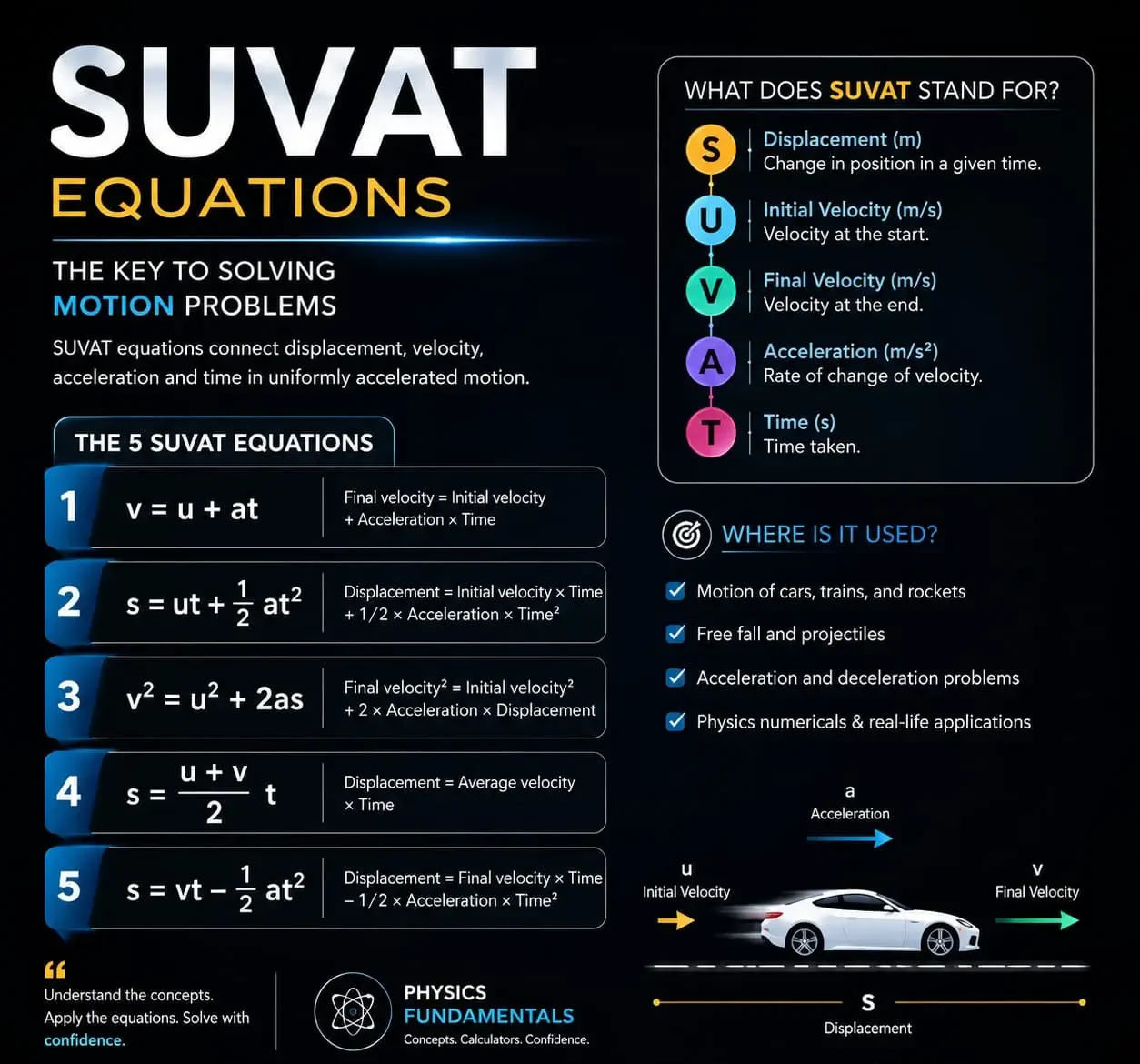
The four main SUVAT equations are:
These equations are used only when acceleration is constant. If acceleration changes during the motion, these equations cannot be applied directly unless the motion is divided into separate parts where acceleration is constant.
A quick way to understand SUVAT is this: each equation connects four of the five motion variables. When solving a question, you identify which variable is not needed, then choose the equation that does not contain that variable. This is usually the fastest and safest method for selecting the correct formula.
What Does SUVAT Stand For?
SUVAT stands for the five quantities used in constant acceleration motion problems. Each symbol has a specific meaning and unit.
|
Symbol |
Meaning |
SI Unit |
|---|---|---|
|
s |
Displacement |
metres, m |
|
u |
Initial velocity |
metres per second, m/s |
|
v |
Final velocity |
metres per second, m/s |
|
a |
Acceleration |
metres per second squared, m/s² |
|
t |
time |
seconds, s |
The variable ‘s’ means displacement, not distance. This is very important because displacement includes direction, while distance does not. Velocity and acceleration also include direction, which means they can be positive or negative depending on the sign convention you choose.
For example, if upward is taken as positive, then a ball thrown upward has positive initial velocity, but gravity has negative acceleration. If downward is taken as positive, gravity becomes positive. Both approaches can give the correct answer, as long as the signs are used consistently.
Derivation of the SUVAT Equations
SUVAT equations are used for motion with constant acceleration. The letters mean:
These equations only work when acceleration stays constant.
Equation 1: Final Velocity Formula
Formula
v = u + at
This comes directly from the definition of acceleration.
Acceleration means the change in velocity per unit time:
a = (v − u) / t
Now rearrange the formula:
at = v − u
Add u to both sides:
v = u + at
So, final velocity equals initial velocity plus the extra velocity gained due to acceleration.
Equation 2: Displacement from Average Velocity
Formula
s = ½(u + v)t
This equation comes from the area under a velocity-time graph.
For constant acceleration, the velocity-time graph is a straight line from u to v. The area under this graph gives displacement.
The shape under the graph is a trapezium.
Area of trapezium:
Area = ½ × (sum of parallel sides) × height
Here:
Parallel sides = u and v
Height = t
So:
s = ½(u + v)t
This also means:
displacement = average velocity × time
Average velocity under constant acceleration is:
average velocity = (u + v) / 2
Therefore:
s = ½(u + v)t
Equation 3: Displacement Using Initial Velocity
Formula
s = ut + ½at²
This equation is found by substituting v = u + at into:
s = ½(u + v)t
Replace v with u + at:
s = ½(u + u + at)t
Simplify inside the bracket:
s = ½(2u + at)t
Now multiply:
s = ut + ½at²
This formula is useful when final velocity v is not given.
Equation 4: Velocity Without Time
Formula
v² = u² + 2as
This equation is found by eliminating time t.
From equation 1:
v = u + at
Rearrange to make t the subject:
t = (v − u) / a
Now substitute this into equation 4:
s = ½(u + v)t
So:
s = ½(u + v)(v − u) / a
Using the identity:
(u + v)(v − u) = v² − u²
So:
s = (v² − u²) / 2a
Now multiply both sides by 2a:
2as = v² − u²
Add u² to both sides:
v² = u² + 2as
This formula is useful when time t is not given.
Extra SUVAT Equation
Another useful equation is:
s = vt − ½at²
This is similar to:
s = ut + ½at²
But it uses final velocity v instead of initial velocity u.
It is useful when u is not given.
The Four SUVAT Equations and When to Use Them
Each SUVAT equation is useful in a different situation. The best equation depends on which variable is missing and not required.
|
SUVAT Equation |
Variable Missing |
Best Used When |
|---|---|---|
|
v = u + at |
s |
Displacement is not involved |
|
s = ut + 1/2at² |
v |
Final velocity is not needed |
|
v² = u² + 2as |
t |
Time is not involved |
|
s = 1/2(u + v)t |
a |
Acceleration is not involved |
For example, if a question gives u, a, and t, and asks for v, then use v = u + at. If a question gives u, v, and s, and asks for a, then time is not needed, so use v² = u² + 2as.
This method is better than memorizing random situations because it works for almost every SUVAT question.
How to Choose the Right SUVAT Equation
Choosing the correct SUVAT equation is often the hardest part for students. The calculation itself is usually easy once the correct formula has been selected. To choose the right formula, use a simple step-by-step method.
Follow these steps:
- Write down all known values from the question.
- Write down the value you need to find.
- Identify the SUVAT variable that is missing and not required.
- Choose the equation that does not contain that missing variable.
- Substitute the values carefully.
- Check signs, units, and direction before finalizing the answer.
For example, suppose a question gives initial velocity, final velocity, and displacement, and asks for acceleration. The variables are:
Since time is not involved, choose:
v² = u² + 2as
This method makes SUVAT questions much easier because it turns formula selection into a logical process.
Understanding Displacement vs Distance in SUVAT
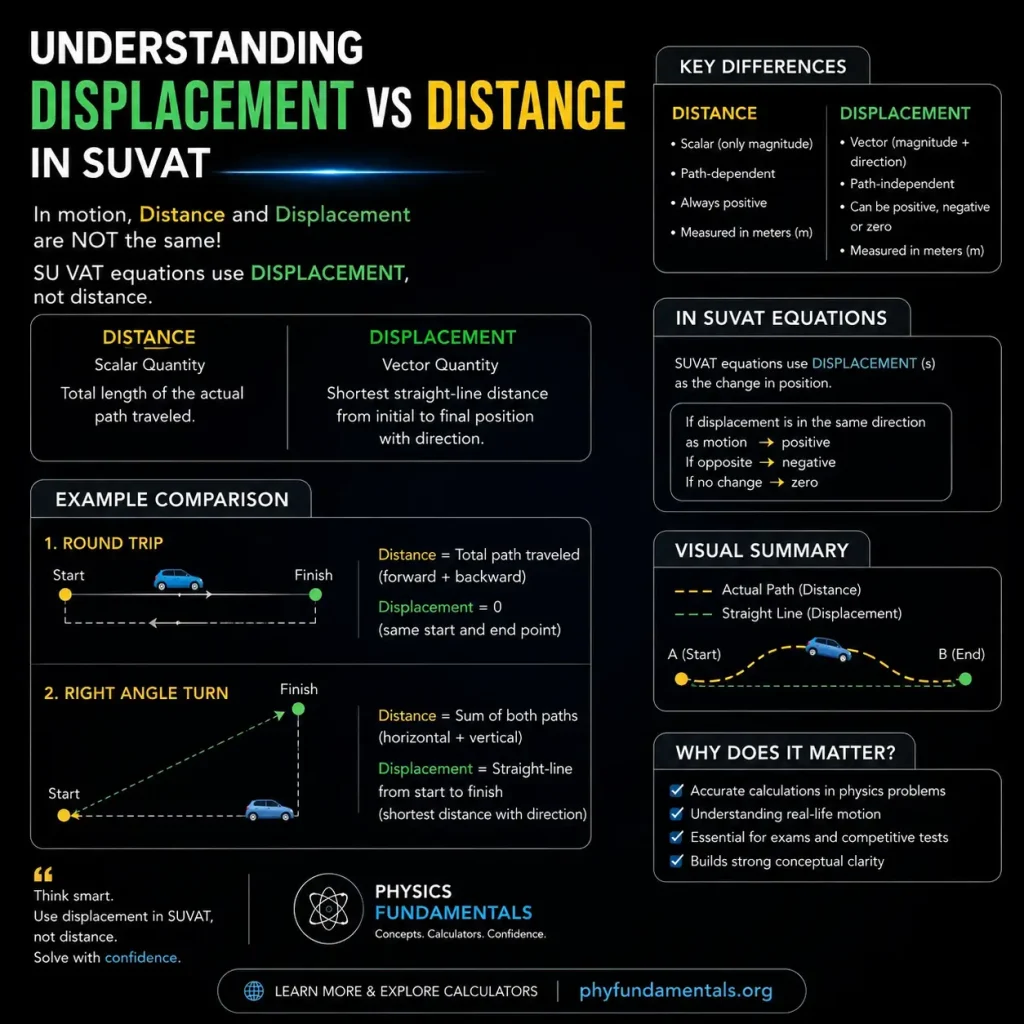
One of the most common mistakes in SUVAT problems is confusing displacement with distance. Although they sound similar, they are not the same.
Distance is the total path travelled by an object. It is always positive and does not include direction.
Displacement is the straight-line change in position from the starting point to the final point. It includes direction and can be positive, negative, or zero.
For example, if a ball is thrown vertically upward and then returns to the same hand, the total distance travelled is not zero because the ball moved up and came back down. However, its displacement is 0 m because its final position is the same as its starting position.
This matters because SUVAT uses displacement, not total distance. If you use distance when the formula needs displacement, your answer may become wrong, especially in questions involving objects that change direction.
Sign Conventions in SUVAT Problems
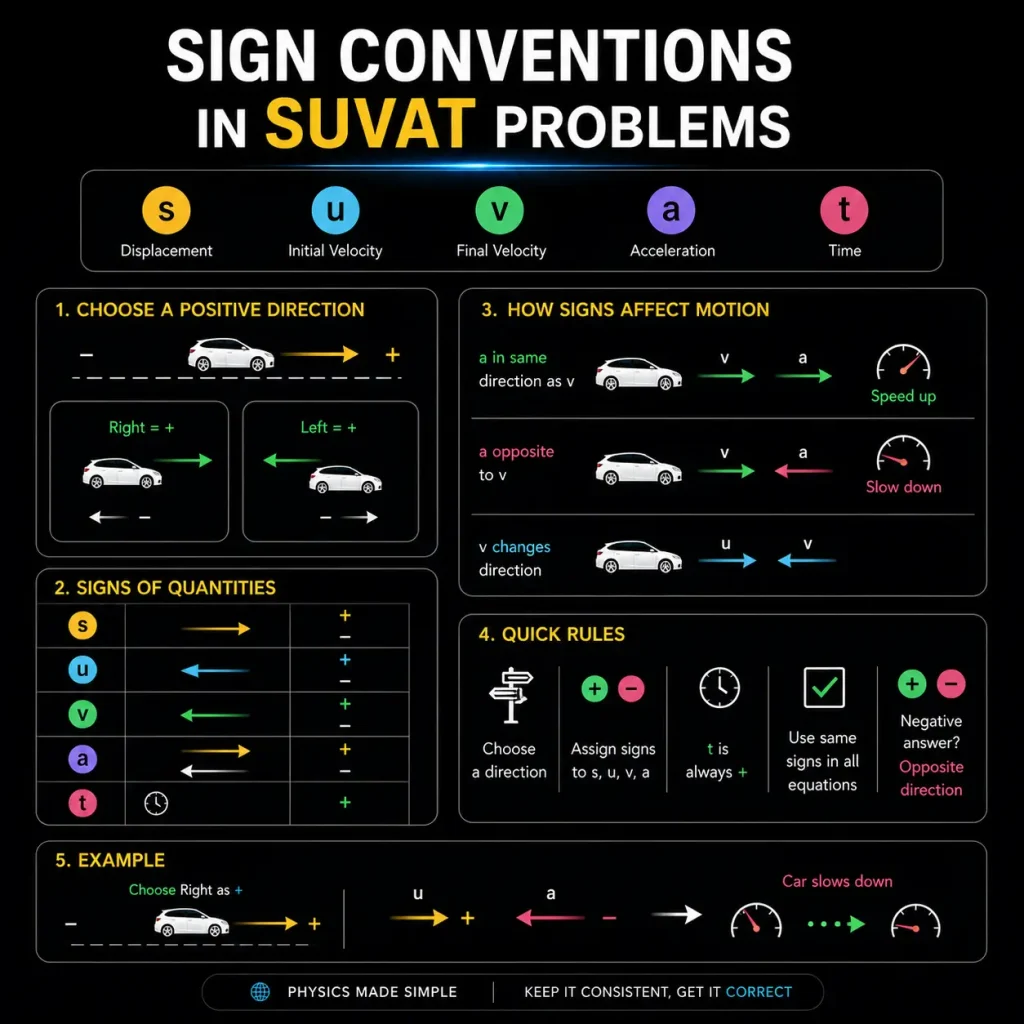
SUVAT equations work with direction, so signs are extremely important. Before solving a problem, always decide which direction is positive.
If upward is positive:
If downward is positive:
A negative answer does not automatically mean the answer is wrong. It usually means the object is moving or accelerating in the opposite direction to the one you selected as positive.
For example, if you take forward motion as positive and calculate acceleration as -5 m/s², this means the object is slowing down. In physics, this is often called deceleration, but it is more accurate to say the acceleration is in the opposite direction to the motion.
Worked Example
Worked Example 1: A Car Braking to Rest
A car slows down from 30 m/s to rest over a distance of 45 m. Find its acceleration.
Known values:
Since time is not involved, use:
v² = u² + 2as
Substitute the values:
0² = 30² + 2(a)(45)
0 = 900 + 90a
-900 = 90a
a = -10 m/s²
The acceleration is -10 m/s². The negative sign shows that the car is decelerating.
Worked Example 2: A Ball Thrown Vertically Upward
A ball is thrown upward with an initial velocity of 20 m/s. Find its maximum height. Take upward as positive and use a = -9.8 m/s².
Known values:
Use:
v² = u² + 2as
Substitute:
0² = 20² + 2(-9.8)s
0 = 400 – 19.6s
19.6s = 400
s = 20.4 m
The maximum height is approximately 20.4 m.
This example is important because at the highest point, the final velocity is zero for a moment, but acceleration is not zero. Gravity is still acting downward.
Worked Example 3: Object Dropped From a Height
A stone is dropped from rest from a height of 80 m. Find the time it takes to hit the ground. Take downward as positive and use a = 9.8 m/s².
Known values:
Use:
s = ut + 1/2at²
Substitute:
80 = 0(t) + 1/2(9.8)t²
80 = 4.9t²
t² = 16.33
t = 4.04 s
The stone takes approximately 4.04 seconds to reach the ground.
Worked Example 4: Finding Displacement From Acceleration and Time
A cyclist starts with an initial velocity of 5 m/s and accelerates at 2 m/s² for 6 seconds. Find the displacement.
Known values:
Use:
s = ut + 1/2at²
Substitute:
s = 5(6) + 1/2(2)(6²)
s = 30 + 36
s = 66 m
The displacement is 66 m.
Worked Example 5: Finding Initial Velocity From Total Time
A ball is thrown vertically upward and returns to the same point after 6 seconds. Find its initial velocity. Take upward as positive and use a = -9.8 m/s².
Because the ball returns to the same point:
Use:
s = ut + 1/2at²
Substitute:
0 = u(6) + 1/2(-9.8)(6²)
0 = 6u – 176.4
6u = 176.4
u = 29.4 m/s
The initial velocity was 29.4 m/s upward.
SUVAT and Velocity-Time Graphs
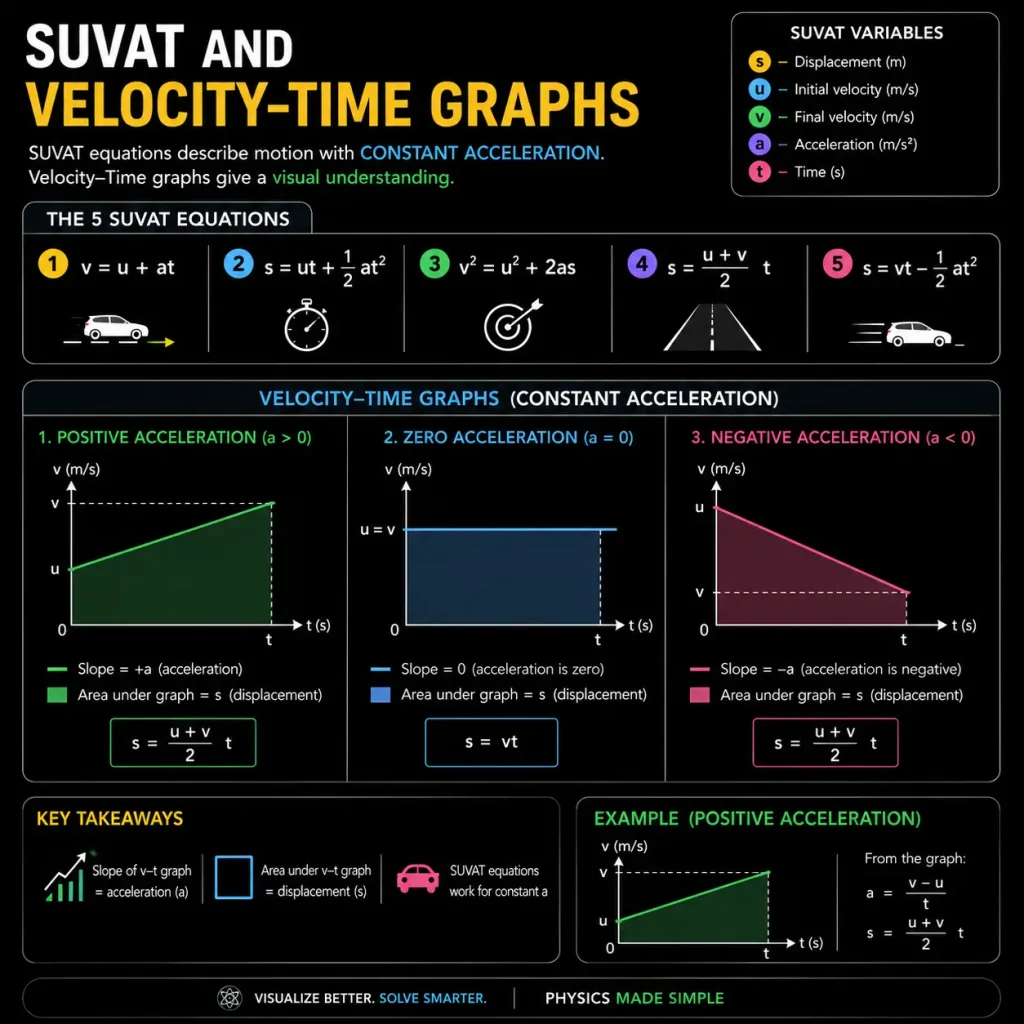
SUVAT equations are closely connected to velocity-time graphs. A velocity-time graph shows how velocity changes with time. When acceleration is constant, the graph is a straight line.
Important ideas:
For example, if velocity increases steadily from 0 m/s to 20 m/s in 5 seconds, the acceleration is:
a = change in velocity / time
a = 20 / 5 = 4 m/s²
The displacement is the area under the graph. Since the graph forms a triangle:
s = 1/2 × base × height
s = 1/2 × 5 × 20 = 50 m
This matches the SUVAT equation:
s = ut + 1/2at²
s = 0 + 1/2(4)(5²) = 50 m
SUVAT and Projectile Motion
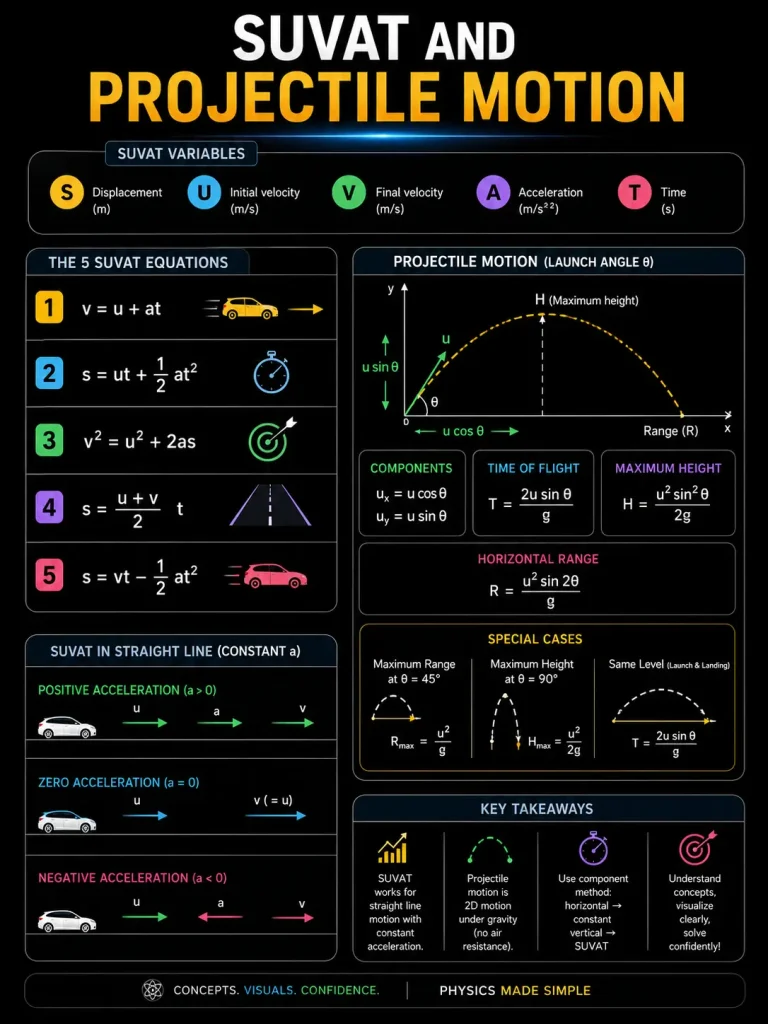
Projectile motion often uses SUVAT equations, but it must be handled carefully. A projectile moves in two directions at the same time: horizontally and vertically.
|
Direction |
Acceleration |
|---|---|
|
Horizontal |
Usually 0 m/s² |
|
Vertical |
Usually ±9.8 m/s² |
The horizontal velocity usually remains constant because there is no horizontal acceleration if air resistance is ignored. The vertical velocity changes because gravity acts downward.
The key rule is this:
Horizontal and vertical motion share the same time.
For projectile motion:
For example, if a ball is thrown horizontally from a cliff, its horizontal velocity stays constant, but vertically it accelerates downward due to gravity. SUVAT can be used to find how long it takes to fall, and then horizontal distance can be calculated using speed × time.
When SUVAT Equations Do Not Apply
However, in most school-level physics questions, air resistance is ignored and gravity is treated as constant. That is why SUVAT equations are so common in exams.
Common SUVAT Mistakes Students Should Avoid
Example:
|
Variable |
Potential Energy |
|---|---|
|
s |
? |
|
u |
20 m/s |
|
v |
0 m/s |
|
a |
-9.8 m/s² |
|
t |
not needed |
This table immediately shows which equation should be used.
SUVAT Formula Selection Guide
Use this quick guide when choosing an equation:
This guide works because each SUVAT equation excludes one variable.
For exam preparation, students should practise identifying the missing variable before doing calculations. This improves speed and reduces formula confusion.
Quick SUVAT Revision Checklist
Exam Tips for SUVAT Questions

Exam Tips for SUVAT Questions
SUVAT questions become easier with practice because they follow repeated patterns. Most exam questions are not designed to trick you with difficult maths. They usually test whether you understand variables, signs, and formula selection.
Use these exam tips:
These small rules can save time and prevent common mistakes.
FAQs About SUVAT Equations
Final Summary
SUVAT equations are essential formulas for solving constant acceleration motion problems. They connect displacement, initial velocity, final velocity, acceleration, and time. The key to using them correctly is not just memorising the formulas, but understanding when each one applies.
The best method is to list the known values, identify the unknown value, find the variable that is not needed, and choose the equation that excludes it. Students should also pay close attention to displacement, direction, signs, and units.With regular practice, SUVAT becomes one of the easiest and most scoring topics in physics. Most questions follow predictable patterns, and once you understand the logic behind the formulas, you can solve them confidently in exams.
