
Newton’s Second Law of Motion states that the acceleration of an object is directly proportional to the net force acting on it and inversely proportional to its mass. In simple terms, stronger forces produce greater acceleration, while heavier objects resist changes in motion more strongly. This relationship is expressed through one of the most famous equations in science:
F = ma
where:
- F = net force
- m = mass
- a = acceleration
What is Newton’s Second Law?
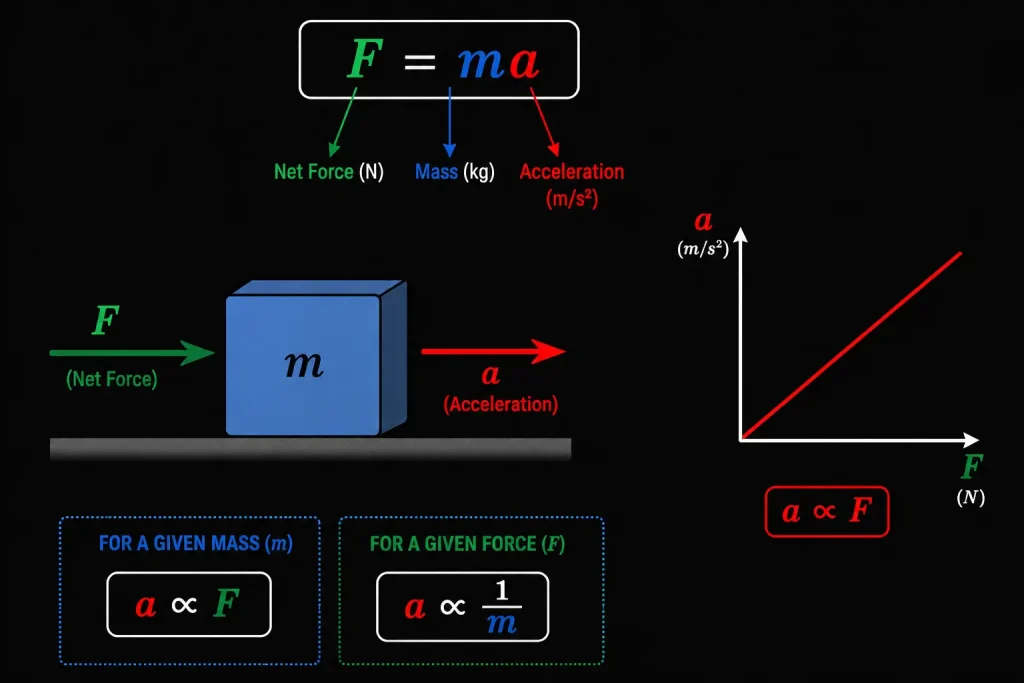
Newton’s Second Law states:
The acceleration of an object is directly proportional to the net force acting on it and inversely proportional to its mass.
This means:
The relationship between these quantities transformed humanity’s understanding of motion. Before Newton, scientists struggled to explain why objects speed up, slow down, or change direction. Newton provided the mathematical framework that connected force and motion for the first time.
The modern equation:
F = ma
became the cornerstone of mechanics, engineering, and applied physics.
This equation states that the net force acting on an object equals its mass multiplied by its acceleration.
In simple terms:
Although the equation appears simple, it governs an astonishing range of physical phenomena. It explains:
According to MIT OpenCourseWare – Classical Mechanics, Newton’s laws remain one of the most important scientific frameworks ever developed because they accurately describe most motion encountered in engineering, transportation, sports, and astronomy. From designing bridges and aircraft to calculating rocket trajectories for NASA missions, Newton’s Second Law continues to power modern science and technology centuries after its discovery.
The Historical Development of Force Mass Acceleration Relationship
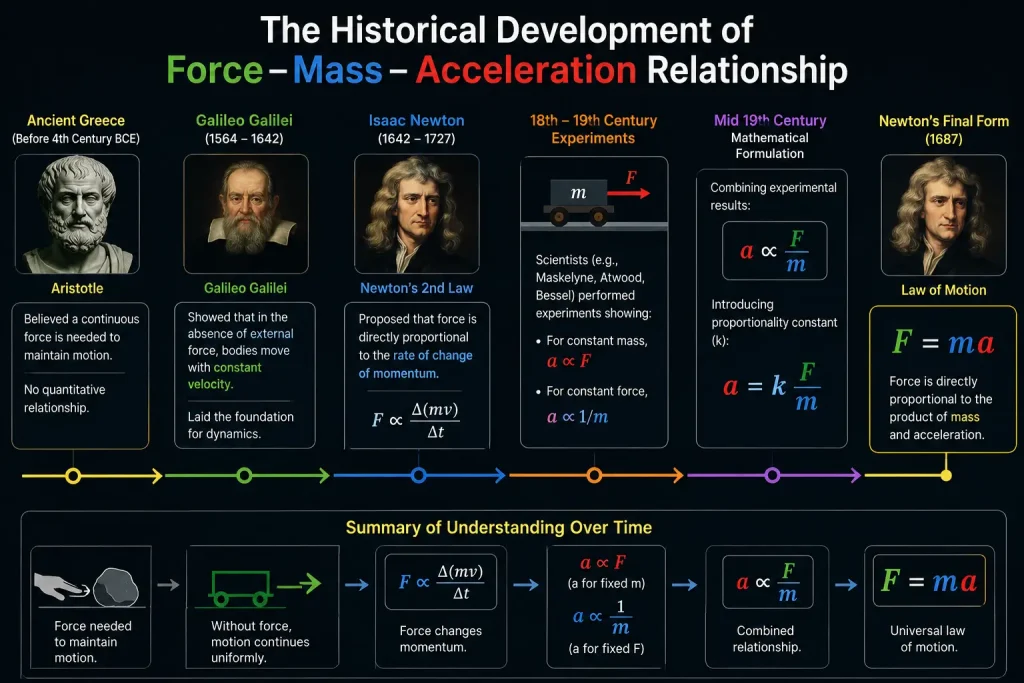
Isaac Newton published his laws of motion in 1687 in Philosophiæ Naturalis Principia Mathematica, one of the most influential scientific books ever written.
Newton built upon the discoveries of earlier scientists, especially:
Galileo demonstrated that falling objects accelerate uniformly under gravity, while Kepler described planetary motion mathematically. Newton unified these ideas into a complete theory of mechanics.
Importantly, Newton did not originally write the equation exactly as students see it today. His deeper formulation described force as the rate of change of momentum:
F = dp/dt
where:
For constant mass systems, this simplifies into:
F = ma
This deeper momentum form becomes essential in advanced mechanics, especially in rocket science and particle physics.
Newton second law formula
Understanding Newton’s Second Law requires understanding each variable individually.
Force
Force is any interaction capable of changing an object’s motion.
Common forces include:
What is the SI unit of force?
The SI unit of force is the newton (N).
One newton is defined as:
1 N = 1 kg.m/s2
This means one newton can accelerate a 1 kg object at 1 m/s².
Forces are vector quantities, meaning they possess:
Direction is critically important because forces acting in opposite directions may cancel one another.
Mass
Mass measures inertia, which is an object’s resistance to acceleration.
An object with greater mass:
This explains why:
Mass is measured in kilograms and remains constant regardless of location.
Unlike weight, mass does not depend on gravity.
Acceleration
Acceleration describes the rate at which velocity changes over time.
Acceleration can involve:
Its SI unit is:
m/s2
A moving object accelerates whenever its velocity changes in any way.
For example:
Net Force: The Core Idea Behind Motion
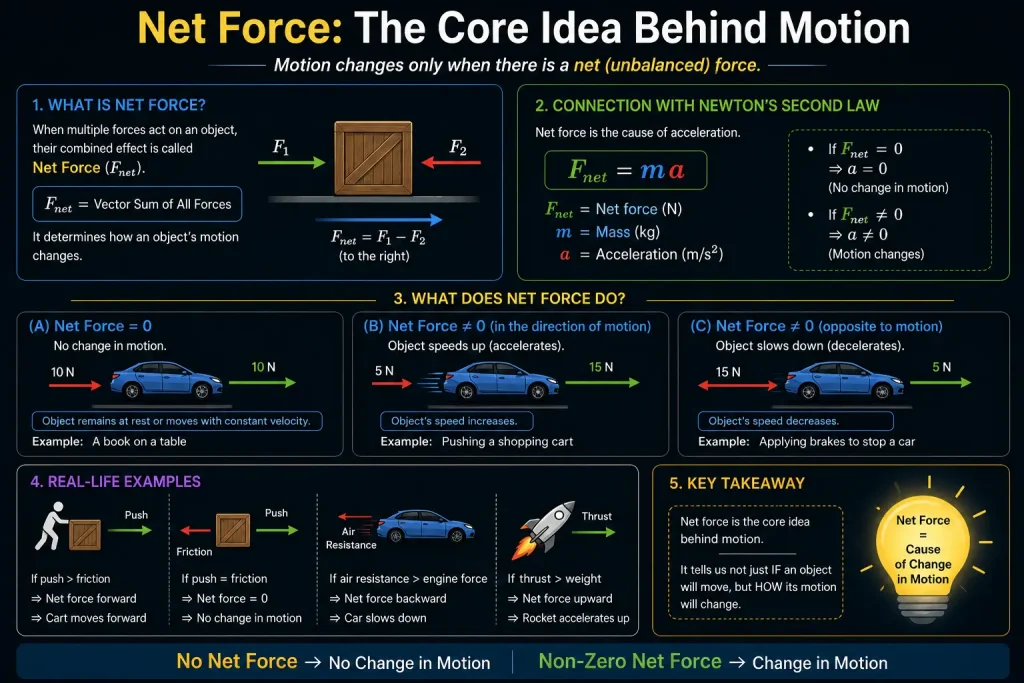
One of the most misunderstood aspects of mechanics is the concept of net force.
Newton’s Second Law applies only to the total force acting on an object.
This total force is written as:
ΣF=ma
The symbol (\Sigma) means “sum of all forces.”
If forces balance perfectly:
ΣF=0
then acceleration becomes zero.
The object may:
This idea explains why passengers continue moving forward when a car stops suddenly. Their bodies tend to maintain their previous motion unless another force acts.
Net force determines how motion changes, not whether motion exists.
Why Force Causes Acceleration Instead of Velocity
One of Newton’s greatest insights was recognizing that force changes velocity rather than sustaining it.
Ancient philosophers believed objects required continuous force to maintain motion. Newton proved otherwise.
A constant force produces:
If friction is absent:
This principle explains:
It also explains why astronauts in space continue drifting once pushed.
Newton’s Second Law as a Vector Equation
Force and acceleration are vectors, meaning direction matters.
The equation works independently in every direction.
For two-dimensional motion:
Horizontal direction:
ΣFx=max
Vertical direction:
ΣFy=may
This decomposition allows scientists and engineers to analyze complex systems such as:
The ability to separate forces into components is one of the most powerful tools in mechanics.
Why do heavier objects accelerate less?
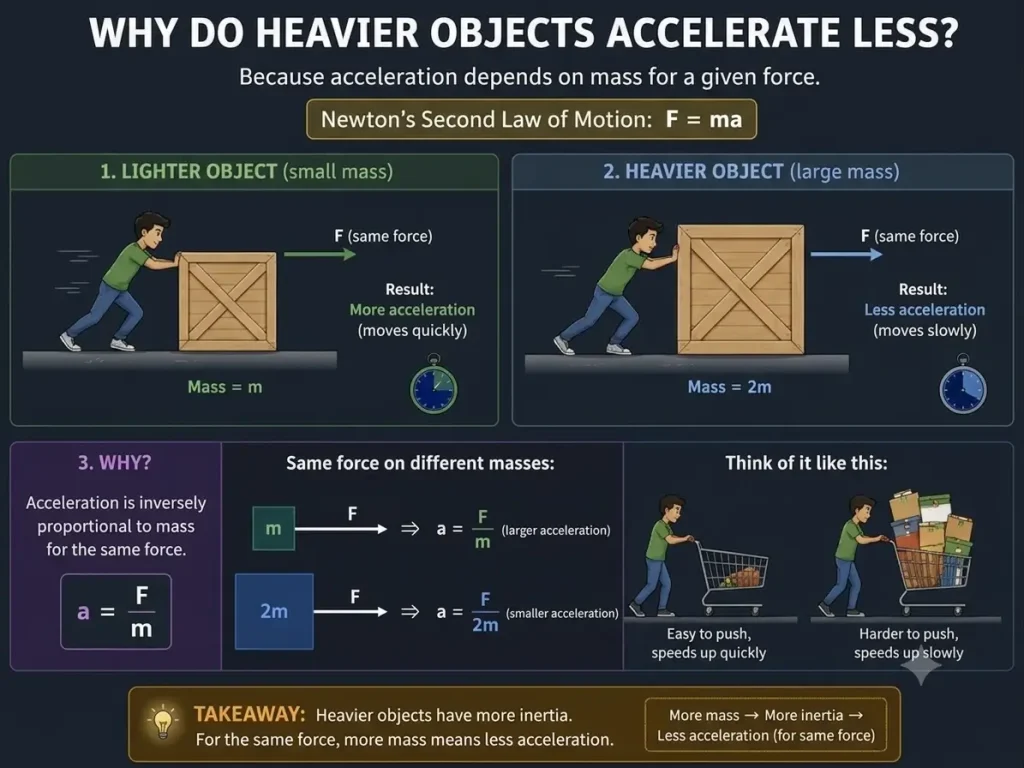
Heavier objects accelerate less because they have greater mass, and mass is a measure of an object’s resistance to changes in motion (inertia). According to Newton’s Second Law:
a = \frac{F}{m}
For the same applied force, increasing mass reduces acceleration. This means that if you push a light object and a heavy object with equal force, the lighter object speeds up more easily because there is less resistance to motion change.
For example:
So, the larger the mass, the smaller the acceleration produced by a given force.
Why is F = ma important?
F = ma
The equation F = ma is important because it is the fundamental relationship that connects force, mass, and motion. It tells us exactly how objects respond when forces act on them.
Its importance lies in three key ideas:
Without this equation, we could not design rockets, calculate vehicle motion, or understand how structures respond to forces.
How does force affect acceleration?
Force directly controls acceleration: the greater the net force applied to an object, the greater its acceleration. This relationship is linear, meaning doubling the force doubles the acceleration (if mass stays constant).
From Newton’s Second Law:
F = ma
Rearranged:
a= F/m
This shows:
For example:
In simple terms, force is what changes motion, and acceleration is the measurable result of that change.
Real-Life Applications of Newton’s Second Law
Newton’s Second Law operates continuously throughout everyday life.
01
Transportation
Cars accelerate because engines generate forward force.
The greater the net force:
Heavy trucks accelerate more slowly than small sports cars because their larger mass resists acceleration.
Braking systems also rely on Newtonian mechanics. Brakes apply force opposite the direction of motion, creating negative acceleration.
02
Rocket Science and Space Exploration
Rocket propulsion is one of the clearest demonstrations of Newton’s Second Law.
Rocket engines expel gases downward at extremely high speeds, producing upward thrust.
When thrust exceeds gravitational force:
According to NASA Glenn Research Center – Rocket Principles, launch calculations rely heavily on Newtonian mechanics and momentum conservation.
Modern space missions depend on precise force calculations for:
03
Sports Physics
Athletes constantly apply Newton’s Second Law.
Examples include:
In sports:
Professional athletes train specifically to maximize force generation.
04
Aviation
Aircraft engines generate thrust that accelerates airplanes along runways.
As velocity increases:
Pilots carefully manage:
Modern aviation relies heavily on Newtonian force analysis.
05
Elevators and Amusement Park Rides
Elevators accelerate upward and downward using controlled forces.
Passengers feel:
Roller coasters create dramatic sensations because riders experience rapid changes in acceleration and force direction.
Friction and Real-World Motion
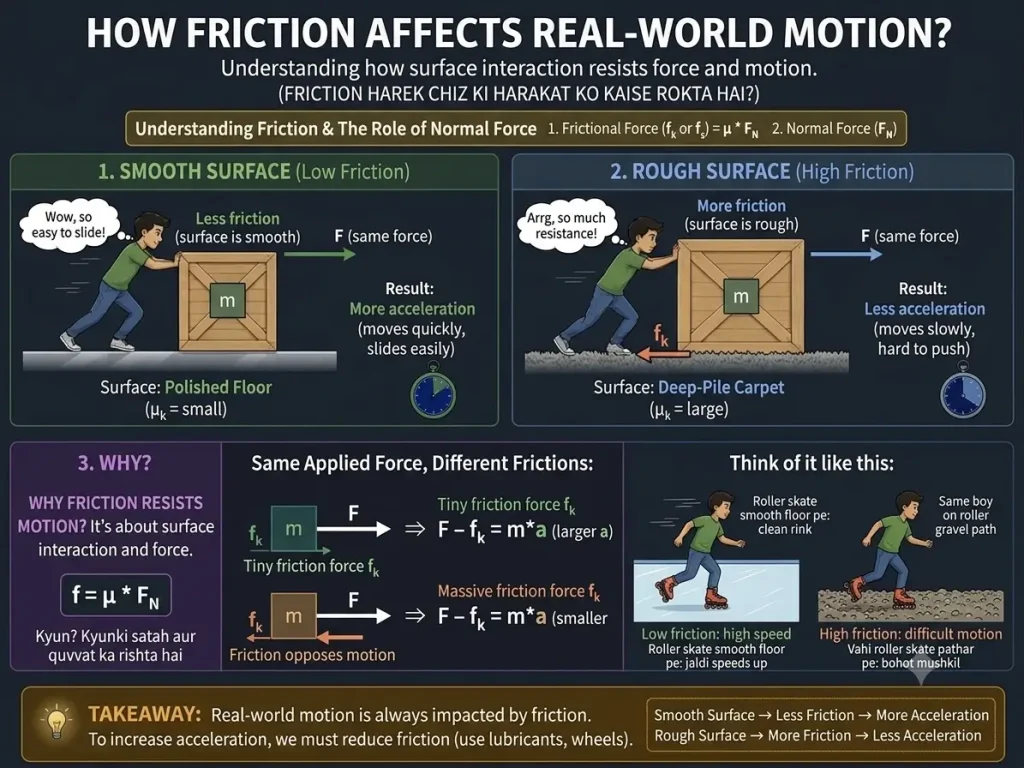
In ideal physics problems, surfaces are often frictionless.
Real life is different.
Friction opposes motion and affects acceleration significantly.
Common types include:
Without friction:
Friction transforms Newton’s Second Law into a more realistic description of everyday motion.
Circular Motion and Centripetal Force
Objects moving in circles constantly change direction. Changing direction means acceleration exists even if speed remains constant.
This inward acceleration is called centripetal acceleration:
ac= v2/r
The required inward force becomes:
Fc= mv2/r
Centripetal force explains:
Without this inward force, objects would move in straight lines.
Newton’s Second Law and Energy
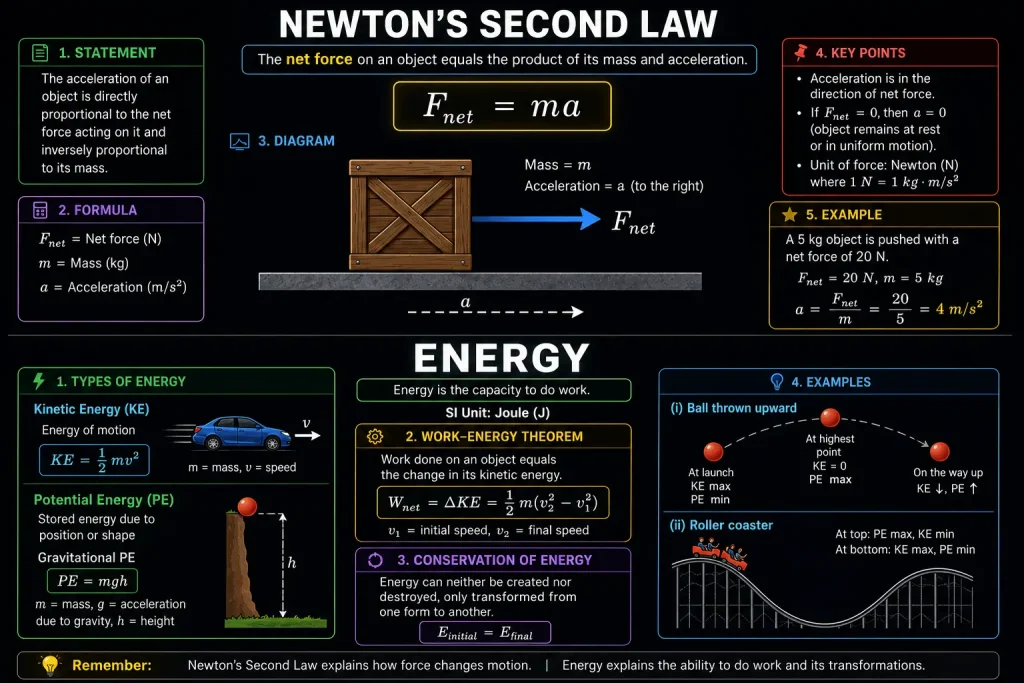
Force and motion connect directly to energy.
When force acts through displacement, work is done.
The work equation is:
W= Fd
This leads directly to the work-energy theorem:
W= ∆ KE
Kinetic energy is given by:
KE= 1/2 mv2
These relationships explain:
Energy methods often simplify complex mechanics problems.
Newton’s Second Law in Orbital Mechanics
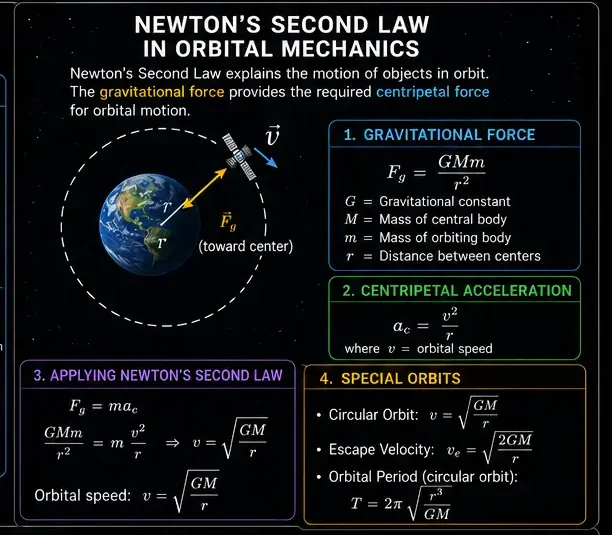
Orbital motion is essentially continuous free-fall motion.
Gravity acts as the centripetal force that keeps planets and satellites in orbit.
Newton combined gravity and motion into a unified framework using:
F=G Mm/r2
and:
F = ma
These equations allow scientists to calculate:
The same physics governing a falling apple also governs the motion of the Moon.
This realization transformed astronomy forever.
Worked Examples:
Worked Example 1: Finding Acceleration
A 40 N force acts on an 8 kg object.
Find the acceleration.
Use:
a= F/m
Substitute values:
a= 40/8
a= 5 m/s2
Final answer:
a= 5 m/s2
Worked Example 2: Calculating Force
A 1200 kg car accelerates at 2.5 m/s².
Find the net force.
Use:
F = ma
Substitute:
F = 1200 x 2.5
F = 3000 N
Final answer:
F = 3000 N
Common Misconceptions About F = ma
Several misconceptions repeatedly appear in mechanics.
Confusing Mass and Weight
Mass:
Weight:
Weight equation:
W=mg
Ignoring Net Force
Many students mistakenly use only one force instead of the total force.
Balanced forces produce no acceleration.
Believing Force Maintains Motion
Motion continues naturally unless unbalanced forces act.
Force changes motion rather than sustaining it.
Assuming Heavier Objects Fall Faster
Ignoring air resistance, all objects accelerate equally under gravity.
This follows directly from Newtonian mechanics.
Engineering Applications of Newton’s Second Law
Modern engineering would be impossible without Newton’s Second Law.
Engineers use it in:
Crash-test engineers study acceleration forces during collisions to improve passenger protection.
Seat belts and airbags reduce harmful acceleration by increasing stopping time during impacts.
This dramatically lowers injury risk.
Why Newton’s Second Law Still Matters Today
Even after centuries of scientific advancement, Newton’s Second Law remains one of the most powerful equations in physics.
It explains:
Modern technologies—from transportation systems to spacecraft navigation—continue to rely on Newtonian mechanics.
According to HyperPhysics – Newton’s Laws and Encyclopaedia Britannica – Newton’s Laws of Motion, Newton’s laws remain among the most influential scientific discoveries ever made because they connect mathematics directly to physical reality.
Mastering Newton’s Second Law does more than solve physics problems. It provides a deeper understanding of how motion works throughout the universe itself.


