

Ideal Gas Law : PV = nRT Explained with Examples and Derivation
The ideal gas law is an equation that relates a gas’s pressure, volume, temperature, and amount in moles. This law is one of those equations that seems simple at first glance but explains an enormous part of the physical world. It helps describe why a balloon expands in warm air, why tyre pressure rises on a hot day, and why gas cylinders behave differently when compressed.
The formula is:
PV = nRT
It connects pressure, volume, temperature, and the amount of gas in one clean relationship. Once you understand what each symbol means and how the units work, many gas-law questions become straightforward.
What Is the Ideal Gas Law?
The ideal gas law is an equation that relates a gas’s pressure, volume, temperature, and amount in moles:
KE = ½mv²
It is used when a gas behaves approximately like an ideal gas, meaning its particles have negligible volume and do not strongly attract or repel one another. The law is most accurate at relatively low pressure and high temperature.
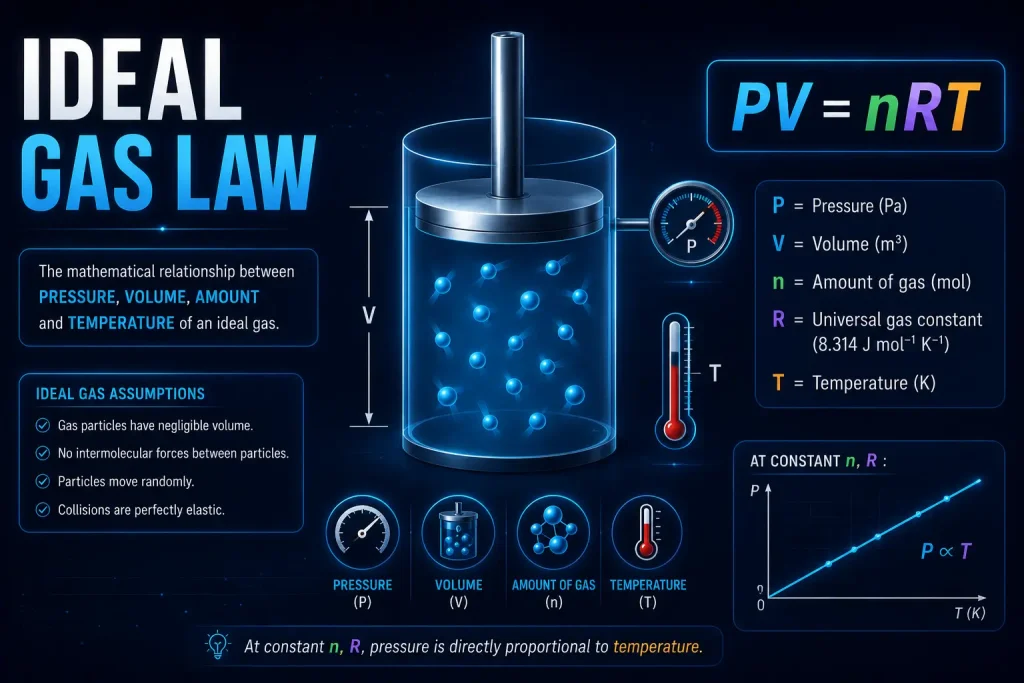
The Ideal Gas Law Formula: PV = nRT
The symbols in the equation mean:
|
Symbol |
Meaning |
Common SI Unit |
|---|---|---|
|
P |
Pressure |
Pascal, Pa |
|
V |
Volume |
cubic metre, m³ |
|
n |
Amount of gas |
mole, mol |
|
R |
Universal gas constant |
J mol⁻¹ K⁻¹ |
|
T |
Absolute temperature |
kelvin, K |
The standard SI value of the gas constant is:
R = 8.314 J mol⁻¹ K⁻¹
For most school, college, and introductory physics problems, using (R = 8.314) is enough.
An ideal gas is a simplified model of a gas. It assumes that gas molecules:
No real gas behaves perfectly this way, but many gases come close under ordinary conditions.
What Does PV = nRT Mean in Simple Words?
This law says that the behavior of a gas depends on four things:
For example, if you heat a gas in a sealed container, its pressure usually rises because the molecules move faster and strike the container walls more forcefully.
Which Value of R Should You Use?
The gas constant must match the units used in your calculation. This is one of the most common places where students lose marks.
|
Value of R |
Use It When |
|---|---|
|
8.314 J mol⁻¹ K⁻¹ |
Pressure is in Pa and volume is in m³ |
|
0.082057 L atm mol⁻¹ K⁻¹ |
Pressure is in atm and volume is in litres |
|
8.314 L kPa mol⁻¹ K⁻¹ |
Pressure is in kPa and volume is in litres |
|
0.08314 L bar mol⁻¹ K⁻¹ |
Pressure is in bar and volume is in litres |
The safest option is usually to convert everything into SI units and use:
R = 8.314 J mol⁻¹ K⁻¹
Remember:
1 L = 0.001 m³
1 atm = 101325 Pa
T(K) = T(°C) + 273.15
Why Must Temperature Be in Kelvin?
You must always use kelvin in gas-law calculations.
The reason is simple: gas laws depend on absolute temperature. Kelvin starts at absolute zero, the theoretical point where molecular motion reaches its minimum possible level.
Celsius does not start at absolute zero. A temperature of 0°C does not mean molecules have stopped moving. Therefore, using Celsius directly in gas-law ratios produces meaningless answers.
For example:
20°C = 293.15K
100°C = 373.15K
If you use 20 and 100 directly, you will get the wrong change in volume or pressure.
Derivation of the Ideal Gas Law
It can be derived from several experimental laws that describe gas behavior.
Boyle’s Law
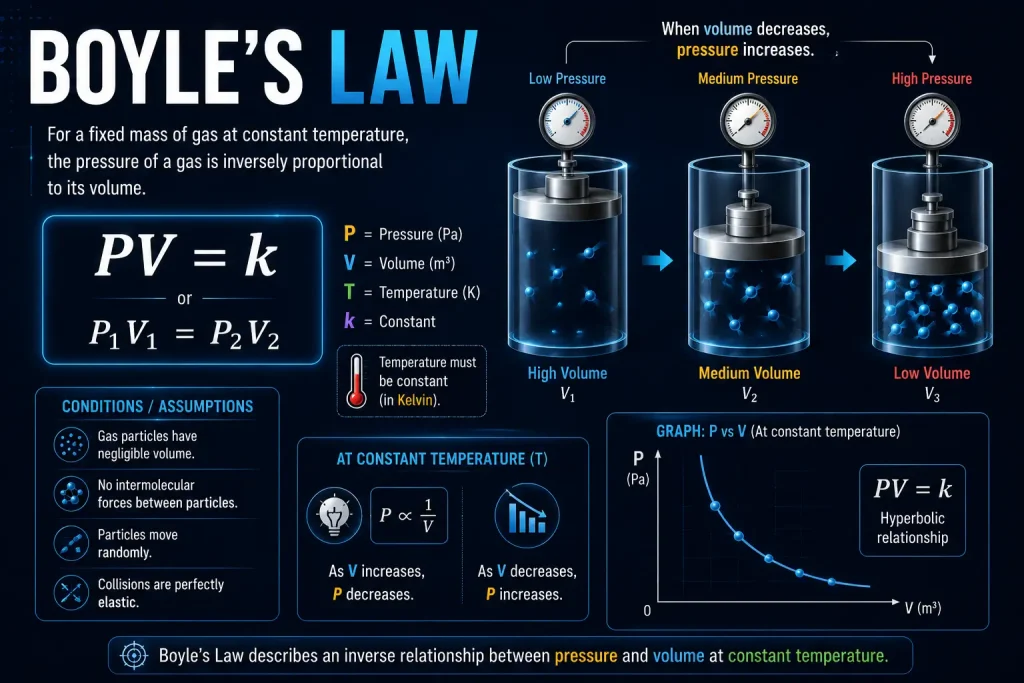
Boyle’s law applies when temperature and the amount of gas stay constant.
P ∝ 1/V
This means pressure and volume are inversely related. If volume decreases, pressure increases.
PV = constant
Charles’s Law
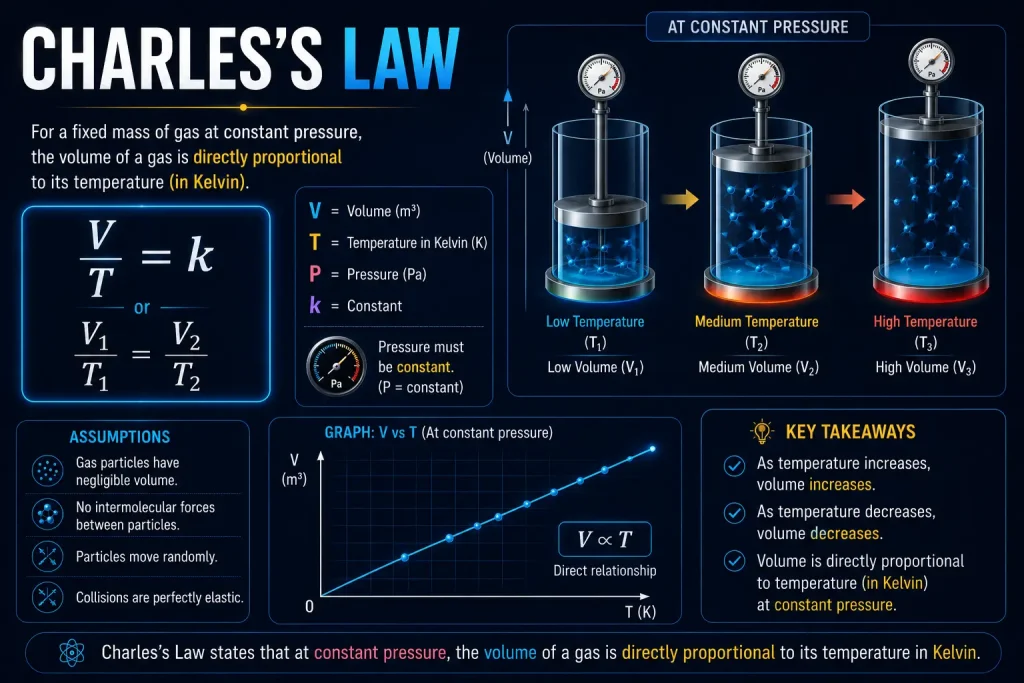
Charles’s law applies when pressure and the amount of gas stay constant.
V ∝ T
A gas expands when heated because its molecules move faster.
V/T = constant
Avogadro’s Law
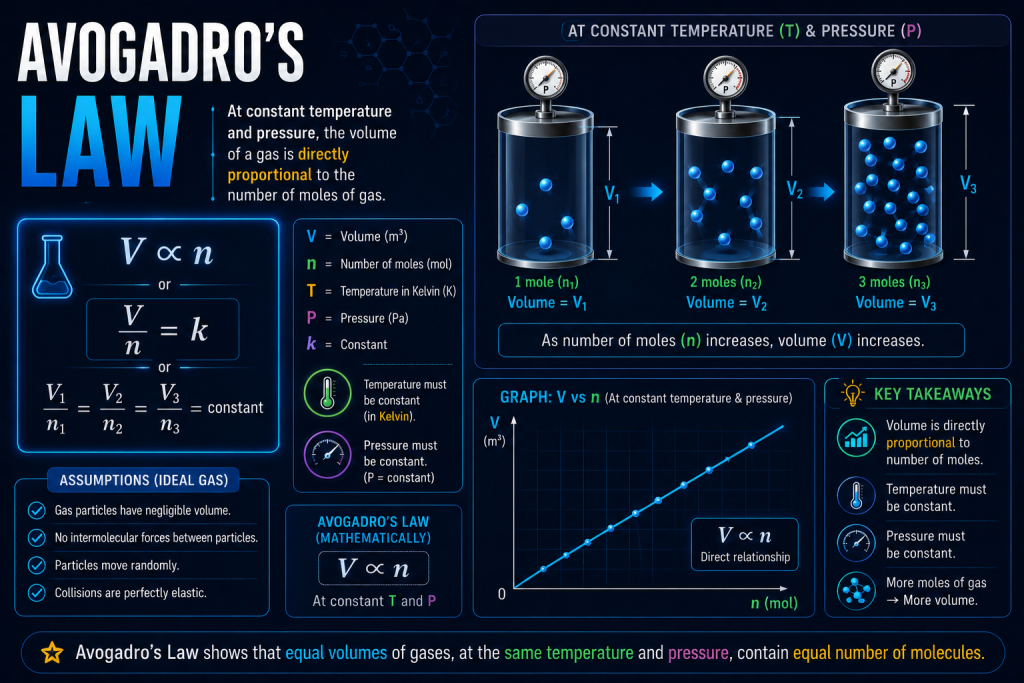
Avogadro’s law applies when pressure and temperature stay constant.
V ∝ n
This means more moles of gas occupy more volume.
Combining the Laws
From Boyle’s law:
V ∝ 1/P
From Charles’s law:
V ∝ T
From Avogadro’s law:
V ∝ n
Combining all three relationships gives:
V ∝ nT/P
Multiplying by pressure:
PV ∝ nT
Replacing the proportionality constant with (R):
PV = nRT
That is the ideal gas law.
Kinetic Theory Derivation of PV = nRT
The ideal gas law can also be derived from kinetic theory.
Kinetic theory treats gas as a huge number of tiny particles moving randomly inside a container. When these particles collide with the container walls, they produce pressure.
For a gas with (N) molecules:
P = ⅓ Nm⟨c²⟩ / V
Multiplying both sides by volume gives:
PV = ⅓ Nm⟨c²⟩
The average translational kinetic energy of one molecule is:
½m⟨c²⟩ = ³⁄₂kBT
Therefore:
m⟨c²⟩ = 3kBT
Substituting this into the pressure equation gives:
PV = NkBT
Since:
N = nNA
and:
R = NAkB
we get:
PV = nRT
This shows that temperature is directly connected to the average translational kinetic energy of gas molecules.
How to Solve Ideal Gas Law Questions
Use this five-step method every time.
Step 1: Write the given values
List pressure, volume, temperature, and moles clearly.
Step 2: Convert the units
Convert Celsius into kelvin. Convert litres into cubic metres if you are using SI units. Convert pressure into pascals when needed.
Step 3: Select the correct value of R
Match the gas constant to your pressure and volume units.
Step 4: Rearrange the formula
Start with:
PV = nRT
Then solve for the unknown.
For pressure:
P = nRT / V
For volume:
V = nRT / P
For moles:
n = PV / RT
For temperature:
T = PV / nR
Step 5: Check your answer
Ask yourself whether the answer makes physical sense. A hotter gas should usually have higher pressure or larger volume. A compressed gas should have higher pressure.
Practical Examples
Solved Example 1: Finding Volume Using PV = nRT
Question:
A container holds 2.0 mol of ideal gas at 300 K and a pressure of 1.5 × 10⁵ Pa. Find the volume.
Given
n = 2.0 mol
T = 300 K
P = 1.5 × 10⁵ Pa
R = 8.314 J mol⁻¹ K⁻¹
Formula
V = nRT / P
Solution
V = (2.0 × 8.314 × 300) / (1.5 × 10⁵)
V = 4988.4 / 150000
V = 0.0333 m³
Convert cubic metres to litres:
0.0333 m³ = 33.3 L
Answer:
V = 33.3 L
Solved Example 2: Boyle’s Law and Gas Compression
Question:
A gas occupies 0.50 m³ at a pressure of 2.0 × 10⁵ Pa. It is compressed at constant temperature to 0.20 m³. Find the new pressure.
Since temperature and moles remain constant, use Boyle’s law:
P₁V₁ = P₂V₂
Rearrange:
P₂ = P₁V₁ / V₂
Substitute the values:
P₂ = (2.0 × 10⁵ × 0.50) / 0.20
P₂ = 5.0 × 10⁵ Pa
Answer:
P₂ = 5.0 × 10⁵ Pa
The volume became smaller, so pressure increased.
Solved Example 3: Charles’s Law and a Hot-Air Balloon
Question:
Air in a balloon is heated from 15°C to 100°C at constant pressure. By what factor does the volume increase?
Convert temperatures to kelvin
T₁ = 15 + 273.15 = 288.15 K
T₂ = 100 + 273.15 = 373.15 K
At constant pressure:
V₁/T₁ = V₂/T₂
V₂/V₁ = T₂/T₁
V₂/V₁ = 373.15 / 288.15
V₂/V₁ = 1.295
Answer:
The volume increases by a factor of approximately:
V₂/V₁ ≈ 1.30
That is an increase of about 29.5%.
Hot-air balloons rise because heating the air reduces its density compared with the cooler air outside.
Solved Example 4: Combined Gas Law
Question:
A gas is initially at 1.0 × 10⁵ Pa, 0.010 m³, and 300 K. It is compressed to 0.004 m³ and heated to 400 K. Find the final pressure.
Use the combined gas law:
P₁V₁/T₁ = P₂V₂/T₂
Rearrange:
P₂ = P₁V₁T₂ / T₁V₂
Substitute the values:
P₂ = (1.0 × 10⁵ × 0.010 × 400) / (300 × 0.004)
P₂ = 4.00 × 10⁵ / 1.20
P₂ = 3.33 × 10⁵ Pa
Answer:
P₂ = 3.33 × 10⁵ Pa
The pressure rises because the gas is both compressed and heated.
Solved Example 5: Finding the Number of Moles
Question:
A 5.0 L container holds gas at 101.3 kPa and 298 K. How many moles of gas are present?
Use:
n = PV / RT
Since pressure is in kPa and volume is in litres, use:
R = 8.314 L kPa mol⁻¹ K⁻¹
Substitute:
n = (101.3 × 5.0) / (8.314 × 298)
n = 506.5 / 2477.6
n = 0.204 mol
Answer:
n = 0.204 mol
Boyle’s, Charles’s, Avogadro’s and Gay-Lussac’s Laws
The ideal gas law combines several simpler gas laws.
|
Gas Law |
What Remains Constant? |
Relationship |
|
Boyle’s Law |
Temperature and moles |
P ∝ 1/V |
|
Charles’s Law |
Pressure and moles |
V ∝ T |
|
Avogadro’s Law |
Pressure and temperature |
V ∝ n |
|
Gay-Lussac’s Law |
Volume and moles |
P ∝ T |
Boyle’s Law Example
A syringe becomes harder to push when you reduce the volume of trapped air.
Charles’s Law Example
A balloon expands when warmed because the gas molecules move faster.
Avogadro’s Law Example
Adding more gas to a balloon increases its volume if pressure and temperature remain constant.
Gay-Lussac’s Law Example
A sealed tyre or gas cylinder experiences higher pressure when heated
Ideal Gas Law vs Combined Gas Law
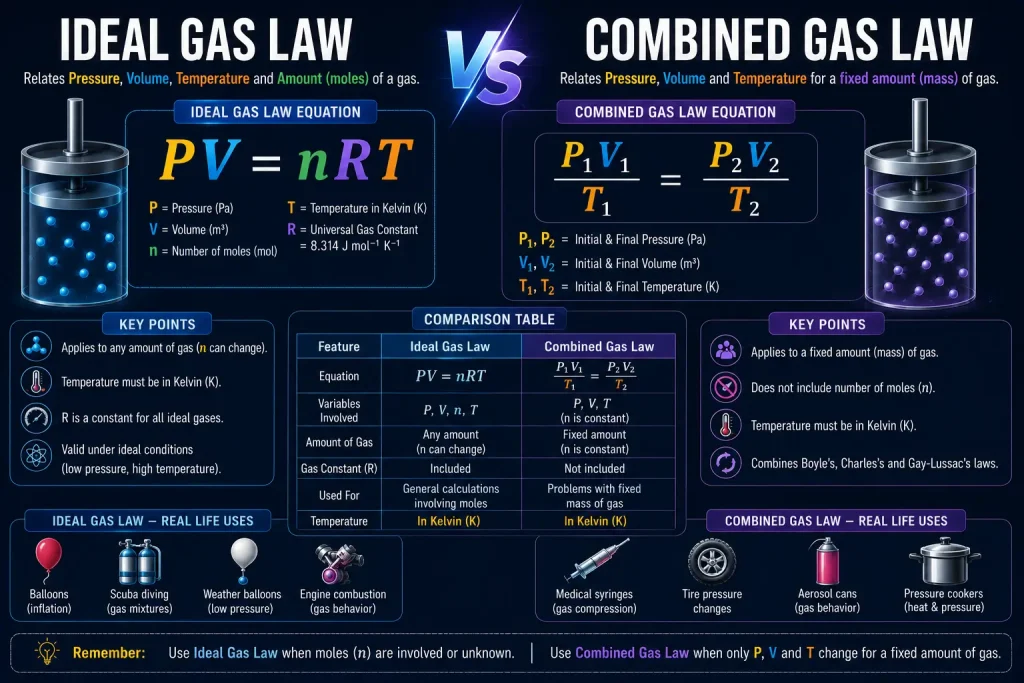
Students often confuse these two equations.
Use the Ideal Gas Law When:
You need to find pressure, volume, temperature, or moles for one gas state.
PV = nRT
Use the Combined Gas Law When:
The amount of gas remains constant, but pressure, volume, and temperature change between two states.
P₁V₁/T₁ = P₂V₂/T₂
The combined gas law is really a special form of the ideal gas law where (n) does not change.
When Can You Use the Ideal Gas Law?
This law works best when:
- Pressure is low.
- Temperature is high.
- The gas is far from condensing into a liquid.
- Molecular attractions are relatively weak.
Gases such as helium, hydrogen, nitrogen, oxygen, and argon can behave approximately ideally under many ordinary laboratory conditions.
However, the law becomes less accurate when gas particles are crowded together or strongly attracted to one another.
When Does the Ideal Gas Law Fail?
The law becomes less reliable at very high pressures and very low temperatures.
At high pressure, gas molecules are forced close together. Their own volume is no longer negligible, and repulsive effects become important.
At low temperature, molecules move more slowly. Attractive forces become more important, and the gas may eventually condense into a liquid.
A useful way to measure real-gas behavior is with the compressibility factor:
Z = PV / nRT
When:
Z = 1
the gas behaves ideally.
When:
Z < 1
attractive forces are more important.
When:
Z > 1
repulsive effects and molecular size become more important.
The van der Waals Equation
For gases that do not behave ideally, scientists often use the van der Waals equation:
(P + an²/V²)(V − nb) = nRT
Where:
a = correction for attractive forces between molecules
b = correction for the finite volume of gas molecules
The ideal gas law is still useful because it is simple, accurate enough in many conditions, and provides the foundation for more advanced gas models.
Common Ideal Gas Law Mistakes
Using Celsius Instead of Kelvin
Wrong:
T = 25
Correct:
T = 25 + 273.15 = 298.15K
Mixing Litres With Pascals
Do not use litres with R = 8.314 J mol⁻¹ K⁻¹. Convert litres to cubic metres first.
Using Gauge Pressure Instead of Absolute Pressure
The ideal gas law uses absolute pressure. Gauge pressure measures pressure above atmospheric pressure.
Forgetting to Convert Millilitres
1000 mL = 1 L
1000 L = 1 m³
Losing the Power of Ten
Scientific notation matters. A missing exponent can completely change the answer.
Using the Wrong Value of R
Always match your gas constant to your pressure and volume units.
Real-World Applications of the Ideal Gas Law
Weather and Atmospheric Pressure
The atmosphere behaves approximately like a gas. As altitude increases, air pressure decreases because there is less air above you pressing downward.
Meteorologists use gas-law principles to understand temperature, pressure, density, wind, and weather systems.
Car Tyres
Tyre pressure rises when a car is driven for a long time because friction heats the air inside the tyre. The volume changes very little, so temperature increase mainly raises pressure.
Hot-Air Balloons
Heating the air inside a balloon increases its volume and lowers its density. The warmer, less-dense air creates buoyancy.
Scuba Diving
Divers need to understand how pressure changes with depth. As pressure rises underwater, gases compress and behave differently in tanks and the human body.
Medical Anaesthesia
Anaesthetic gases are measured and delivered under controlled pressure, temperature, and volume conditions. Gas-law calculations help medical systems deliver accurate concentrations.
Industrial Gas Storage
Factories store gases in cylinders, pipelines, and tanks. Engineers use this law to estimate how much gas can be stored and how pressure changes with temperature.
Final Takeaway
The ideal gas law is more than a formula to memorise. It is a practical way to understand how gases respond when pressure, temperature, volume, or amount changes.
Start with:
PV=nRT
Convert temperature to kelvin. Choose the correct value of (R). Keep units consistent. Then check whether your answer makes physical sense.
Once you can do that confidently, questions involving balloons, tyres, weather, engines, gas cylinders, and laboratory experiments all become easier to understand.


