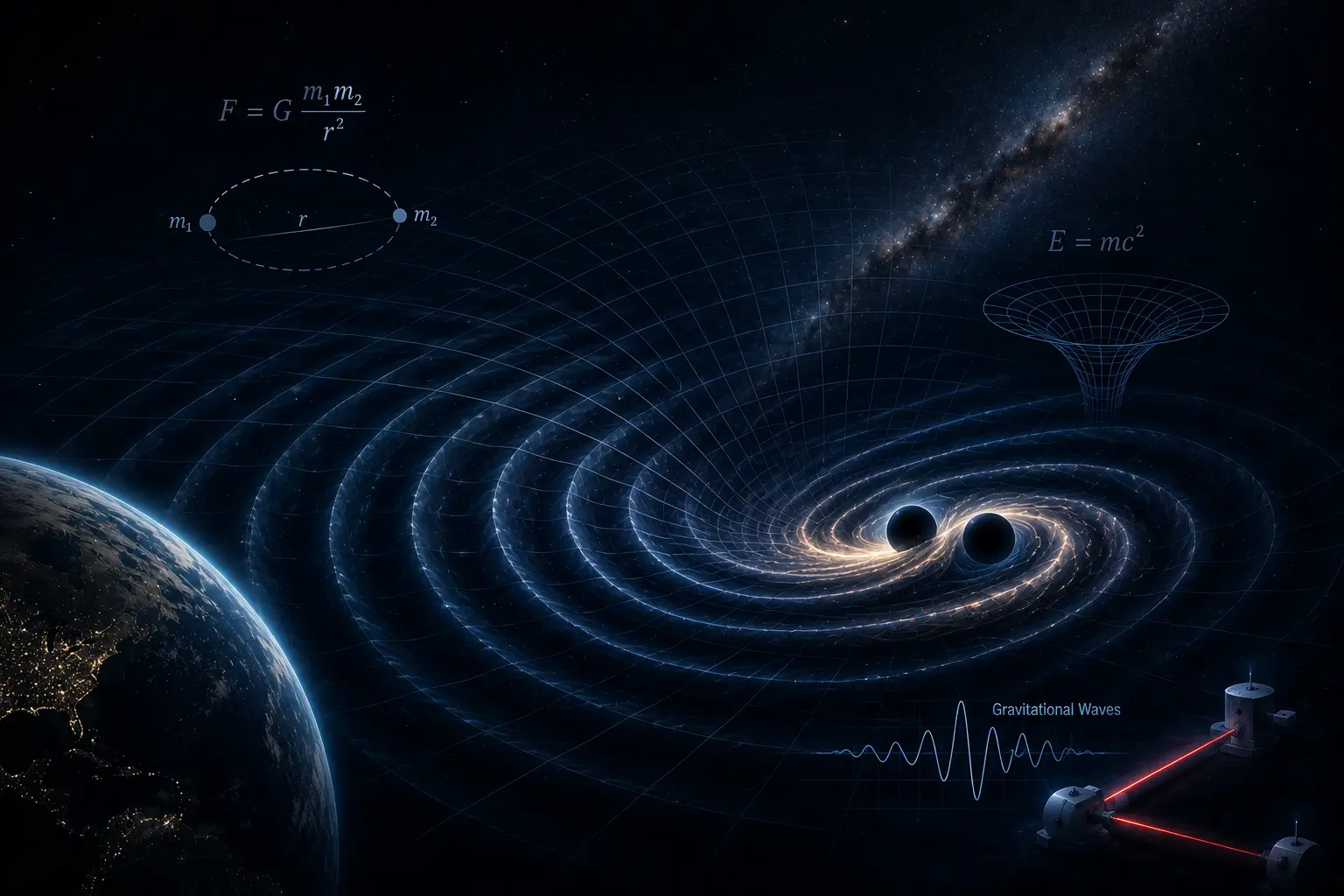
Newton’s law of gravitation states that every two objects with mass attract each other with a force that depends on their masses and the distance between them.
Gravitational force is one of the most fundamental interactions in nature and the reason everything in the universe with mass attracts everything else. It governs the fall of an apple, the motion of planets, the orbits of satellites, and even the structure of galaxies. From everyday motion to cosmic-scale dynamics, gravity is the invisible framework that holds the universe together.
Isaac Newton was the first scientist to describe this universal interaction mathematically in 1687 in his Philosophiae Naturalis Principia Mathematica along with his famous three laws of motion. His law unified two previously separate ideas: objects falling on Earth and planets moving in the sky.
Newton’s Law of Universal Gravitation
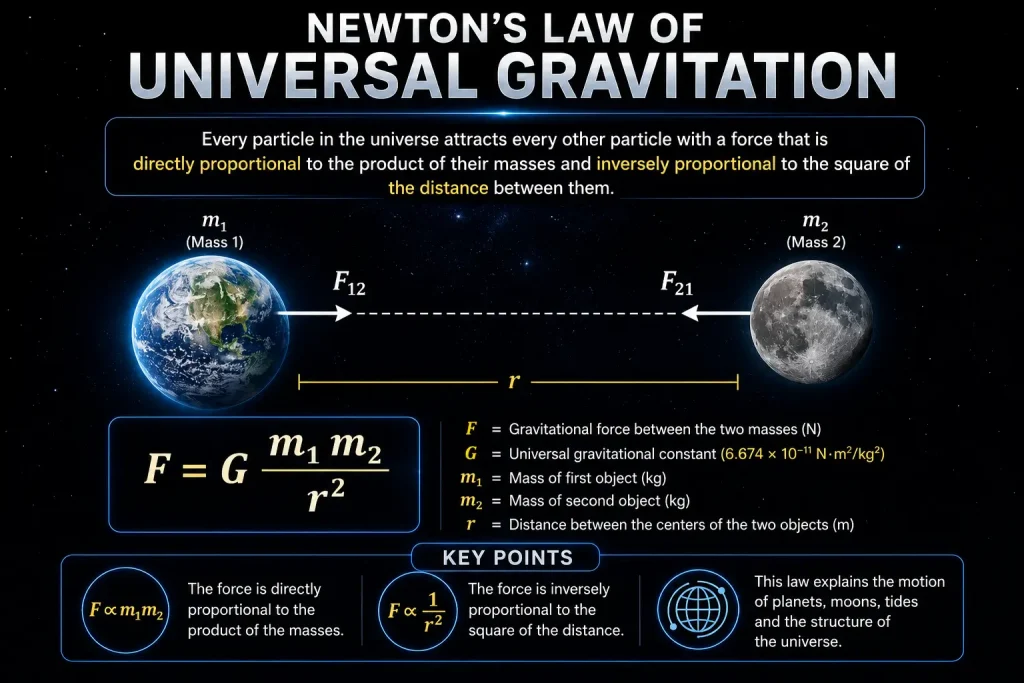
Newton’s law of gravitation states that every two objects with mass attract each other with a force that depends on their masses and the distance between them.
The mathematical form is:
F=G m1m2/r2
Where:
This equation is one of the most powerful in physics because it applies universally—from subatomic particles to galaxies.
Key Properties of Gravitational Force
1. Gravity is always attractive
Gravity is fundamentally different from electric forces. It never repels. It only attracts. This is why all objects with mass naturally pull toward each other.
At cosmic scales, this attraction is responsible for:
Without gravity, the universe would not form structured systems.
2. Gravity follows the inverse-square law
The strength of gravitational force decreases rapidly with distance:
F ∝ 1/r2
This means:
Even though gravity has infinite range, its effect becomes extremely weak at large distances.
For example:
This inverse-square behavior is crucial for understanding orbital mechanics and space navigation.
3. Action and reaction in gravity
Newton’s third law applies to gravity as well:
F12= – F21
This means:
However, acceleration differs because:
a= F/m
Since Earth’s mass is enormous, its acceleration is negligible, while yours is noticeable.
4. Gravity Depends on Mass
Larger masses produce stronger gravitational attraction.
For example:
Mass determines gravitational strength directly.
Historical Development of Gravitational Theory
Before Newton, scientists struggled to explain planetary motion.
Johannes Kepler discovered empirical laws describing planetary orbits, but he could not explain why planets moved that way.
Newton connected Kepler’s observations with force and motion.
Legend says Newton became inspired after observing a falling apple. Whether literally true or not, the story symbolizes his insight:
Newton’s theory revolutionized physics and became the foundation of classical mechanics.
The Universal Gravitational Constant (G)
The constant G is extremely small:
G = 6.674 × 10⁻¹¹
This explains why gravity between ordinary objects is weak.
For example:
Gravity becomes significant only when at least one object has enormous mass, such as:
The value of G was first measured experimentally by Henry Cavendish in 1798 using a torsion balance experiment.
Gravitational Field Strength
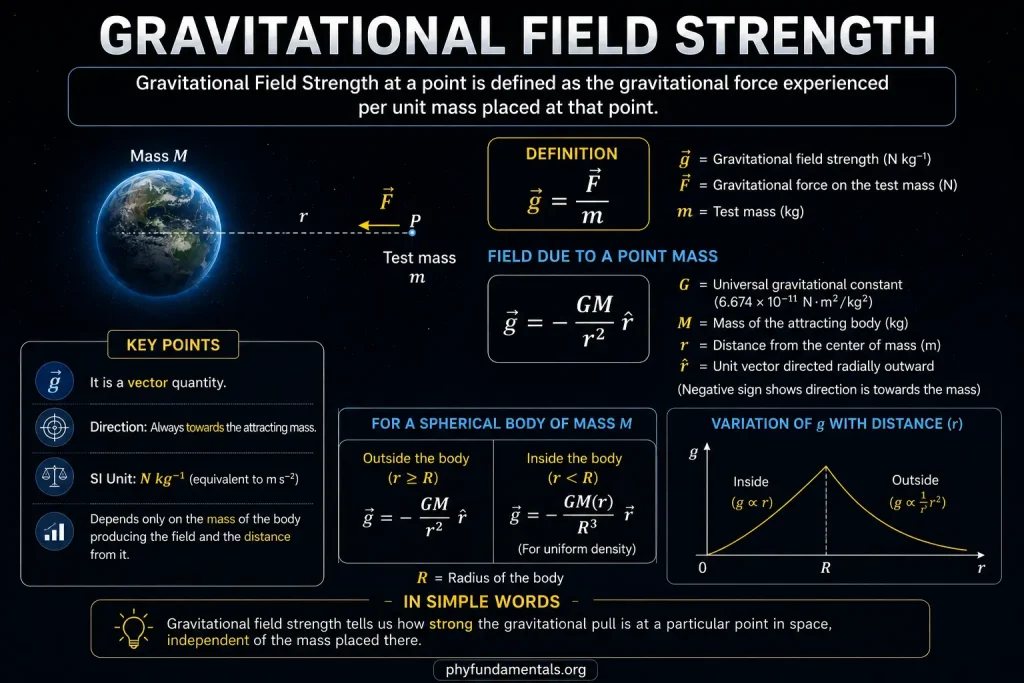
A gravitational field describes how strongly gravity acts at a location.
The gravitational field strength is:
g= GM/r2
Near Earth’s surface:
g ≈9.8 m /s2
This means every freely falling object accelerates downward at 9.8 m/s².
Weight vs Mass: A Critical Physics Concept
One of the most important distinctions in gravitational physics is between mass and weight.
Mass
Weight
Weight is given by:
W=mg
Where:
On Earth:
g ≈9.8 m /s2
On the Moon:
g ≈1.6 m /s2
Example:
But mass remains 80 kg everywhere.
This distinction is essential in:
Why Do All Objects Fall at the Same Rate?
One of the most famous results in physics is that all objects fall at the same rate in a vacuum, regardless of mass.
Gravitational force on an object:
F = mg
Newton’s second law:
F = ma
Equating both:
mg = ma
Canceling mass:
a = g
This shows that acceleration due to gravity is independent of mass.
Real-world confirmation
This principle was dramatically confirmed during the Apollo missions when a hammer and a feather were dropped on the Moon and hit the surface at the same time due to the absence of air resistance.
This demonstrates a deep principle: gravity accelerates all objects equally, regardless of their composition.
Free Fall Motion
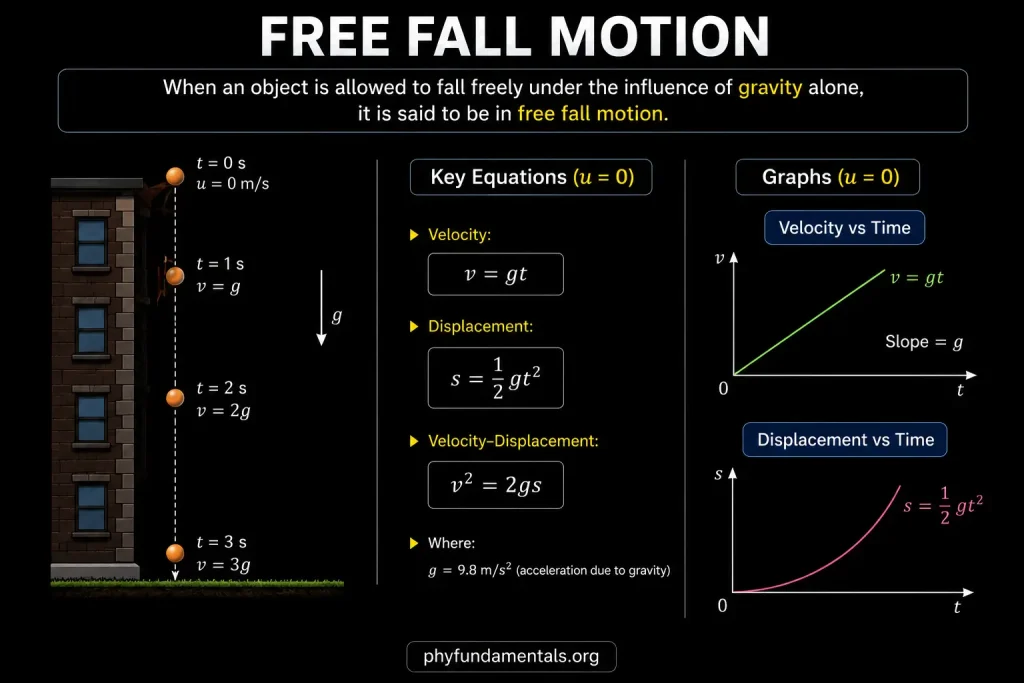
An object under gravity alone undergoes free fall.
Key equations include:
Velocity:
v=u+gt
Displacement:
s=ut+ 1/2 gt2
Velocity-displacement relation:
v2= u2+2gs
These equations form the basis of kinematics under gravity.
Orbital Mechanics: Gravity as a Centripetal Force
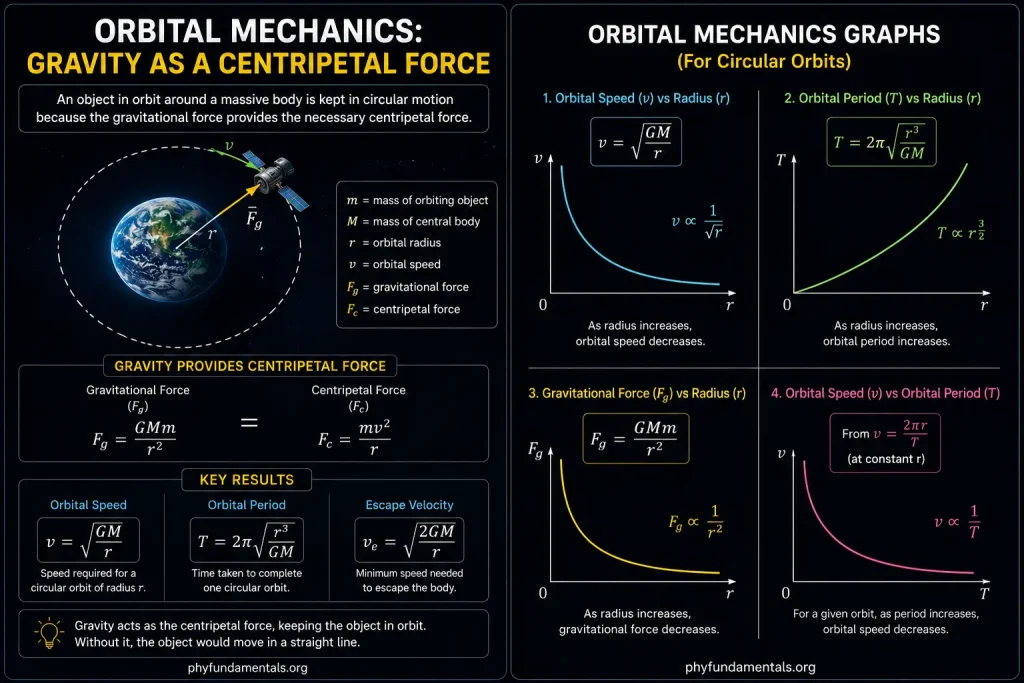
Gravity is not only responsible for falling motion—it also keeps planets, moons, and satellites in orbit.
An orbit is essentially continuous free-fall motion where forward velocity prevents collision with the central body.
For circular orbits, gravitational force provides centripetal force:
GMm/r2= m v2/r
Solving for orbital velocity:
v= √(Gm/r)
This equation explains several real-world observations:
The closer the orbit, the stronger the gravitational pull and the faster the required orbital speed.
Escape Velocity
Escape velocity is the minimum speed required to leave a planet permanently without further propulsion.
Formula:
ve= √(2GM/r)
For Earth:
ve ≈ 11.2 km/s
Rockets must exceed this speed to escape Earth’s gravity.
Energy in Orbital Motion
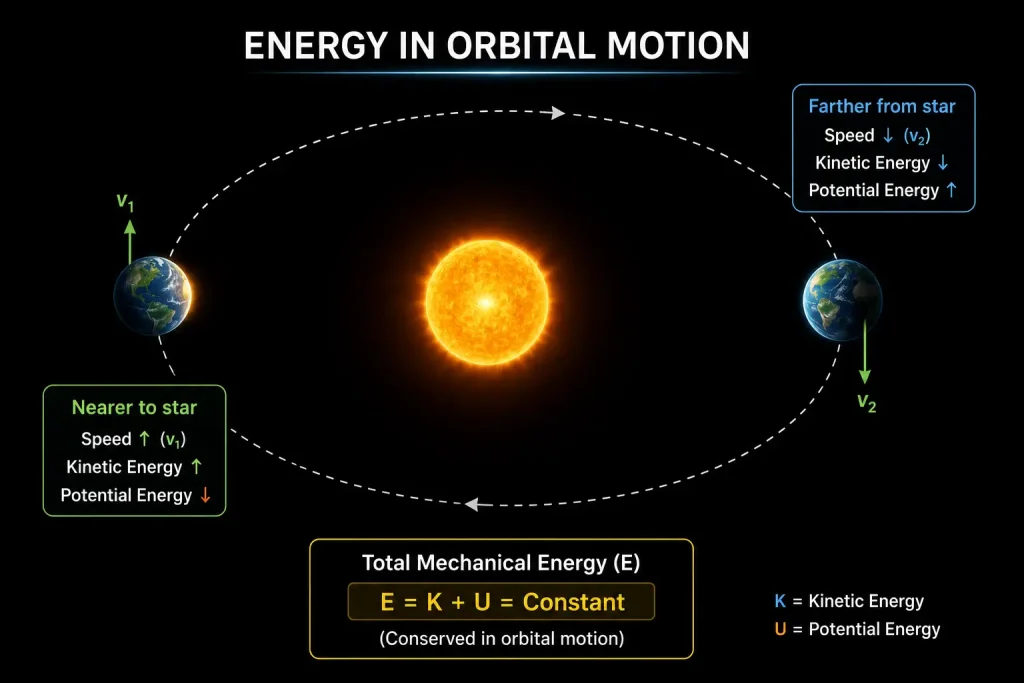
Orbits are not just about force—they are also about energy balance.
Total mechanical energy remains constant:
E = KE + PE = constant
Where:
KE= 1/2 mv2
Gravitational potential energy:
PE= – GMm/r
This constant exchange between kinetic energy and potential energy keeps satellites in stable orbit.
When a satellite moves closer to Earth:
When it moves farther:
This balance is what allows stable orbital motion over long periods.
Gravity and Planetary Motion
Kepler’s laws describe planetary motion:
Newton explained these laws using gravitation.
The gravitational force between Sun and planets creates orbital motion naturally.
Tides: Gravity of the Moon and Sun
Ocean tides result mainly from:
The Moon exerts different gravitational pull on different parts of Earth, producing tidal bulges.
This creates:
Tidal forces also affect:
Gravity and Black Holes
Black holes are regions where gravity becomes so strong that nothing—not even light—can escape.
The escape velocity exceeds light speed.
Black holes form from collapsing massive stars and are predicted by Einstein’s relativity.
They strongly bend space-time and can:
From Newton to Einstein: Limits of Classical Gravity
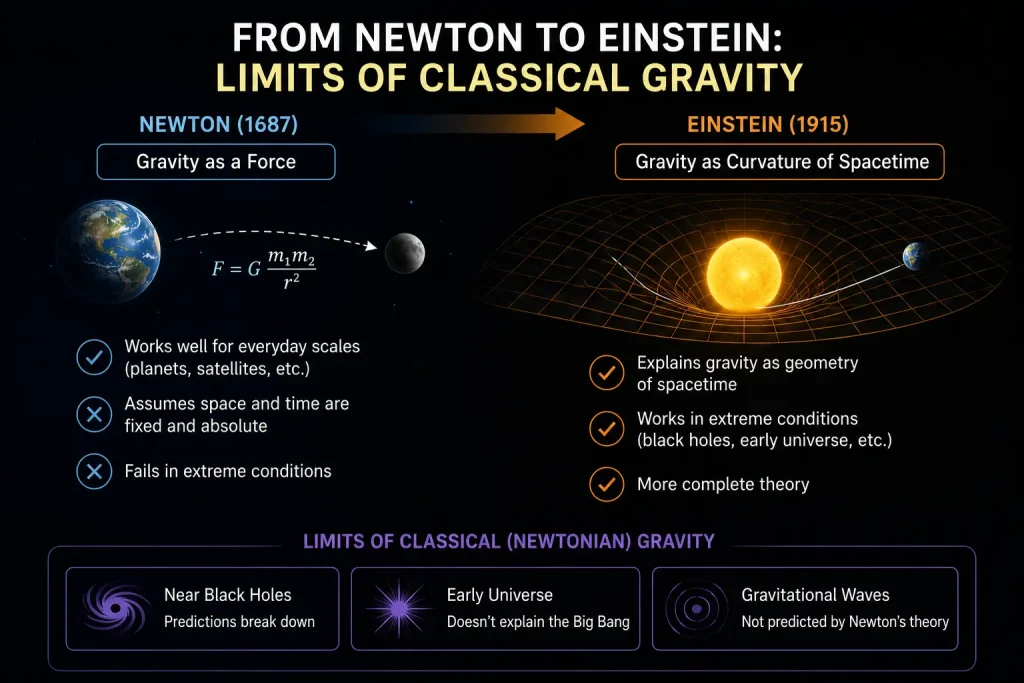
Newton’s law of gravitation is extremely accurate for most every day and astronomical calculations, including:
However, it has limitations in extreme environments such as:
In these cases, Albert Einstein’s General Theory of Relativity provides a deeper explanation.
Einstein described gravity not as a force, but as the curvature of space-time caused by mass and energy. Objects move along curved space-time paths called geodesics.
Despite this modern refinement, Newton’s law remains widely used in engineering and space science because:
Gravitational Waves
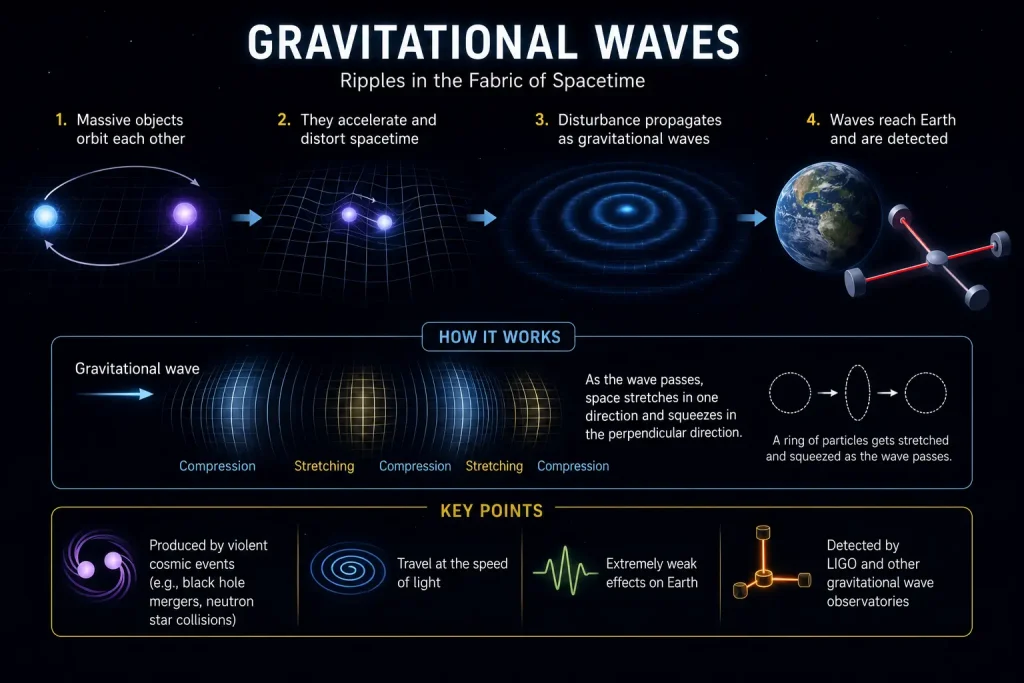
In 2015, Laser Interferometer Gravitational-Wave Observatory (LIGO) detected gravitational waves directly for the first time. These are ripples in space-time caused by massive accelerating objects like merging black holes.
This discovery confirmed Einstein’s predictions and opened a new era in astronomy.
Real-World Applications of Gravitational Force
Gravity is not just theoretical—it has practical applications in multiple fields.
1. Space exploration
2. Astronomy
3. Engineering
4. Earth sciences
Worked Problems
Problem 1: Calculating Gravitational Force Between Earth and a Person
A person of mass 70 kg stands on Earth’s surface. Calculate the gravitational force acting on the person.
Given:
ME=5.97 x 1024 kg
- Radius of Earth:
RE=6.37 x 10⁶ m
- Gravitational constant:
G=6.674 x 10⁻¹¹ Nm2/kg2
- Person’s mass:
m = 70 kg
Step 1: Use Newton’s Law of Gravitation
The formula is:
F=G Mm/r2
Substitute the values:
F= (6.674 x 10⁻¹¹ )(5.97 x 1024)(70)/(6.37 x 106)2
Step 2: Simplify the Numerator
(6.674 x 10⁻¹¹ )(5.97 x 1024)(70)
≈ 2.79 x 10¹⁶
Step 3: Simplify the Denominator
(6.37 x 10⁶)2
≈ 4.06 x 10¹³
Step 4: Calculate the Force
F= 2.79 x 10¹⁶/ 4.06 x 10¹³
Final Answer F ≈686 N
The gravitational force acting on the person is approximately:
F ≈686 N
This is essentially the person’s weight on Earth.
Problem 2: Finding Orbital Velocity of a Satellite
A satellite orbits Earth at an altitude where its orbital radius from Earth’s center is:
r=7.0 x 10⁶ m
Calculate the orbital speed of the satellite.
Given:
ME=5.97 x 1024 kg
- Gravitational constant:
G=6.674 x 10⁻¹¹ Nm2/kg2
Step 1: Use Orbital Velocity Formula
For circular orbit:
v= √(Gm/r)
Substitute values:
v= √((6.674 x 10⁻¹¹ )(5.97 x 1024))/7.0 x 106
Step 2: Simplify the Numerator
(6.674 x 10⁻¹¹ )(5.97 x 1024)
≈ 3.986 x 10¹⁴
Step 3: Divide by Radius
3.986 x 10¹⁴ /7.0 x 106
≈ 5.69 x 10⁷
Step 4: Take Square Root
v= √(5.69 x 10⁷)
v≈ 7540 m/s
Final Answer
The satellite’s orbital velocity is approximately:
v≈ 7.54 x 10³ m/s
or
v≈ 7.54 km/s
This is close to the speed of many low Earth orbit satellites, including spacecraft near the altitude of the International Space Station.
Final Insight
Newton’s law of universal gravitation reveals a profound truth: every object in the universe is connected through an invisible force of attraction.
From a simple falling object to the motion of planets around stars, gravity governs motion across all scales of existence. It is the foundation of classical mechanics and the starting point for modern astrophysics and space exploration.
Even with Einstein’s refinement of gravitational theory, Newton’s law remains one of the most powerful and practical equations in science—an essential bridge between everyday physics and the structure of the universe itself.


