Electric Charge and Coulomb’s Law are two of the most important ideas in physics because they explain how objects become electrically charged and how charged particles push or pull each other. Every spark, lightning strike, electric field, atom, circuit, and electronic device depends on the behavior of electric charge. When two charged objects come close, they either attract or repel, and Coulomb’s Law helps us calculate the exact strength of that electric force shares the same inverse-square structure as Newton’s law of gravitation .
In simple words, electric charge is a basic property of matter that can be positive or negative. Like charges repel each other, while opposite charges attract. This law gives this relationship a clear mathematical form by showing that the force between two charges depends on the size of the charges and the distance between them. The greater the charges, the stronger the force; the greater the distance, the weaker the force.
Electric Charge: The Basic Property Behind Coulomb’s Law
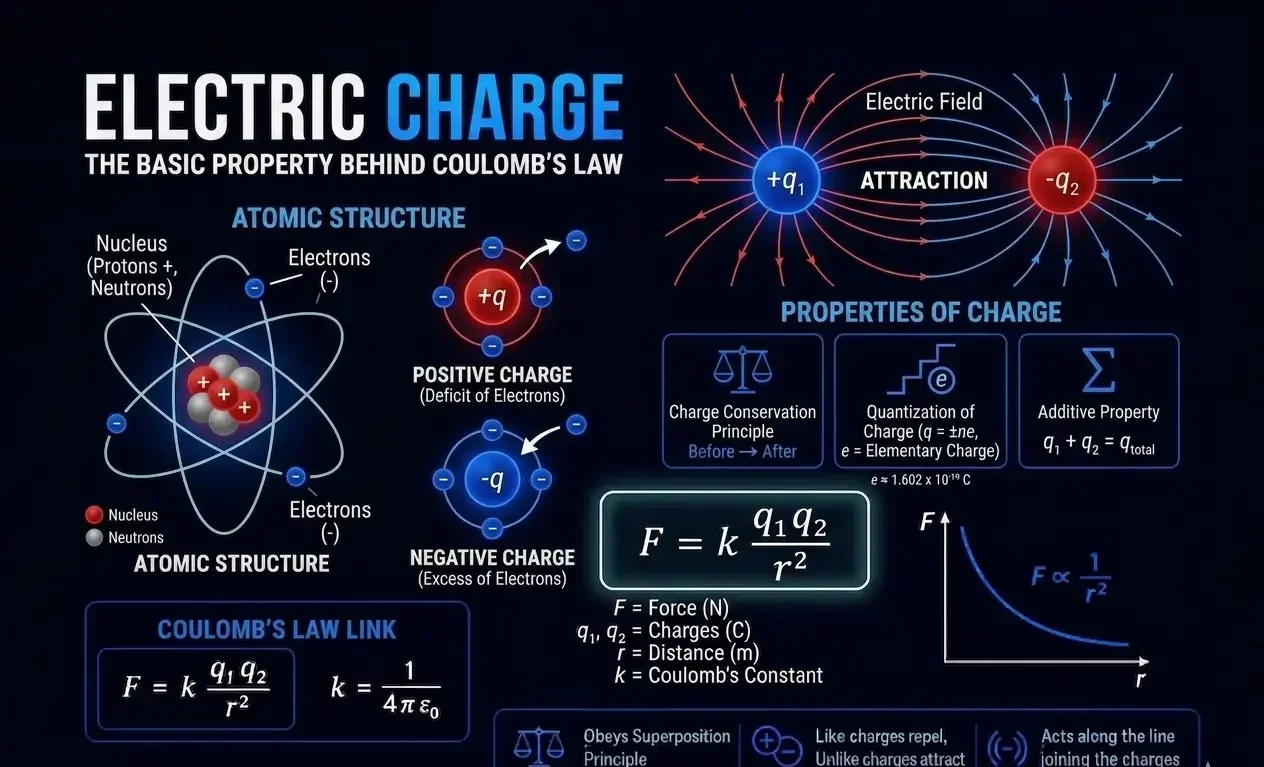
Electric charge is a fundamental property of matter. It is responsible for electric forces and electromagnetic interactions. Every atom, molecule, electrical device, and biological nerve signal depends on the behavior of electric charge.
There are two main types of electric charge:
|
Type of Charge |
Example Particle |
Behavior |
|
Positive charge |
Proton |
Attracts negative charge and repels positive charge |
|
Negative charge |
Electron |
Attracts positive charge and repels negative charge |
|
Neutral |
Neutron |
Has no net electric charge |
Atoms are usually electrically neutral because they contain equal numbers of protons and electrons. Protons are located in the nucleus, while electrons move around the nucleus in regions called orbitals or electron clouds.
When an atom or object gains electrons, it becomes negatively charged. When it loses electrons, it becomes positively charged. This movement or transfer of electrons is the basis of static electricity.
For example, when a balloon is rubbed against hair, electrons may transfer from one surface to another. The balloon can become negatively charged and may stick to a wall because it attracts positive charges or induces charge separation in the wall surface.
The same principle is involved in electric sparks, lightning, photocopiers, laser printers, charged dust particles, and many electronic devices.
Important Properties of Electric Charge
Electric charge has several essential properties that help explain how matter and electricity behave.
|
Property |
Explanation |
|
Charge is measured in coulombs |
The SI unit of electric charge is the coulomb, written as C. |
|
Charge is conserved |
Electric charge cannot be created or destroyed; it can only be transferred. |
|
Charge is quantized |
Charge exists in fixed units based on the elementary charge. |
|
Charge produces electric fields |
A charged object affects the space around it. |
|
Charge causes electric forces |
Charged objects attract or repel each other. |
The smallest independent unit of charge is called the elementary charge. Its value is:
e = 1.602 × 10⁻¹⁹ C
A proton has a charge of:
+e
An electron has a charge of:
−e
This means that charge appears in multiples of the elementary charge. An object cannot normally have a charge of half an electron. Instead, charge appears in whole-number multiples of 1.602 × 10⁻¹⁹ C.
Conservation of Electric Charge
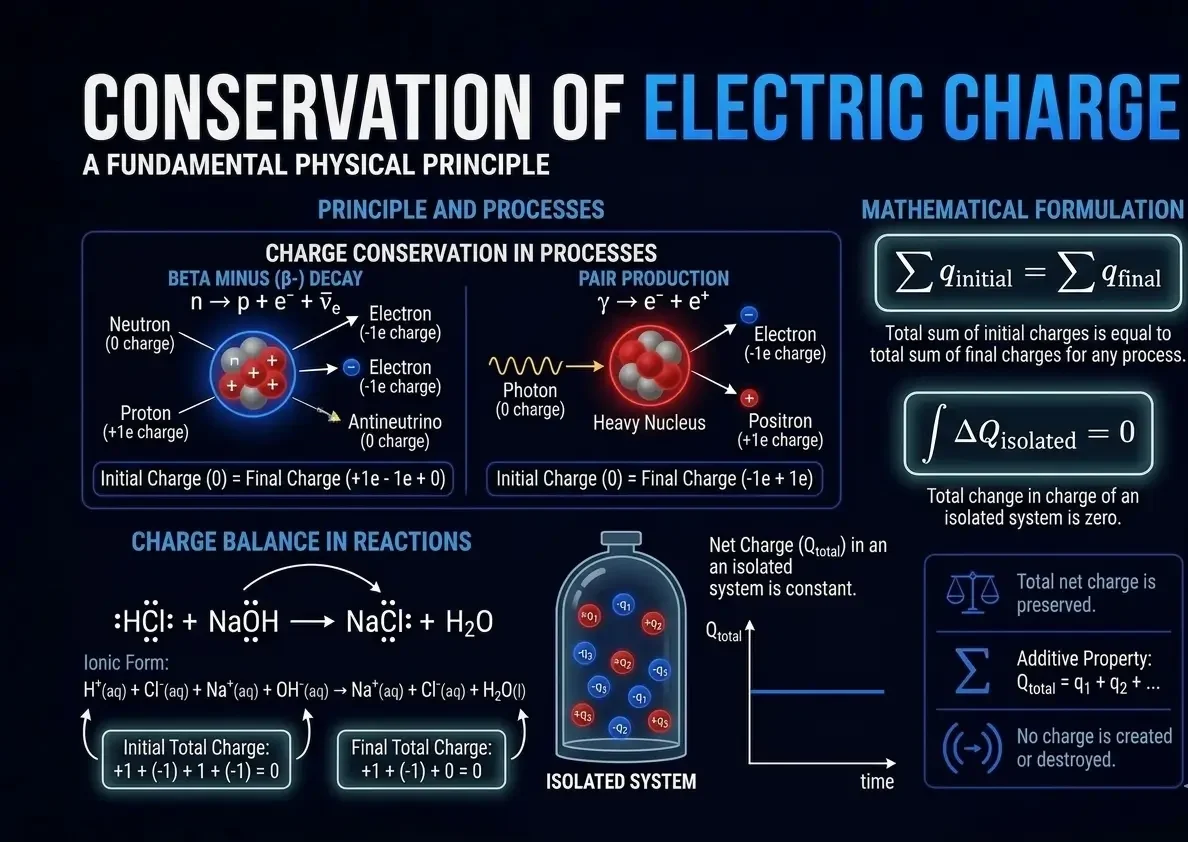
One of the most important principles in physics is the conservation of electric charge.
The law of conservation of charge states that electric charge cannot be created or destroyed. It can only be transferred from one object to another.
If one object gains electrons, another object must lose electrons. The total charge of an isolated system remains constant.
Examples of charge conservation include:
When clothes stick together after coming out of a dryer, electrons have moved between fabrics. One material becomes more negatively charged, while another becomes more positively charged. No charge has been created from nothing. It has only been redistributed.
This principle is important in physics, chemistry, electronics, electrical engineering, and particle physics.
Key Facts About Electric Charge
What is Coulomb’s Law?
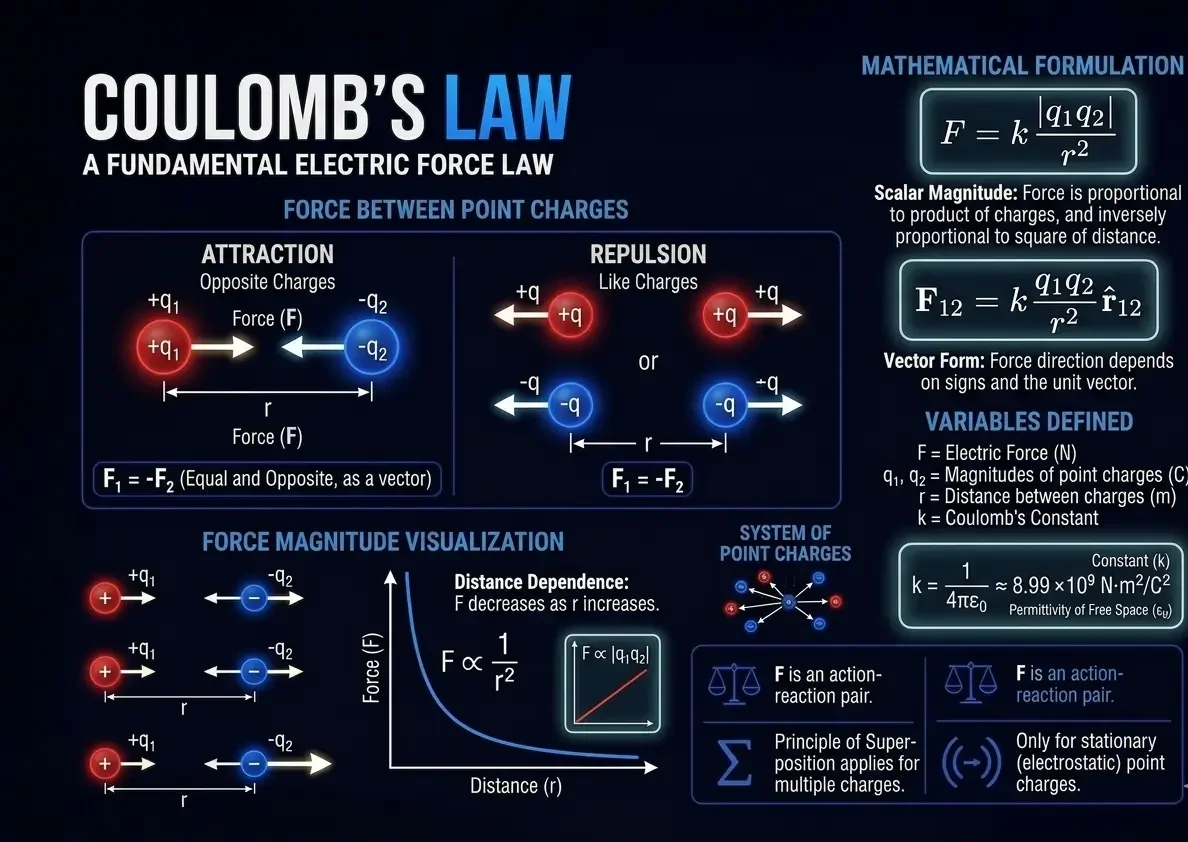
In simple terms, Coulomb’s Law states that the electric force between two stationary charges is directly proportional to the product of the charges and inversely proportional to the square of the distance between them. If the charges are larger, the force becomes stronger. If the distance between them increases, the force becomes weaker very quickly.
The formula is:
F=k |q1q2|/r2
Where:
|
Symbol |
Meaning |
SI Unit |
|
F |
Electrostatic force |
Newton, N |
|
q₁ |
First electric charge |
Coulomb, C |
|
q₂ |
Second electric charge |
Coulomb, C |
|
r |
Distance between the charges |
Meter, m |
|
k |
Coulomb constant |
N·m²/C² |
The value of Coulomb’s constant in air or vacuum is approximately:
k = 8.99 × 10⁹ N·m²/C²
It helps explain why like charges repel and opposite charges attract. Two positive charges push each other away. Two negative charges also push each other away. A positive charge and a negative charge pull toward each other.
This simple rule explains many events in nature and technology, from a balloon sticking to a wall to lightning flashing across the sky.
What is the Formula of Coulomb’s Law?
Coulomb’s Law gives the size of the electrostatic force between two point charges.
F=k |q1q2|/r2
This formula shows three important relationships:
- The force increases when either charge increases.
- The force decreases when the distance increases.
- The force follows an inverse-square relationship with distance.
The absolute value signs around q₁q₂ are used when calculating the magnitude of the force. The signs of the charges are then used separately to determine whether the force is attractive or repulsive.
If both charges have the same sign, the force is repulsive.
|
Charge Combination |
Type of Force |
|
+ and + |
Repulsive |
|
− and − |
Repulsive |
|
+ and − |
Attractive |
|
− and + |
Attractive |
This behavior makes electric force different from gravity. Gravity is always attractive, but electric force can be either attractive or repulsive.
Meaning of Each Term
The force F represents the electrostatic force between two charges. It is measured in newtons, the same unit used for mechanical force.
The charges q₁ and q₂ represent the amount of electric charge on each object. They must be measured in coulombs for standard SI calculations.
The distance r is the separation between the centers of the two charges. It must be measured in meters. This is one of the most common mistakes students make. If distance is given in centimeters or millimeters, it must be converted to meters first.
The constant k is Coulomb’s constant. In vacuum or air, it is approximately:
K = 8.99 × 10⁹ N·m²/C²
In many school-level calculations, this is rounded to:
9.0 × 10⁹ N·m²/C²
The Inverse-Square Relationship
One of the most important features of Coulomb’s Law is the inverse-square relationship. The force changes according to:
1/r2
This means distance has a very strong effect on electric force.
|
Change in Distance |
Effect on Force |
|
Distance doubles |
Force becomes 1/4 as large |
|
Distance triples |
Force becomes 1/9 as large |
|
Distance becomes 4 times larger |
Force becomes 1/16 as large |
|
Distance is halved |
Force becomes 4 times larger |
For example, if two charges are moved from 1 meter apart to 2 meters apart, the force does not simply become half. It becomes one-fourth. If they are moved from 1 meter apart to 3 meters apart, the force becomes one-ninth.
This inverse-square pattern also appears in gravitational force, light intensity, sound intensity, and radiation intensity. It is one of the most common mathematical patterns in physics.
Direction of Electric Force
Coulomb’s Law gives the size of the force, but electric force also has direction.
The force acts along the straight line joining the two charges.
For like charges, the force pushes the charges away from each other. For opposite charges, the force pulls them toward each other.
Example:
If a positive charge is placed to the left of another positive charge, the left charge is pushed further left, and the right charge is pushed further right. If the charges are opposite, they move toward each other.
This direction is important in electric field diagrams, atomic models, particle motion, and circuit-related physics.
Vector Form of Coulomb’s Law
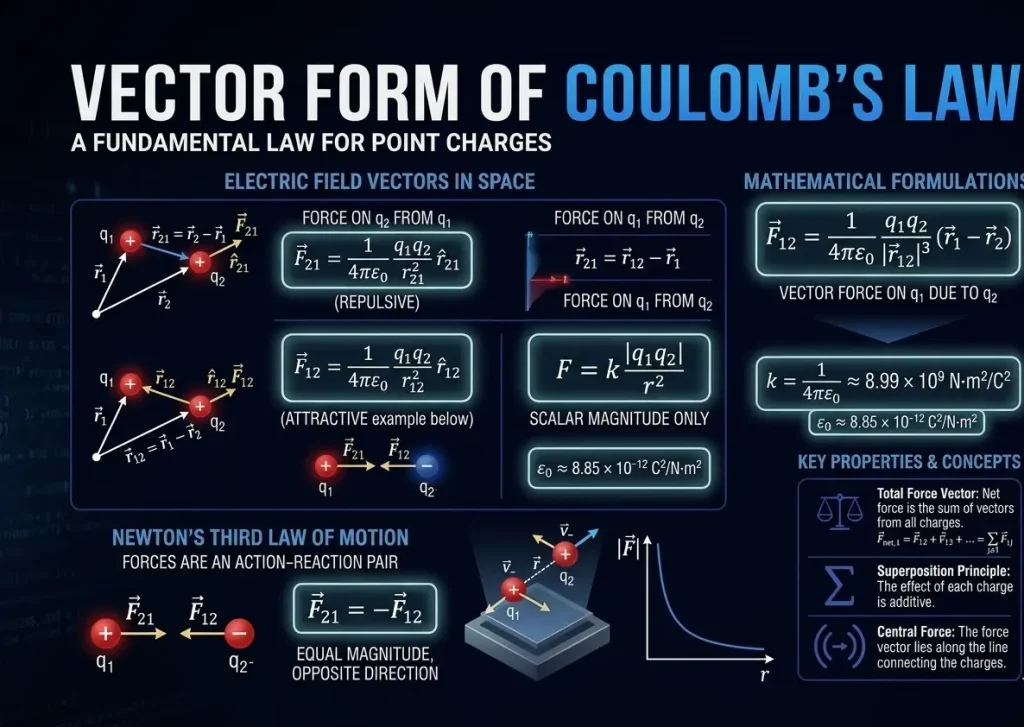
For more advanced physics, Coulomb’s Law can be written in vector form. The vector form includes both magnitude and direction.
A common form is:
F=k (|q1q2|/r2) r̂
Here, r̂ is a unit vector pointing along the line between the charges.
The vector form is useful when:
In basic physics, the scalar form is usually enough for calculating the magnitude of force. In advanced physics and engineering, the vector form becomes essential.
Electric Field and Coulomb’s Law
This law is closely connected to the concept of the electric field.
An electric field is the region around a charged object where another charge experiences a force. Instead of saying that one charge acts directly on another from a distance, physicists describe the first charge as creating an electric field in the surrounding space.
The electric field is defined as force per unit positive test charge:
E= F/q
Where:
|
Symbol |
Meaning |
Unit |
|
E |
Electric field strength |
N/C or V/m |
|
F |
Electric force |
N |
|
q |
Test charge |
C |
For a point charge, the electric field is:
E=k Q/r2
Where Q is the source charge and r is the distance from the charge.
Electric field lines point outward from positive charges and inward toward negative charges. The closer the field lines are, the stronger the electric field is.
The electric field concept is important because it helps explain capacitors, electric potential, circuits, particle accelerators, lightning, and electromagnetic waves.
Why Electric Force Is So Powerful
The electrostatic force is enormously stronger than gravity.
For two protons separated by the same distance:
1036
times stronger than gravitational attraction.
This is one of the most astonishing numerical comparisons in science.
Electric interactions dominate:
Gravity dominates cosmic scales mainly because:
According to HyperPhysics, electromagnetic interactions determine nearly all everyday physical phenomena except large-scale astronomical structure.
Coulomb’s Law and Newton’s Law of Gravitation
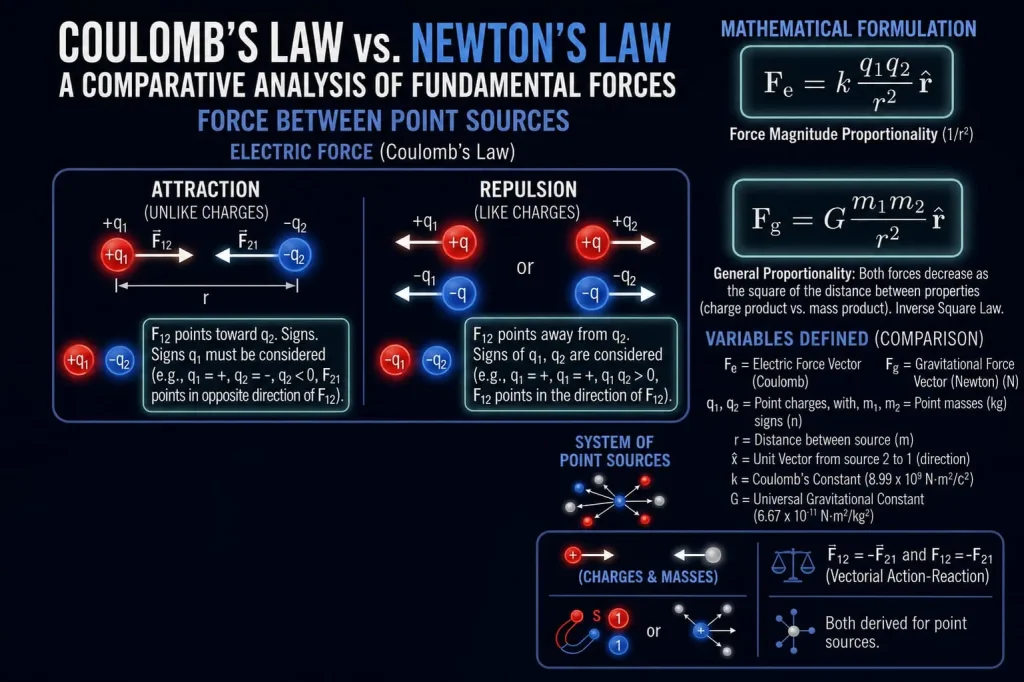
Coulomb’s Law and Newton’s law of gravitation have similar mathematical structures. Both are inverse-square laws.
Coulomb’s Law:
F=k |q1q2|/r2
Newton’s law of gravitation:
F=G m1m2/r2
Both laws describe forces that act over distance. Both forces weaken as the square of the distance increases. However, they are very different in several important ways.
|
Feature |
Electric Force |
Gravitational Force |
|
Depends on |
Electric charge |
Mass |
|
Can attract |
Yes |
Yes |
|
Can repel |
Yes |
No |
|
Relative strength |
Extremely strong |
Very weak |
|
Can cancel in matter |
Yes |
No |
|
Important scale |
Atomic and electrical systems |
Planetary and cosmic systems |
Electric force is much stronger than gravitational force between elementary particles. For example, the electric repulsion between two protons is enormously stronger than their gravitational attraction.
However, gravity dominates at astronomical scales because matter usually contains nearly equal amounts of positive and negative charge. These charges mostly cancel out. Mass, on the other hand, does not cancel because gravity is always attractive.
This is why gravity controls planets, stars, and galaxies, while electric forces dominate atoms, molecules, materials, chemistry, electronics, and everyday contact forces.
Limitations of Coulomb’s Law
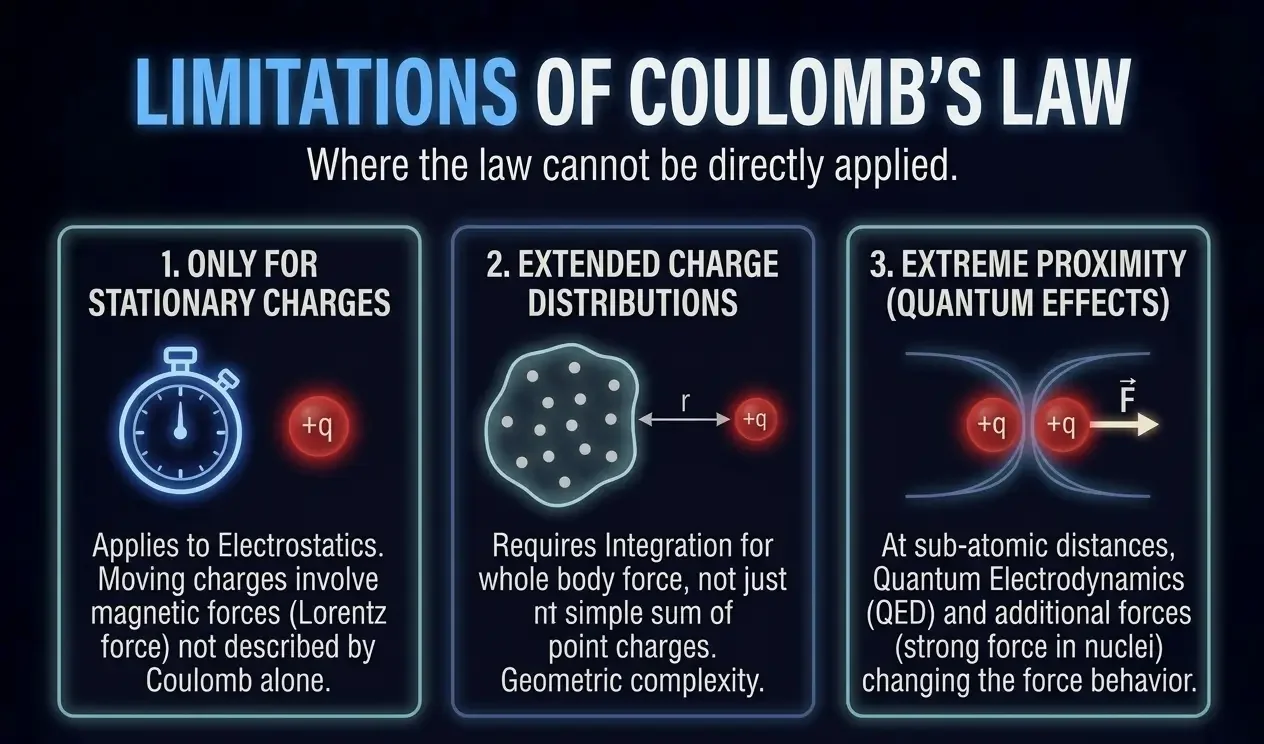
Coulomb’s Law is extremely important, but it does not apply perfectly in every situation. It works best for stationary point charges or objects that can be treated as point charges.
A point charge is an idealized charge that is considered to exist at a single point in space. Real objects have size and shape, so this law is most accurate when the distance between charged objects is much larger than their physical size.
This law may not be directly accurate when:
For extended charge distributions, physicists use integration, electric fields, or Gauss’s Law. For moving charges, magnetic forces and Maxwell’s equations may be needed. For atomic and subatomic scales, quantum mechanics provides a deeper explanation.
Another limitation is that the value of Coulomb’s constant depends on the medium. In vacuum or air, the common value is approximately 8.99 × 10⁹ N·m²/C². In other materials, the force can be reduced because the medium affects the electric field. This is described using permittivity.
In a medium, Coulomb’s Law can be written as:
F=(1/4π∈) |q1q2|/r2
Here, ε is the permittivity of the medium.
This is important in materials science, electronics, capacitors, chemistry, and biological systems.
Conductors, Insulators and Semiconductors
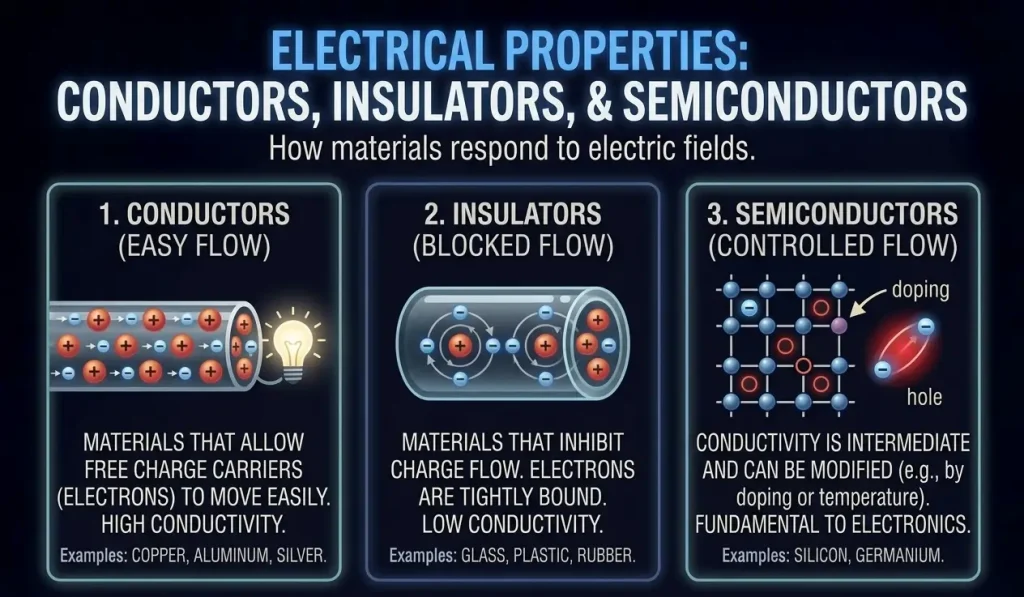
Different materials respond differently to electric charge. This behavior is essential for understanding circuits, electronics, static electricity, and modern technology.
Conductors
Conductors allow electric charges, especially electrons, to move easily. Metals such as copper, silver, aluminum, and gold are good conductors.
In conductors:
Conductors are used in wires, power lines, circuit boards, electrical machines, and electronic devices.
Insulators
Insulators resist the movement of electric charge. Examples include rubber, plastic, glass, dry wood, and ceramic materials.
In insulators:
This is why plastic, rubber, and ceramic materials are often used for electrical safety.
Semiconductors
Semiconductors have electrical properties between conductors and insulators. Silicon and germanium are common examples.
Their conductivity can be controlled by:
Semiconductors are the foundation of transistors, diodes, microchips, solar cells, sensors, smartphones, computers, and digital technology.
Without controlled charge movement in semiconductors, modern computing and communication systems would not exist.
Static Electricity in Daily Life
Static electricity occurs when electric charge builds up on the surface of an object. It usually happens when electrons transfer between materials through friction or contact.
Common examples include:
Dry air increases static electricity because moisture in the air normally helps charges leak away. In dry weather, charges remain on surfaces longer, making static shocks more common.
Static electricity may seem simple, but it has many practical uses. It is used in photocopiers, laser printers, paint spraying, air filters, and electrostatic dust removal systems.
Lightning: Nature’s Giant Electrostatic Discharge
Lightning is one of the most dramatic examples of electric charge in nature.
Inside thunderclouds:
This creates extremely strong electric fields. When the electric field exceeds the breakdown strength of air:
3 x 10⁶ V/m
air becomes ionized, forming plasma channels. A sudden electrical discharge then occurs as lightning. Lightning temperatures may exceed:
30,000 ℃
which is hotter than the Sun’s visible surface.
According to NASA Earth Observatory, lightning significantly influences atmospheric chemistry and planetary electrical balance.
Electric Charge and Atomic Structure
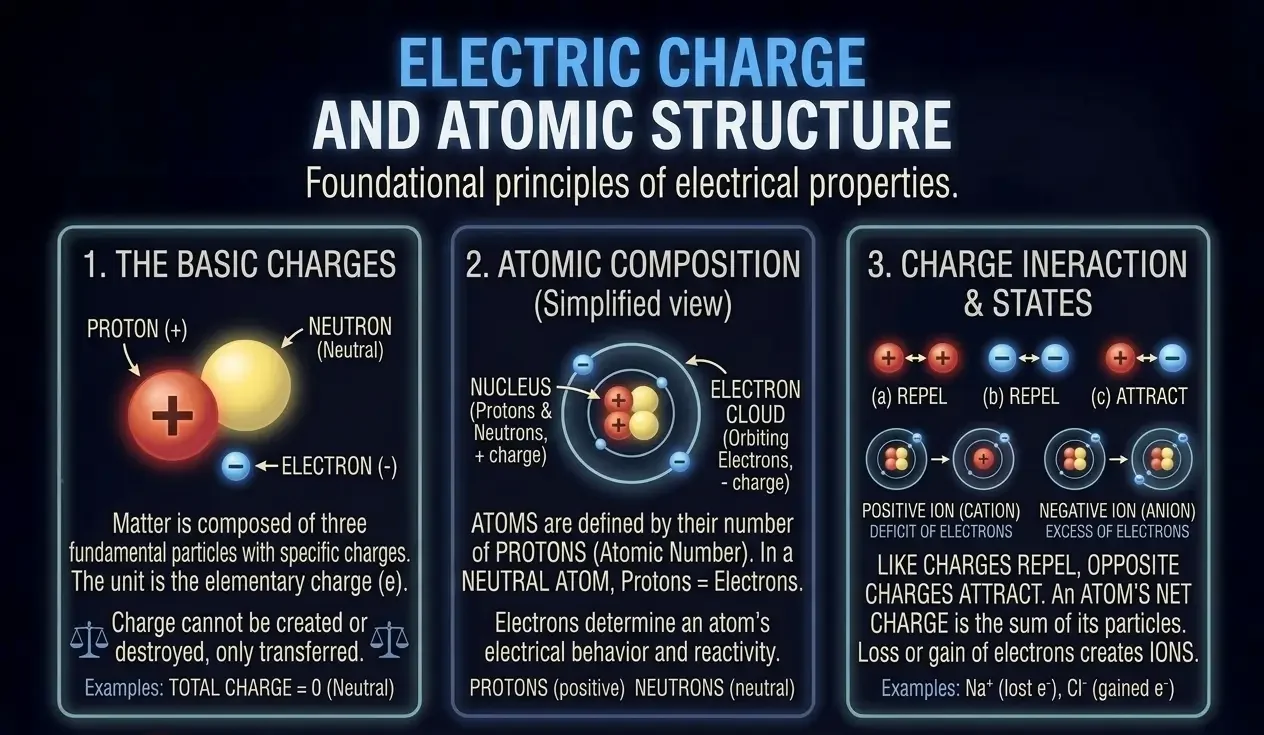
Atoms exist because of electrostatic attraction.
Inside atoms:
This creates stable atomic systems. Chemical bonding also emerges from electromagnetic interactions between atoms.
Without electric forces:
Electromagnetism therefore underpins all chemistry and life itself.
Applications of Coulomb’s Law
It is not only a classroom formula. It has many real-world applications in science, engineering, and technology.
Atomic Structure
Atoms exist because of electric attraction between positively charged nuclei and negatively charged electrons. Without electrostatic attraction, electrons would not remain associated with atoms, and matter as we know it would not exist.
Chemical Bonding
Chemical bonds form because of electromagnetic interactions between charged particles. Ionic bonds, covalent bonds, molecular attraction, and many chemical reactions depend on electric forces.
Capacitors
Capacitors store electric charge and electrical energy. They consist of two conducting plates separated by an insulating material. Opposite charges accumulate on the plates, creating an electric field between them.
Capacitors are used in:
Laser Printers and Photocopiers
Laser printers and photocopiers use electrostatic attraction. Charged toner particles are attracted to oppositely charged regions on a drum or paper. The toner is then fused to the paper using heat.
Electrostatic Precipitators
Factories and power plants use electrostatic precipitators to remove dust and pollution particles from exhaust gases. Particles are electrically charged and then attracted to oppositely charged plates.
This helps reduce air pollution.
Touchscreens and Sensors
Many modern touchscreens and sensors depend on electric fields and charge distribution. When a finger touches the screen, it changes the local electric field, allowing the device to detect position.
Particle Accelerators
Charged particles can be accelerated and controlled using electric fields. Particle accelerators use these principles for scientific research, medicine, and material analysis.
Space Physics
Charged particles from the Sun interact with Earth’s magnetic field and atmosphere. These interactions produce auroras, radiation belts, and geomagnetic storms. Plasma, which consists of charged particles, is common in stars, nebulae, and interstellar space.
Common Mistakes in Coulomb’s Law Calculations
Students often make avoidable mistakes when using this law.
|
Mistake |
Correct Method |
|
Using centimeters instead of meters |
Convert distance to meters before calculation |
|
Forgetting micro coulomb conversion |
1 µC = 10⁻⁶ C |
|
Using signs incorrectly |
Use absolute values for force magnitude |
|
Confusing attraction and repulsion |
Same signs repel, opposite signs attract |
|
Forgetting to square the distance |
Always use r² in the denominator |
|
Using surface distance instead of center distance |
Use center-to-center distance for point charges |
|
Rounding too early |
Keep extra digits until the final answer |
|
Applying it to complex objects without care |
Use electric fields or integration for extended charge distributions |
The most common error is failing to convert units. Since Coulomb’s Law uses SI units, charges must be in coulombs and distance must be in meters.
Worked Examples:
Solved Example 1: Force Between Two Opposite Charges
Two charges are placed 0.10 m apart.
q₁ = +3 µC
q₂ = −2 µC
r = 0.10 m
Find the electrostatic force between them.
First, convert micro coulombs to coulombs:
3 µC = 3 × 10⁻⁶ C
2 µC = 2 × 10⁻⁶ C
Use:
F=k |q1q2|/r2
Substitute the values:
F = (8.99 × 10⁹)(3 × 10⁻⁶)(2 × 10⁻⁶) / (0.10)²
Multiply the charges:
(3 × 10⁻⁶)(2 × 10⁻⁶) = 6 × 10⁻¹²
Now multiply by Coulomb’s constant:
(8.99 × 10⁹)(6 × 10⁻¹²) = 0.05394
Square the distance:
(0.10)² = 0.01
Now divide:
F = 0.05394 / 0.01
F = 5.394 N
Rounded:
F ≈ 5.39 N
Because the charges are opposite, the force is attractive.
Final answer: 5.39 N, attractive
Solved Example 2: Effect of Doubling Distance
Two charges exert a force of 12 N on each other when separated by a certain distance. What happens to the force if the distance is doubled?
The law follows the inverse-square relationship:
F ∝ 1 / r²
If the distance doubles, then:
new distance = 2r
The new force becomes:
Fnew= F/22
Fnew= F/4
Substitute the original force:
Fnew= 12 / 4
Fnew= 3 N
Final answer: the force becomes 3 N
This example shows that electric force decreases very quickly when distance increases.
Solved Example 3: Finding Distance Between Charges
Two charges produce an electric force of 9 N.
q₁ = 4 µC
q₂ = 5 µC
F = 9 N
Find the distance between the charges.
Start with:
F=k |q1q2|/r2
Rearrange the formula to solve for r:
r2=k |q1q2|F
r =√(k |q1q2|/F)
Convert charges:
4 µC = 4 × 10⁻⁶ C
5 µC = 5 × 10⁻⁶ C
Substitute values:
r = √[(8.99 × 10⁹)(4 × 10⁻⁶)(5 × 10⁻⁶) / 9]
Multiply the charges:
(4 × 10⁻⁶)(5 × 10⁻⁶) = 20 × 10⁻¹² = 2.0 × 10⁻¹¹
Multiply by Coulomb’s constant:
(8.99 × 10⁹)(2.0 × 10⁻¹¹) = 0.1798
Divide by force:
0.1798 / 9 = 0.01998
Take the square root:
r = √0.01998
r ≈ 0.141 m
Final answer: approximately 0.141 m