
MCQs
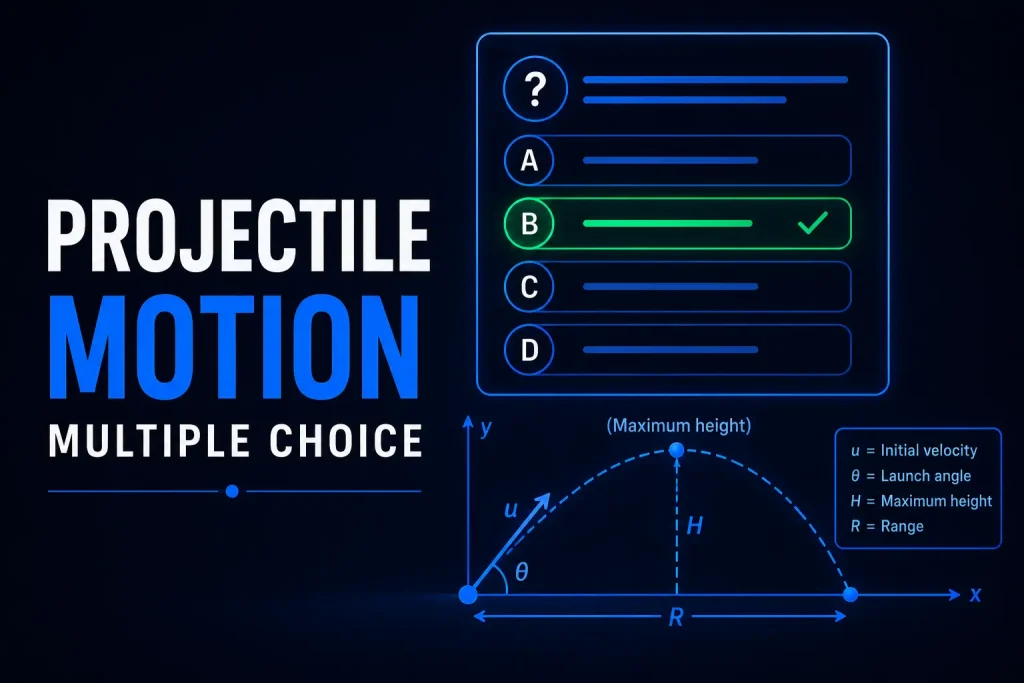
Projectile Motion(MCQs)
A) One-dimensional motionB) Uniform circular motionC) Two-dimensional motionD) Random motion A) CircleB) EllipseC) ParabolaD) Straight line A) gB) 0C) 9.8 m/s² upwardD) Variable A) ZeroB) Constant upwardC) Constant downward (g)D) Changing A) IncreasingB) DecreasingC) ConstantD) Zero A) velocityB) displacementC) timeD) acceleration A) MaximumB) ZeroC) Negative maximumD) Constant A) cosθB) sinθC) tanθD) sin²θ only A) 30°B)…
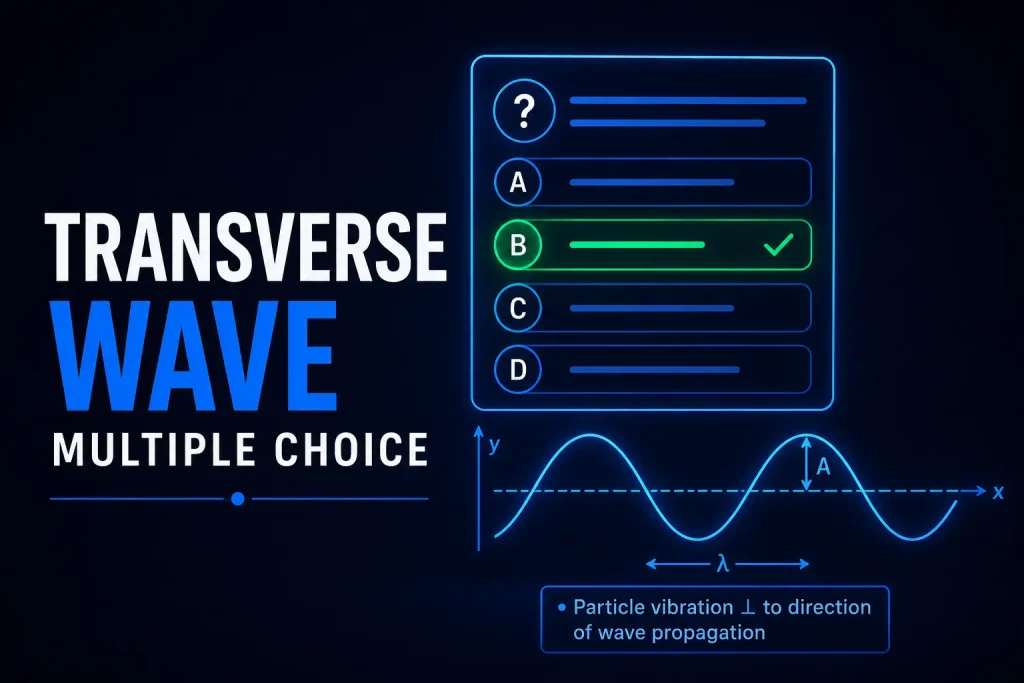
Transverse waves(MCQs)
A) Parallel to wave motionB) Opposite to wave motionC) Perpendicular to wave motionD) Circular to wave motion A) Sound wave B) Light wave C) Compression wave D) Shock wave A)) Compression B) Rarefaction C) Crest D) Node A) Trough B) Crest C) Antinode D) Pulse A) Reflection B) Refraction C) Polarization D) Diffraction A) Longitudinal wavesB)…

Angular Momentum(MCQs)
A) The force causing rotationB) The energy of rotationC) The quantity of rotational motionD) The resistance to motion A) kg·m/sB) N·mC) kg·m²/sD) J/s A) Scalar quantityB) Vector quantityC) Dimensionless quantityD) Tensor only L = I\omega A) L = mvB) L = IωC) L = FrD) L = ma A) Fleming’s ruleB) Left-hand ruleC) Right-hand ruleD)…
Kinetic Energy(MCQs)
A) Stored energy due to positionB) Energy due to motionC) Heat energyD) Chemical energy A) F = maB) P = mvC) KE = ½mv²D) V = IR A) NewtonB) PascalC) JouleD) Watt A) Mass onlyB) Velocity onlyC) Mass and velocityD) Force and pressure A) DoubleB) TripleC) Four timesD) Half A) Maximum kinetic energyB) Negative kinetic…
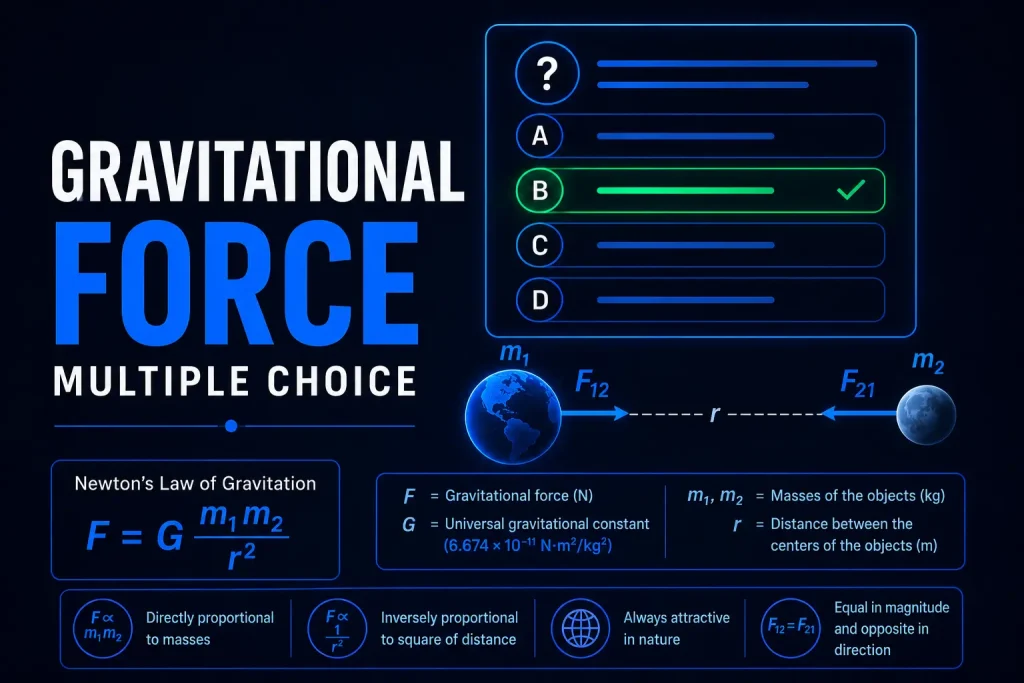
Gravitational Force(MCQs)
A) GalileoB) EinsteinC) NewtonD) Kepler A) RepulsiveB) AttractiveC) ZeroD) Random A) JouleB) WattC) NewtonD) Pascal F=G m1m2/r2 What does (r) represent? A) Radius of EarthB) Distance between centers of massesC) Radius of orbit onlyD) Velocity A) gB) GC) FD) M A) 1.6 m/s²B) 3.7 m/s²C) 9.8 m/s²D) 24.8 m/s² A) kilogramsB) metersC) newtonsD) joules A)…
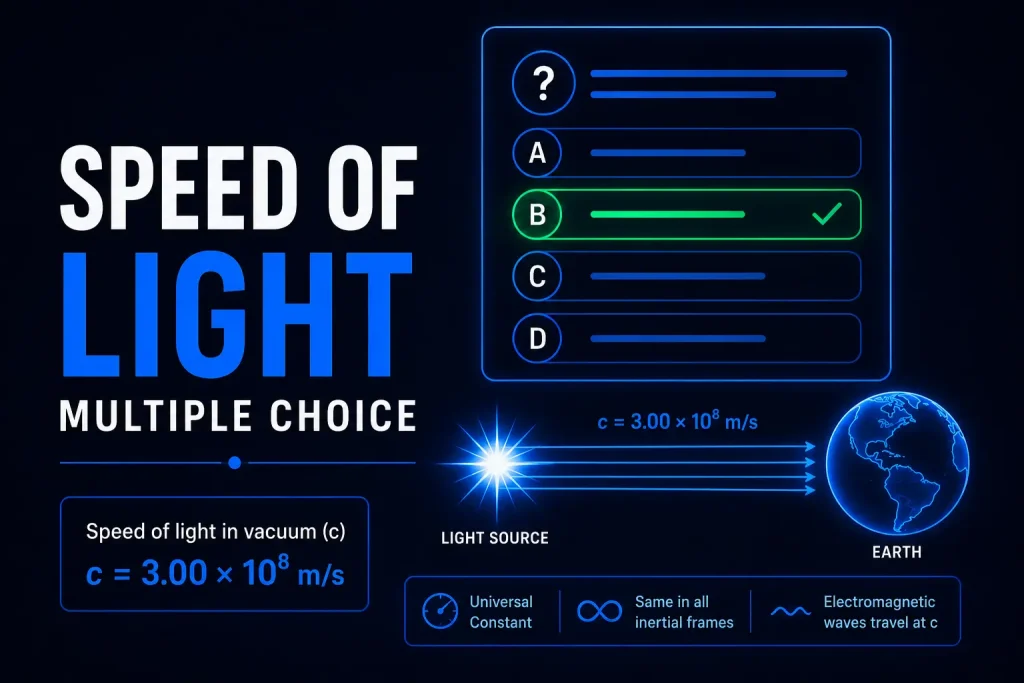
Speed of Light(MCQs)
c = 299,792,458\ \text{m/s}A) 3 × 10⁶ m/s A) 3 × 10⁶ m/sB) 3 × 10⁷ m/sC) 3 × 10⁸ m/sD) 3 × 10⁹ m/s A) vB) λC) cD) f A) 300 km/sB) 3,000 km/sC) 30,000 km/sD) 300,000 km/s A) Isaac NewtonB) James Clerk MaxwellC) Albert EinsteinD) Galileo Galilei c = f\lambdaA) F = ma…
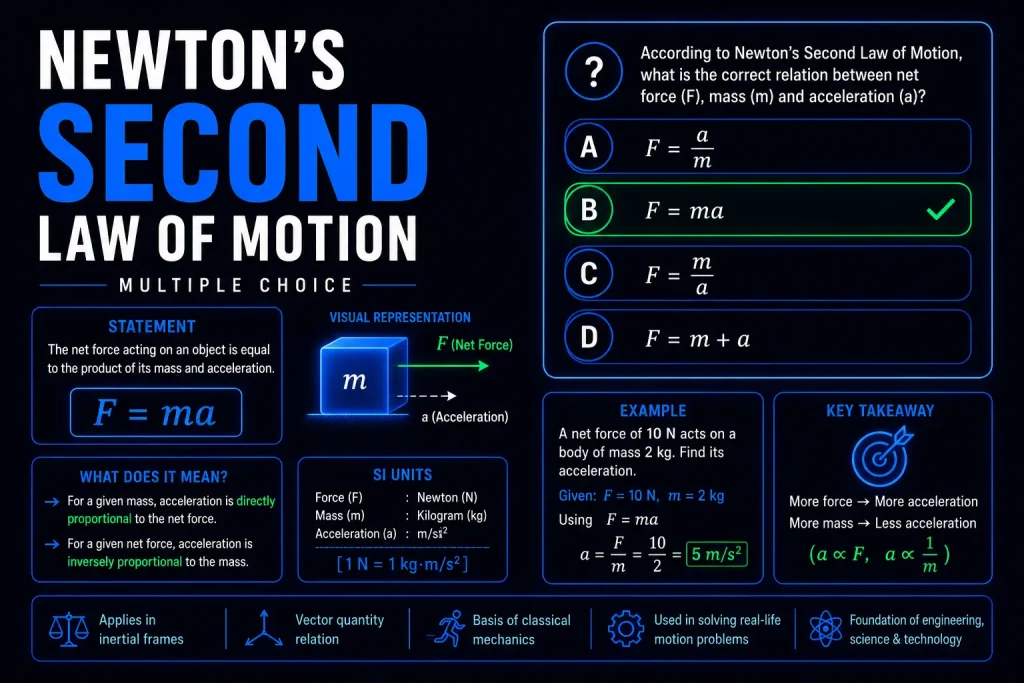
Newton’s Second Law(MCQs)
A) F = mvB) F = maC) F = m/aD) F = a/m A) FrictionB) ForceC) FlowD) Field A) JouleB) WattC) NewtonD) Pascal A) NewtonB) KilogramC) GramD) Meter A) m/sB) m/s²C) kg/m²D) N/kg A) DecreasesB) Remains constantC) IncreasesD) Becomes zero A) IncreasesB) DecreasesC) Remains sameD) Becomes infinite A) F = m/vB) F = dp/dtC) F…
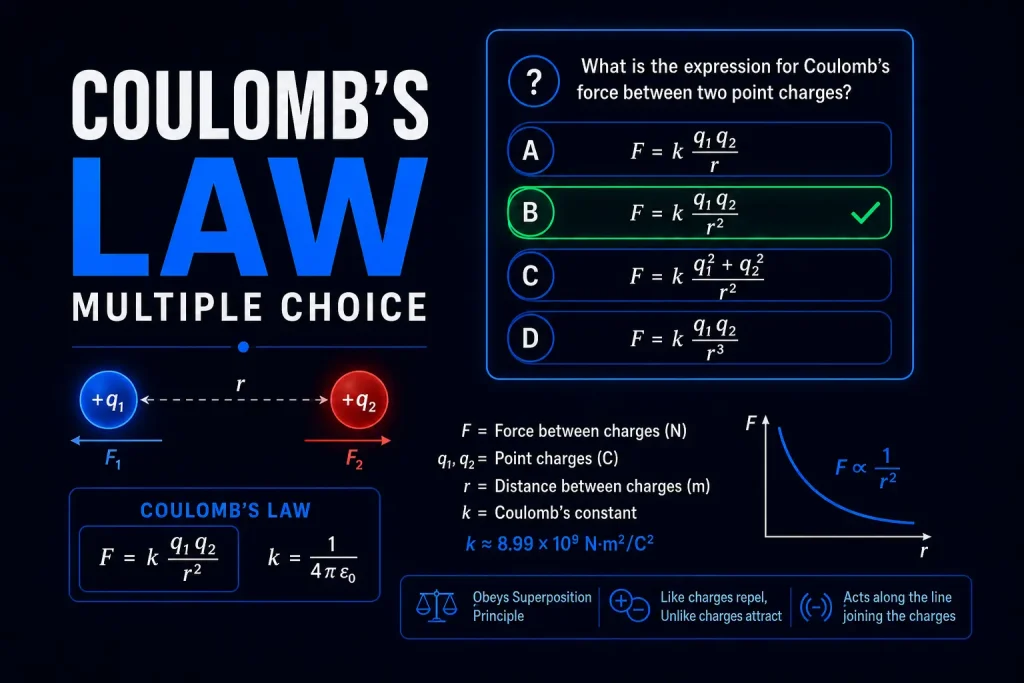
Coulomb’s Law(MCQs)
A. NewtonB. JouleC. CoulombD. Volt A. FB. qC. ED. V A. OneB. TwoC. ThreeD. Four A. North and southB. Hot and coldC. Positive and negativeD. Heavy and light A. Attract each otherB. Repel each otherC. Cancel each other completelyD. Have no effect on each other A. Repel each otherB. Attract each otherC. Always remain neutralD….
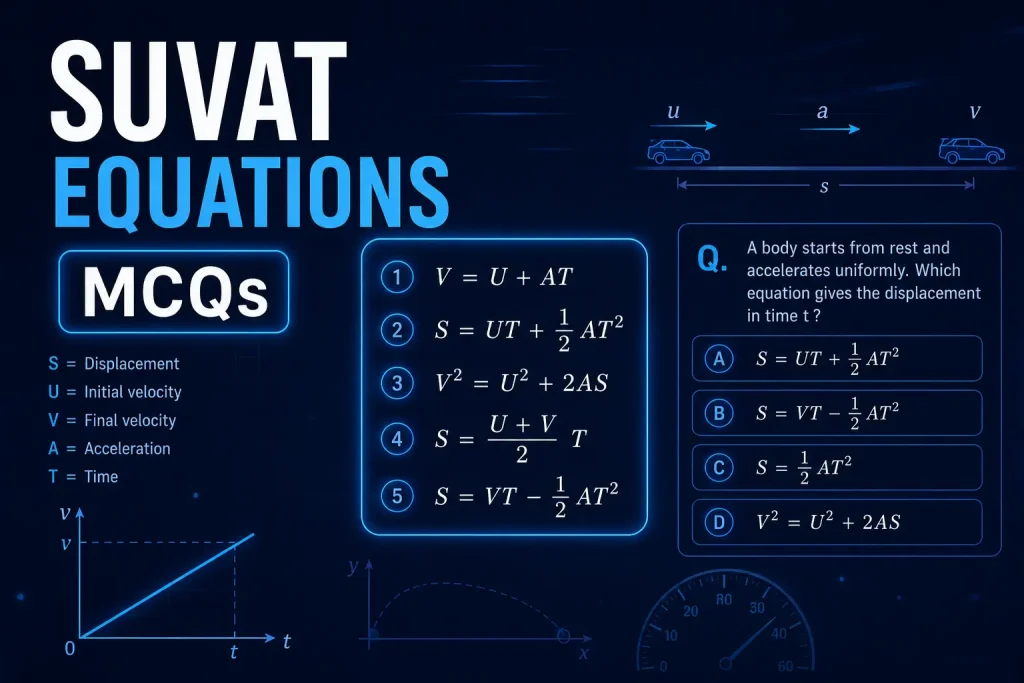
SUVAT Equations MCQs
1. In SUVAT equations, what does s represent? A. SpeedB. DisplacementC. AccelerationD. Time 2. Which SUVAT equation is the definition of constant acceleration? A. (s = ut + 1/2at²)B. (v² = u² + 2as)C. (v = u + at)D. (s = 1/2(u + v)t) 3. If (u = 10 , m/s), (a = 2 ,…
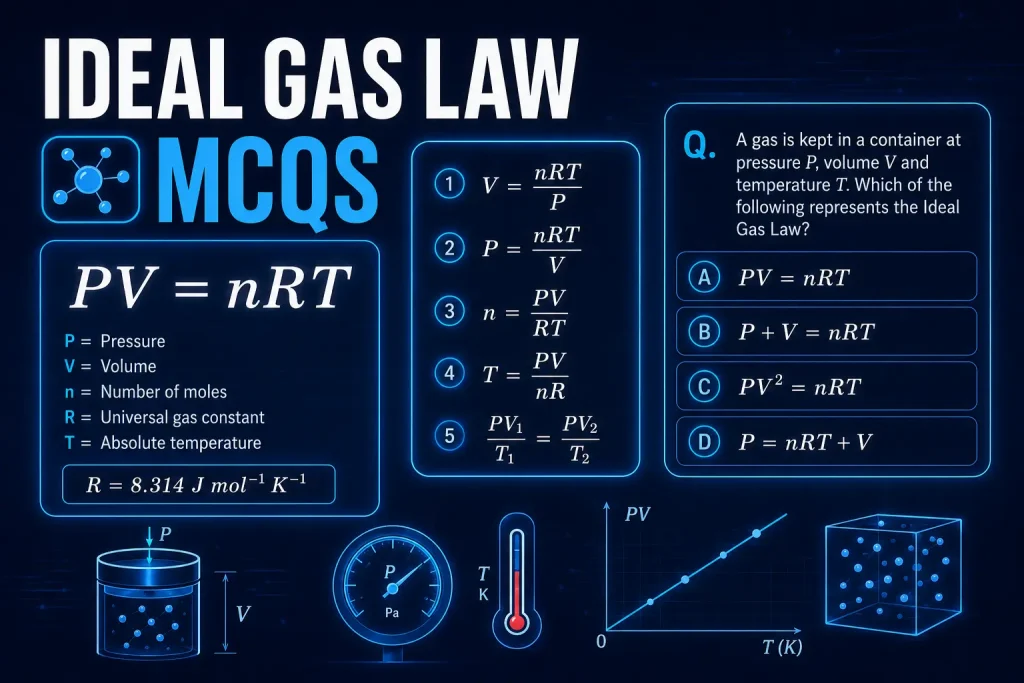
Ideal Gas Law MCQs
1. What is the mathematical form of the Ideal Gas Law?A. P = nRTVB. PV = nRTC. PT = nRVD. V = PnRT 2. In the equation PV = nRT, what does P represent?A. PowerB. PressureC. Particle sizeD. Potential energy 3. In PV = nRT, what does V stand for?A. VelocityB. VolumeC. Vapor pressureD. Viscosity…