

A transverse wave is a wave in which the particles of the medium vibrate perpendicular (at right angles) to the direction the wave travels. When a drop hits still water and ripples spread outward while particles move up and down, it demonstrates a simple transverse wave pattern. Common examples include light waves, water ripples, waves on a rope, and seismic S-waves. Transverse waves are one of the most important concepts in physics fundamentals because they explain how energy travels through strings, solids, water surfaces, and even empty space through electromagnetic radiation.
Transverse waves are one of the most important concepts in physics fundamentals because they explain how energy travels through strings, solids, water surfaces, and even empty space through electromagnetic radiation.
What Is a Transverse Wave?
A transverse wave is a type of wave in which the oscillation of the medium occurs perpendicular to the direction of wave propagation. In simple terms, the particles of the medium move at right angles to the direction the wave itself travels. This perpendicular motion is the defining characteristic of all transverse waves and is what distinguishes them from longitudinal waves.
For example, imagine shaking one end of a rope up and down. The disturbance created on the rope travels horizontally along its length, but each individual particle of the rope moves vertically. The movement of the particles is therefore perpendicular to the direction in which the wave transfers energy. Even though the wave moves forward, the particles themselves only oscillate around their equilibrium positions rather than traveling with the wave.
Simple Definition
A transverse wave is a wave where particles vibrate at right angles to the direction the energy travels. The energy moves forward through the medium, while the particles move up and down or side to side relative to the direction of propagation.
This type of wave motion is commonly observed in everyday life and in many important areas of physics. Some of the most common examples of transverse waves include:
In all of these examples, the oscillation occurs perpendicular to the wave’s direction of travel. This is the commonality in all transverse waves.
A transverse wave typically contains recognizable features such as crests and troughs. The crest is the highest point of the wave above the equilibrium position, while the trough is the lowest point below equilibrium. The distance between two consecutive crests or troughs is called the wavelength, and the maximum displacement from equilibrium is known as amplitude. These properties help scientists and students describe wave behavior mathematically and physically.
One of the most important aspects of transverse waves is that they transfer energy without permanently transporting matter. When a transverse wave travels through a medium, the particles only oscillate around fixed positions. They do not move along with the wave. For instance, when ocean waves move toward the shore, the water itself does not travel all the way to the beach. Instead, the wave carries energy through the water while the water particles move in small oscillatory motions.
Transverse Wave Diagram
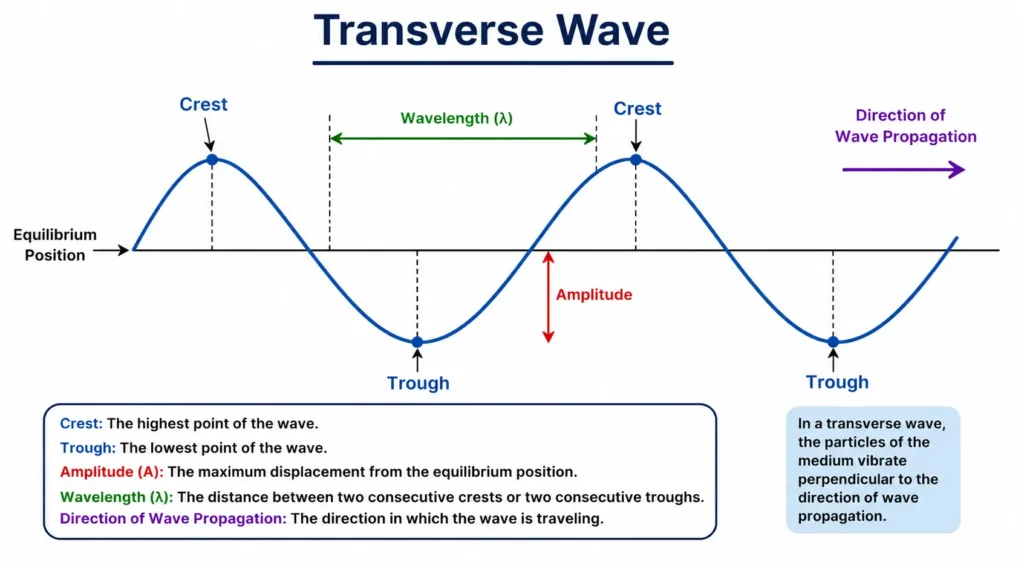
A labeled transverse wave contains several important parts:
Main Parts of a Transverse Wave
|
Part |
Meaning |
|---|---|
|
Crest |
Highest point of the wave |
|
Trough |
Lowest point of the wave |
|
Amplitude |
Maximum displacement from equilibrium |
|
Wavelength (λ) |
Distance between two identical points |
|
Equilibrium Line |
Rest position of the medium |
|
Propagation Direction |
Direction the wave travels |
Properties of Transverse Waves
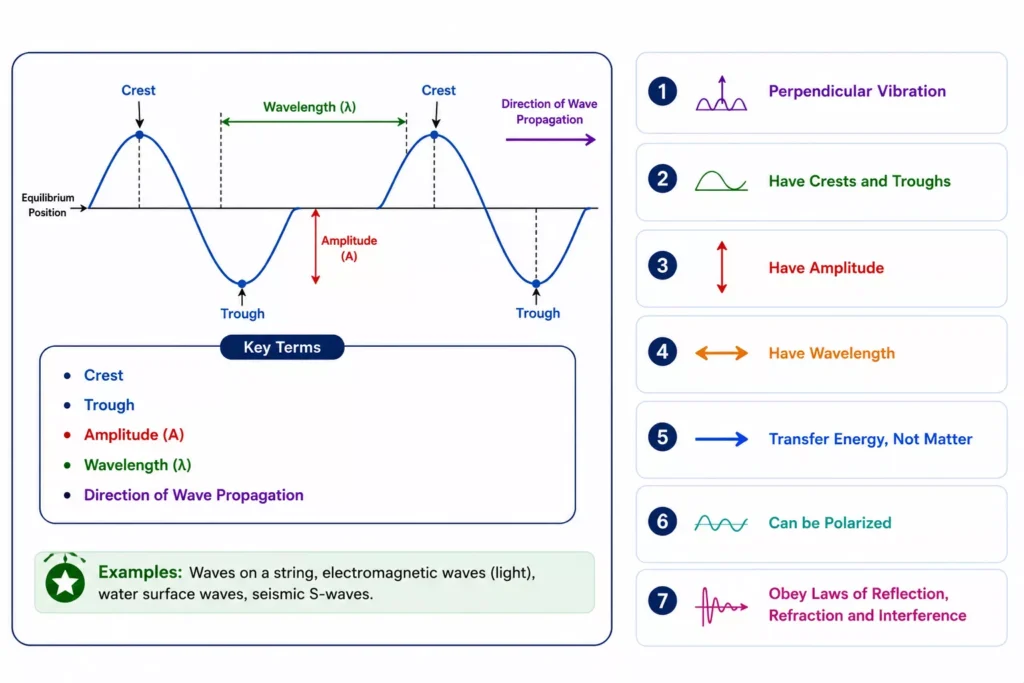
Every transverse wave can be described using a few important physical quantities. These properties help scientists measure wave behavior, compare different types of waves, and solve problems involving wave motion, energy transfer, and oscillation. Understanding these quantities is essential in physics because they determine how waves behave in different media and conditions.
1. Amplitude
Amplitude is the maximum displacement of a particle from its equilibrium position. In a transverse wave, particles move above and below their normal resting position, and the amplitude measures the greatest distance reached during this oscillation.
Amplitude is directly related to the energy carried by the wave. A wave with a larger amplitude carries more energy because the particles oscillate with greater motion. In physical systems, larger amplitudes often produce stronger effects and more noticeable vibrations.
Larger amplitude means:
For example, in water waves, larger amplitudes create taller waves. In light waves, greater amplitude corresponds to brighter light. In vibrating strings, larger amplitude produces stronger vibrations and louder sounds.
The relationship between energy and amplitude is not linear. Instead, wave energy is proportional to the square of amplitude.
E ∝ A2
This means doubling the amplitude increases the energy four times. Similarly, tripling the amplitude increases the energy by a factor of nine. Because of this squared relationship, even small increases in amplitude can greatly increase the energy transported by the wave.
2. Wavelength
Wavelength is the distance between two identical points on consecutive waves. It represents the length of one complete wave cycle and is one of the most important characteristics used to describe wave motion.
Examples include:
In transverse waves, wavelength is measured horizontally along the direction of wave travel. If two crests appear next to each other, the distance between them equals one wavelength. The same applies to two consecutive troughs or any identical repeating points on the wave.
Wavelength plays a major role in determining the nature of different waves. Long wavelengths are generally associated with low-frequency waves, while short wavelengths are linked to high-frequency waves. For example, radio waves have extremely long wavelengths, whereas gamma rays have extremely short wavelengths.
Longer wavelengths usually correspond to lower frequencies because fewer wave cycles pass a fixed point each second. Conversely, shorter wavelengths correspond to higher frequencies because more cycles pass in the same amount of time.
3. Frequency
Frequency is the number of complete oscillations passing a point every second. It tells us how fast the particles of the medium vibrate as the wave propagates.
Hertz: One hertz means one complete cycle per second. If a wave has a frequency of 50 Hz, it means 50 complete oscillations occur every second.
Different types of electromagnetic waves have vastly different frequencies.
Examples:
Low-frequency waves usually have longer wavelengths, while high-frequency waves have shorter wavelengths. Frequency is also closely related to the energy of electromagnetic radiation. Higher-frequency waves generally carry more energy.
Pitch of Sound: In sound and vibration systems, frequency determines pitch. High-frequency vibrations produce higher-pitched sounds, while low-frequency vibrations produce lower-pitched sounds.
4. Period
The period is the time required for one complete wave cycle. It represents the duration of a single oscillation and is the opposite of frequency.
A wave with a short period oscillates rapidly, while a wave with a long period oscillates more slowly.
Frequency and period are inversely related.
T ∝1/f
This relationship means that increasing frequency decreases the period, and decreasing frequency increases the period. For example, a wave with a frequency of 100 Hz has a period of 0.01 seconds.
The concept of period is especially useful in studying repetitive motion and oscillatory systems because it measures the time taken for one complete vibration.
5. Wave Speed
Wave speed is the speed at which the wave transfers energy through a medium. It describes how fast the disturbance travels from one point to another.
The universal wave equation is:
v=f λ
Where:
This equation shows that wave speed depends on both frequency and wavelength. If either quantity changes, the speed of the wave changes accordingly, depending on the medium.
This equation applies to:
Wave speed varies depending on the properties of the medium. For example, sound travels faster in solids than in gases, while light travels fastest in vacuum. Despite these differences, the wave equation remains universally valid for all wave types.
Types of Transverse Waves
Transverse waves can be either mechanical or electromagnetic.
Mechanical transverse Waves
Mechanical transverse waves require a medium through which they can travel. Examples include waves on ropes, vibrating strings, and seismic S-waves traveling through Earth’s crust.
Electromagnetic transverse waves
Electromagnetic transverse waves, on the other hand, do not require a material medium. Light from the Sun can travel through the vacuum of space because electromagnetic waves are self-propagating oscillations of electric and magnetic fields.
Key Characteristics of Transverse Waves
Transverse waves have several unique features that make them fundamentally different from other types of waves and extremely important in both physics and real-world applications.
One of their most defining properties is that the oscillation of the particles or fields occurs perpendicular to the direction in which the wave travels. This means that while the wave moves forward, the medium or field vibrates side to side or up and down, creating a distinct wave pattern that can be easily identified in graphical form.
Another important characteristic is that transverse waves transfer energy without transporting matter. This means that although the wave carries energy from one point to another, the particles of the medium themselves do not move along with the wave; they simply oscillate around their equilibrium positions. This property is essential for understanding how energy can travel across long distances, such as light from the Sun reaching Earth.
Transverse waves also have visible structural features known as crests and troughs. A crest represents the highest point of the wave, while a trough represents the lowest point. These repeating peaks and valleys help describe the wave’s amplitude and intensity, which are important in measuring wave energy.
A key property of transverse waves is that they can be polarized. Polarization refers to the restriction of the wave’s vibration direction to a single plane. This property is especially significant in optics, sunglasses, photography, and communication technologies where controlling light direction improves clarity and signal quality.
Electromagnetic waves, including light, radio waves, and X-rays, are all transverse in nature. These waves do not require a physical medium to travel, which makes them incredibly versatile. In fact, some transverse waves, especially electromagnetic ones, can travel through a vacuum, such as the vacuum of space, allowing sunlight and radio signals to reach Earth from distant sources.
These characteristics collectively help distinguish transverse waves from longitudinal waves, where oscillations occur parallel to the direction of wave motion. Understanding these differences is essential for studying wave behavior in physics, engineering, and modern technology. To summarize:
These characteristics help distinguish them from longitudinal waves.
Examples of Transverse Waves
Transverse waves appear throughout nature and modern technology.
1. Light Waves
Visible light is a transverse electromagnetic wave.
In light waves:
This perpendicular arrangement is what makes light transverse.
Light waves include:
All electromagnetic radiation is transverse.
2. Waves on a Rope
When one end of a rope is shaken up and down, a disturbance travels horizontally along the rope.
The rope particles move vertically while the wave moves horizontally.
This is one of the clearest examples of transverse motion.
3. Water Ripples
When a stone is dropped into water, ripples spread outward across the surface.
The disturbance moves horizontally while water particles oscillate mainly up and down.
This creates a surface transverse wave.
4. Seismic S-Waves
Earthquakes produce two main seismic waves:
S-waves move rock particles perpendicular to the wave direction.
These waves cannot travel through liquids because liquids cannot support shear stress.
This discovery helped scientists determine that Earth’s outer core is liquid.
5. Guitar String Vibrations
Plucking a guitar string creates a transverse standing wave.
The string oscillates perpendicular to its length while energy travels along the string.
Changing:
changes the wave frequency and pitch.
Transverse Waves on a String
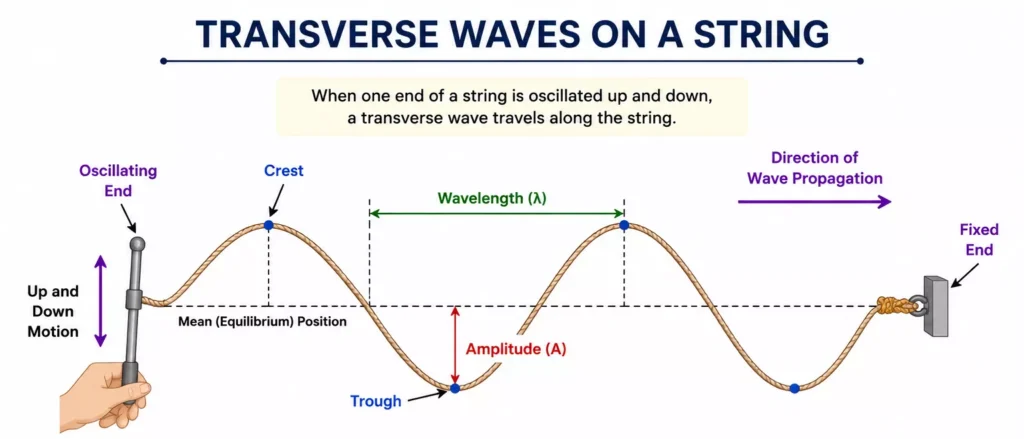
The speed of a transverse wave on a stretched string depends on:
The equation is:
v= √(T/μ)
Where:
Higher tension produces faster waves.
This is why tightening a guitar string raises its pitch.
Electromagnetic Waves: The Most Important Transverse Waves
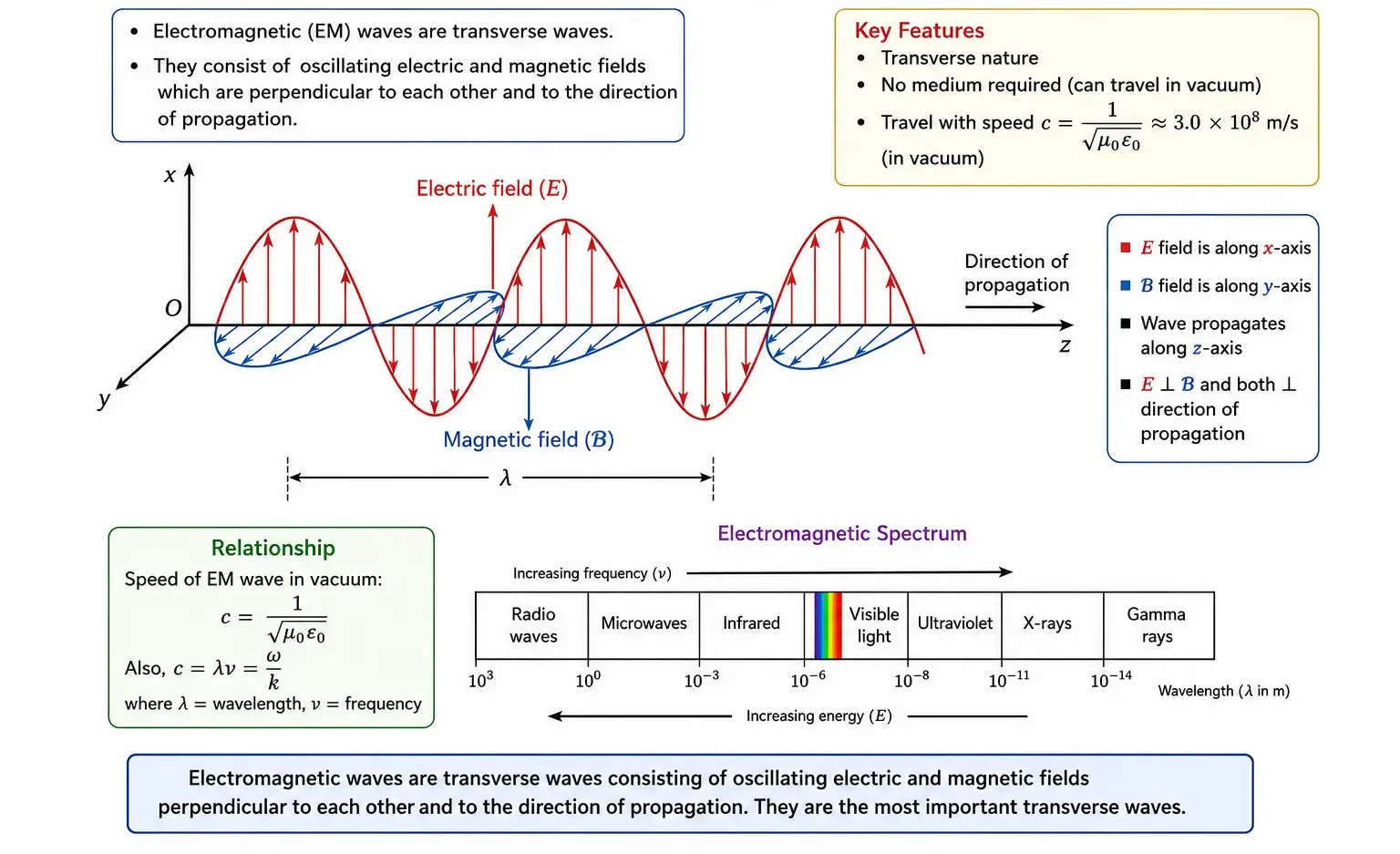
Electromagnetic waves are among the most important types of transverse waves in physics because they are capable of transferring energy through empty space without requiring a material medium. Unlike mechanical waves, which need substances such as air, water, or solids to propagate, electromagnetic waves can travel freely through vacuum. This unique property allows sunlight to travel millions of kilometers through space before reaching Earth.
Electromagnetic waves can travel through:
These waves are produced by oscillating electric and magnetic fields. As the electric field changes, it generates a magnetic field, and the changing magnetic field generates another electric field. This continuous interaction allows electromagnetic waves to sustain themselves and move forward through space. Because the electric and magnetic fields oscillate perpendicular to the direction of propagation, electromagnetic radiation is classified as a transverse wave.
Sunlight reaches Earth through empty space because electromagnetic waves are self-propagating oscillations of electric and magnetic fields. Even though space contains almost no matter, light from the Sun can still travel across the vacuum because electromagnetic waves do not depend on particles of a medium for transmission.
All electromagnetic waves travel in vacuum at approximately:
C =3×10⁸m/s
This speed is known as the speed of light in vacuum and is represented by the symbol (c). It is one of the most important constants in physics. At this speed, light can travel around Earth more than seven times in a single second. The enormous value of the speed of light explains how electromagnetic signals can travel vast distances across space in relatively short periods of time.
Electromagnetic spectrum
Electromagnetic waves form a continuous spectrum known as the electromagnetic spectrum. Although all electromagnetic waves travel at the same speed in vacuum, they differ in wavelength and frequency. Waves with long wavelengths have lower frequencies, while waves with short wavelengths have higher frequencies.
Electromagnetic waves form a continuous spectrum known as the electromagnetic spectrum. Although all electromagnetic waves travel at the same speed in vacuum, they differ in wavelength and frequency. Waves with long wavelengths have lower frequencies, while waves with short wavelengths have higher frequencies.
The electromagnetic spectrum includes:
Radio waves have the longest wavelengths and lowest frequencies in the spectrum. They are widely used in communication systems such as television broadcasting, radio transmission, satellite communication, and wireless networks. Gamma rays, on the other hand, have the shortest wavelengths and highest frequencies. Because of their extremely high energy, gamma rays are used in medical treatments and scientific research.
Visible light is only a very small portion of the electromagnetic spectrum, yet it is the part detectable by the human eye. Different colors of visible light correspond to different wavelengths and frequencies. Red light has a longer wavelength and lower frequency, while violet light has a shorter wavelength and higher frequency.
Electromagnetic waves also exhibit several important wave properties such as reflection, refraction, diffraction, interference, and polarization. Polarization is especially significant because it confirms the transverse nature of electromagnetic radiation. Since the oscillations occur perpendicular to the direction of travel, electromagnetic waves can be restricted to a single plane using polarizing filters.
The applications of electromagnetic waves are essential to modern technology and daily life. Radio waves are used for communication, microwaves are used in cooking and radar systems, infrared radiation is used in thermal imaging, visible light enables vision, ultraviolet radiation is used for sterilization, X-rays are used in medical imaging, and gamma rays are used in cancer treatment.
Electromagnetic waves are also fundamental in astronomy and space science. Telescopes detect different regions of the electromagnetic spectrum to study stars, galaxies, planets, and black holes. By analyzing electromagnetic radiation from distant objects, scientists can determine temperature, composition, motion, and distance in the universe.
The study of electromagnetic waves transformed modern physics and led to major scientific developments, including Maxwell’s equations, Einstein’s theory of relativity, wireless communication, and quantum mechanics. Their ability to transfer energy through vacuum makes them one of the most remarkable and important examples of transverse wave motion in nature.
Polarization: Evidence That Light Is Transverse
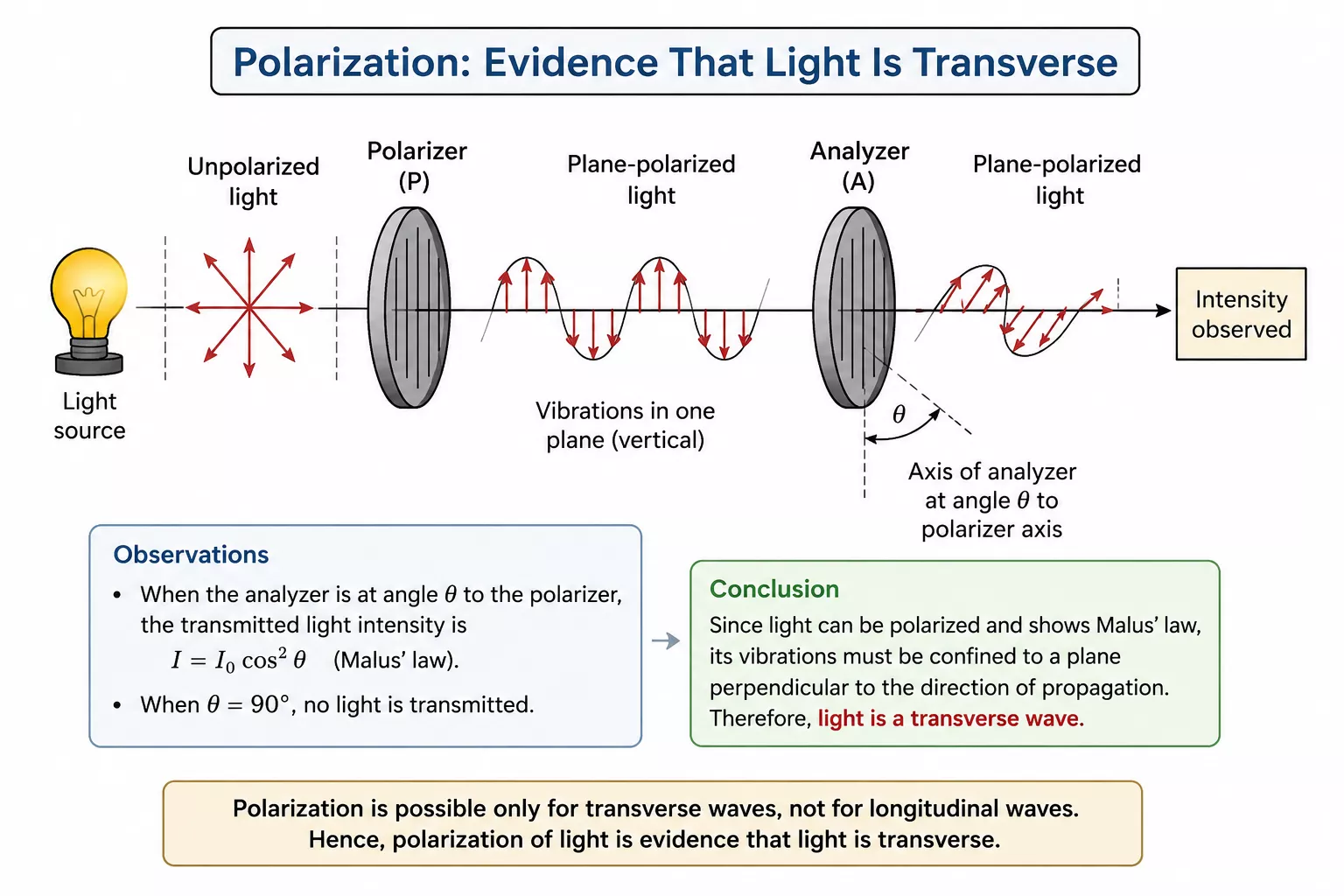
Polarization is one of the strongest proofs that light is a transverse wave. It is a phenomenon that can only occur in waves whose oscillations are perpendicular to the direction of propagation. Since light shows polarization effects, this demonstrates that light behaves as a transverse electromagnetic wave rather than a longitudinal wave.
A polarizing filter allows vibrations in only one direction to pass through. When unpolarized light passes through such a filter, only the component oscillating in the permitted direction is transmitted, while the remaining vibrations are blocked. As a result, the intensity of the light decreases, and the emerging light becomes polarized.
This process works only for transverse waves because transverse oscillations occur in many possible directions perpendicular to the wave’s motion. A polarizer can therefore select one specific plane of vibration and eliminate the others. This ability to restrict vibrations to a single direction is the defining feature of polarization.
Longitudinal waves cannot be polarized because their oscillations occur parallel to the direction of propagation. In longitudinal motion, particles vibrate back and forth along the same axis the wave travels, leaving no perpendicular direction that can be filtered or restricted. Because of this, sound waves in air cannot be polarized.
The existence of polarization provides direct experimental evidence that light is transverse in nature.
Real-Life Applications of Polarization
Polarization is used in:
How Energy Travels in a Transverse Wave
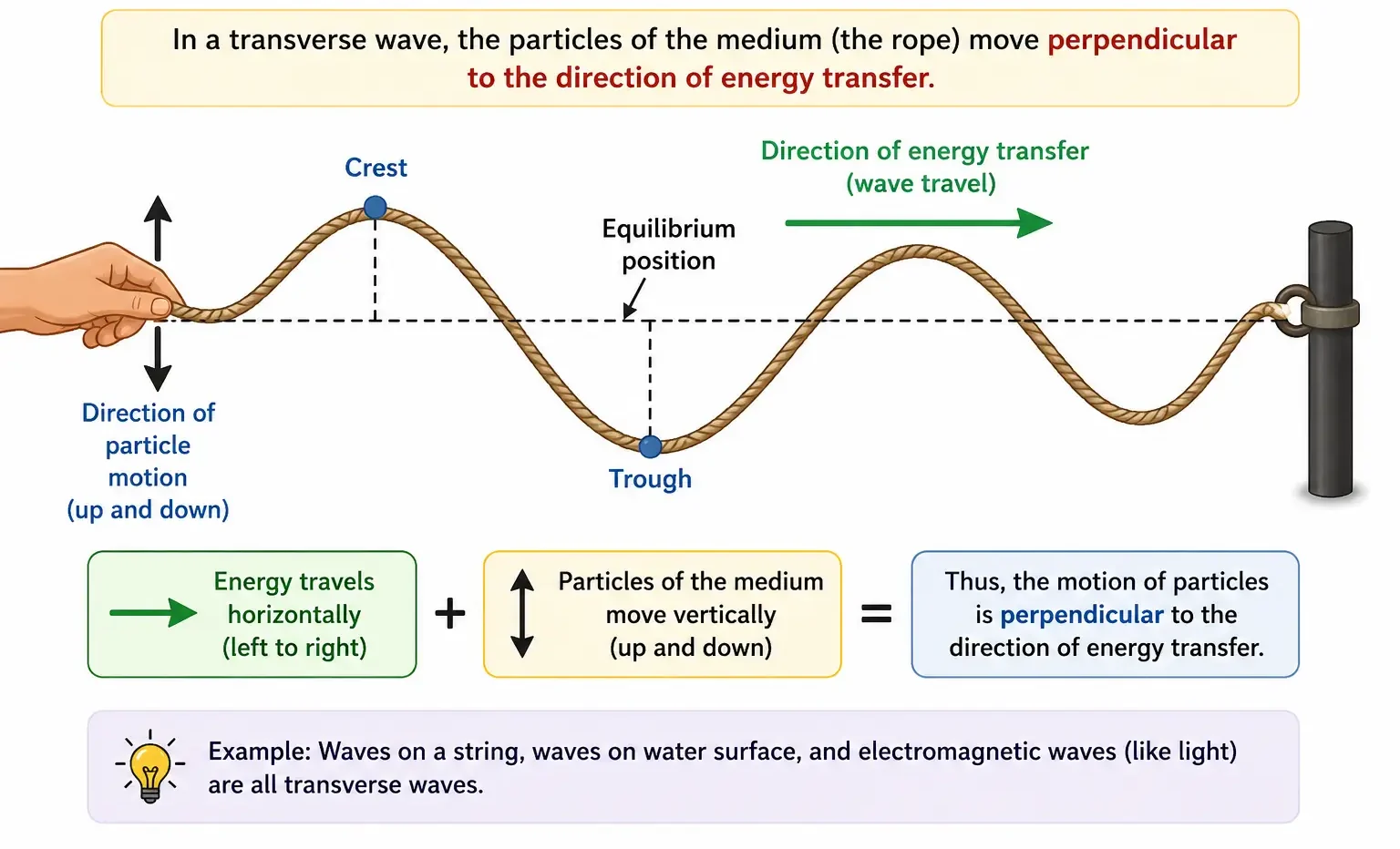
A common misconception is that matter travels with the wave.
It does not.
Only energy propagates through the medium.
For example:
The disturbance moves, not the material itself.
Wave Interference and Superposition
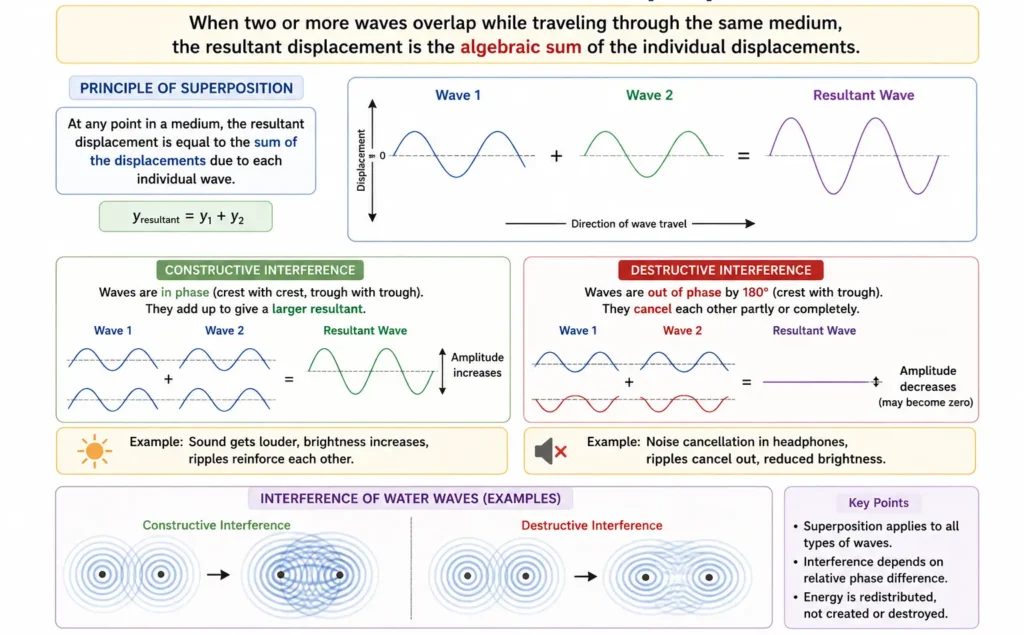
When two transverse waves meet, they combine according to the principle of superposition. This principle states that the resultant displacement at any point is equal to the algebraic sum of the displacements produced by each individual wave. In other words, when waves overlap in the same medium, their effects temporarily add together. After the interaction, the waves continue traveling in their original directions without being permanently altered.
Wave interference is one of the most important behaviors of wave motion because it explains many natural phenomena and technological applications. The way waves interact depends on the relative positions of their crests and troughs during overlap.
Constructive Interference
If two crests meet:
This type of interference is called constructive interference because the waves reinforce one another. The combined wave has a greater amplitude than either individual wave. Constructive interference also occurs when two troughs overlap, since both displacements are in the same direction.
For example, if two waves each have an amplitude of 2 cm and their crests meet perfectly, the resulting amplitude becomes 4 cm. Since wave energy depends on amplitude, constructive interference produces regions of greater energy and intensity.
Constructive interference can be observed in many situations involving sound, light, and water waves. In musical instruments, constructive interference helps produce louder and stronger sounds through resonance. When waves repeatedly reinforce one another at specific frequencies, standing waves form and create clear musical notes.
Destructive Interference
If a crest meets a trough:
This process is known as destructive interference because the waves oppose each other. If the crest and trough have equal amplitudes, they can completely cancel out, producing zero displacement at that point. This temporary cancellation does not destroy the waves themselves; it only affects the resultant displacement during overlap.
Destructive interference is especially important in controlling unwanted vibrations and noise. Noise-cancelling headphones operate using this principle. They generate sound waves that are exactly opposite in phase to surrounding noise. When the two waves combine, destructive interference reduces or cancels the unwanted sound, creating a quieter listening environment.
Wave interference also explains the famous double-slit experiment in physics. When light passes through two narrow slits, the overlapping light waves create alternating bright and dark fringes on a screen. Bright regions are formed by constructive interference, while dark regions result from destructive interference. This experiment provided strong evidence that light behaves as a wave.
Another common example of interference appears in soap bubbles and thin oil films. The colorful patterns seen on their surfaces are produced by interference between light waves reflected from different layers of the thin film. Some wavelengths interfere constructively and become brighter, while others interfere destructively and disappear. This selective interference creates the shifting rainbow-like colors commonly observed.
Interference is also essential in resonance within musical instruments. Vibrations inside strings, air columns, and membranes combine to strengthen certain frequencies. This reinforcement produces rich and sustained sounds that define the tone and quality of musical instruments.
The principle of superposition and interference is fundamental throughout physics because it explains how waves behave when they overlap. From sound engineering and optics to quantum mechanics and modern communication systems, interference remains one of the most important concepts in the study of transverse waves.
In short, interference explains:
Standing Waves
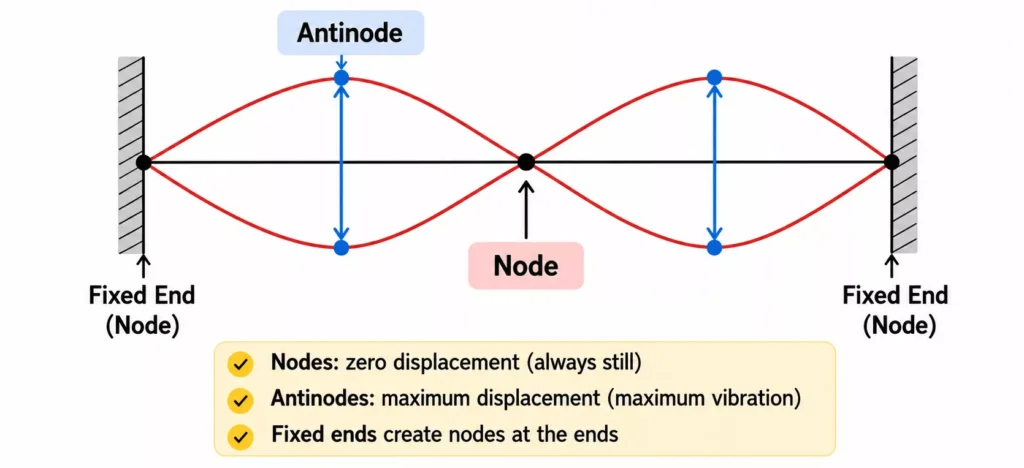
Standing waves form when two identical transverse waves travel in opposite directions through the same medium. These waves must have the same frequency, wavelength, and amplitude. When they overlap, the principle of superposition causes them to combine and produce a stationary wave pattern that appears to remain fixed in place rather than traveling forward.
This creates:
Nodes are points along the standing wave where no vibration occurs. At these points, destructive interference continuously takes place, so the displacement always remains zero.
Antinodes are the opposite; they are points where constructive interference produces the greatest possible vibration and maximum amplitude.
In a standing wave, energy is not transferred from one end of the medium to the other as it is in a traveling wave. Instead, the energy remains confined within the standing wave pattern. The distance between two consecutive nodes or two consecutive antinodes is equal to half a wavelength.
Standing waves are extremely important in music and acoustics because they determine the frequencies produced by vibrating systems. Musical instruments rely on standing wave formation to create stable notes and harmonics.
Standing waves are essential in:
In string instruments such as guitars and violins, the strings are fixed at both ends, forcing nodes to form at the ends of the string. The standing wave patterns produced determine the pitch of the sound. Shorter strings or tighter strings create higher frequencies, while longer or looser strings create lower frequencies.
In organ pipes and wind instruments, standing waves form in vibrating air columns. Different standing wave patterns produce different musical notes. Resonance occurs when the frequency of vibration matches a natural frequency of the system, causing large-amplitude standing waves to form efficiently.
Standing waves are also important in physics, engineering, and electronics because they appear in resonance systems, radio transmission lines, microwave cavities, and many other oscillating systems where wave reflection occurs.
Transverse vs Longitudinal Waves
Understanding the difference between these two wave types is fundamental in physics.
|
Property |
Transverse Waves |
Longitudinal Waves |
|---|---|---|
|
Oscillation Direction |
Perpendicular |
Parallel |
|
Wave Shape |
Crests and troughs |
Compressions and rarefactions |
|
Polarization |
Possible |
Not possible |
|
Can Travel in Vacuum? |
Electromagnetic waves: yes |
No |
|
Examples |
Light, S-waves, rope waves |
Sound, P-waves |
Why Transverse Waves Matter
Transverse waves are central to modern science and technology. They are a fundamental type of wave in which the vibration of particles (or fields) is perpendicular to the direction in which the wave travels. This simple geometric relationship leads to extremely powerful and useful behaviors, especially when we consider electromagnetic waves, which are transverse in nature. Because of this property, transverse waves are not just a theoretical concept in physics—they are the backbone of almost every modern communication and imaging system.
Transverse waves are used in telecommunications in a very direct way. Every time you make a phone call, send a message, or stream a video, you are relying on electromagnetic waves that carry information through space. These waves travel at the speed of light and can encode vast amounts of data through modulation techniques. Without their transverse nature, efficient wireless communication systems would not function the way they do today.
In fiber optics, transverse waves play an even more specialized role. Light traveling through optical fibers is guided and reflected internally, allowing information to move across continents with minimal loss. This is the foundation of the global internet infrastructure. The reason fiber optics work so effectively is due to the behavior of light as a transverse electromagnetic wave, which allows it to maintain coherence and carry signals over long distances with very high bandwidth.
Medical imaging also relies heavily on transverse wave behavior. Technologies such as X-rays and certain forms of electromagnetic scanning depend on wave interaction with matter to create detailed images of the human body. These imaging systems allow doctors to diagnose diseases, detect fractures, and examine internal organs without invasive procedures, significantly improving healthcare outcomes.
In astronomy, transverse waves in the form of light and other electromagnetic radiation allow scientists to observe distant stars, galaxies, and cosmic phenomena. Since space is largely empty, light is often the only information carrier available from distant objects. By analyzing these waves, astronomers can determine the composition, temperature, motion, and even the age of celestial bodies.
Earthquake analysis also benefits from wave science, where transverse seismic waves (S-waves) help geologists understand the internal structure of the Earth. These waves move through the Earth’s interior and provide critical data about layers such as the crust, mantle, and core. Studying how these waves travel and reflect gives insight into natural disasters and helps improve prediction models.
In wireless communication systems such as Wi-Fi, Bluetooth, and satellite communication, transverse electromagnetic waves are essential. They allow devices to connect without physical cables, enabling global connectivity and real-time data exchange. Satellites in orbit rely entirely on these waves to transmit signals back and forth with Earth-based stations.
In quantum physics, the study of electromagnetic waves becomes even more fundamental. Light behaves both as a wave and a particle, and its transverse wave properties are essential in understanding phenomena such as polarization, interference, and quantum field interactions.
Without transverse electromagnetic waves, modern civilization would be drastically different. Radio technology would not exist, meaning no broadcasting or wireless audio communication. Internet signals could not travel through space or fiber systems, effectively collapsing global digital communication. Satellites would be unable to communicate with Earth, breaking navigation systems, weather forecasting, and global positioning systems. Modern optics, including cameras, microscopes, and telescopes, would also be impossible without the behavior of light as a transverse wave.
To sum up, Transverse Waves are used in:
Without transverse electromagnetic waves:
GCSE and A-Level Notes
In GCSE and A-level physics, students should be able to:
These topics frequently appear in exams.
Worked Examples
Example 1: Wave Speed
A wave has:
Find the wave speed.
Using:
v=f λ
Substitute values:
200 × 0.5 = 100 m/s
Answer: v =100 m/s
Example 2: Frequency from Period
A wave has a period of 0.004 s.
Find the frequency.
Using:
f= 1/T
Substitute:
1 ÷ 0.004 = 250 Hz
Answer: 250 Hz
