
The speed of light is the speed at which light waves travel through various materials. In a vacuum, the speed of light is defined as exactly 299,792,458 meters per second. The speed of light is one of the most fundamental constants in physics and represents the fastest speed at which energy, matter, and information can travel through the universe. From astronomy and relativity to telecommunications and quantum physics, it plays a central role in understanding how the universe works.
The speed of light in a vacuum is exactly:
c = 3.0 x 10⁸ m/s
or approximately:
This constant is represented by the symbol “c” and is considered the universal speed limit according to modern physics.
Key Takeaways
What Is the Speed of Light?
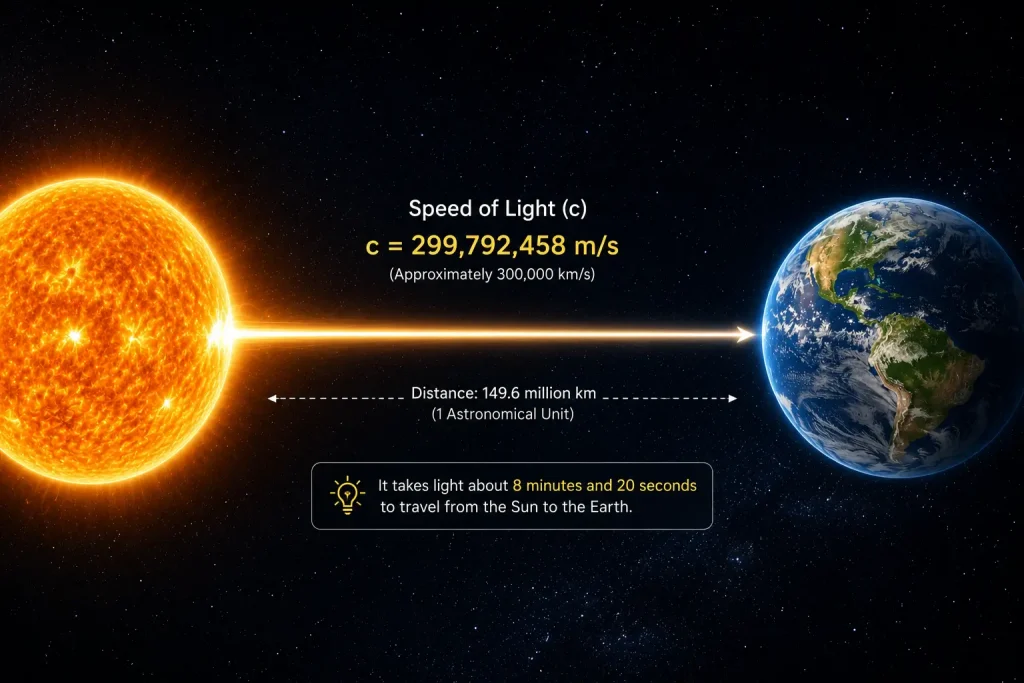
The light speed is the rate at which light waves travel through a vacuum. It is the maximum possible speed in the universe, meaning no object or signal can travel faster than light.
Light belongs to the electromagnetic spectrum and behaves both as a wave and as a particle. In empty space, all electromagnetic waves travel at the same speed regardless of their wavelength or frequency.
According to NASA Science, visible light is only a small part of the electromagnetic spectrum, which also includes radio waves, microwaves, X-rays, and gamma rays.
The speed at which light travels is denoted by the symbol:
which comes from the Latin word “celeritas,” meaning swiftness.
Value of the speed at which light travels
The exact value of the its in a vacuum is:
c = 299,792,458 m/s
For simplicity, it is often rounded to:
c 3.0 x 10⁸ m/s
This means light can travel:
The speed of light is so important that scientists use it to define the meter itself.
According to Britannica – Speed of Light, it is a fundamental constant of nature and forms the basis of modern physics.
Formula for the Speed of Light
It can be calculated using the wave equation:
c = f λ
where:
This equation shows that it depends on both wavelength and frequency.
If wavelength increases, frequency decreases proportionally so that the speed remains constant in a vacuum.
What Does “c” Actually Represent?
Many people think its only applies to visible light, but this is not true. The constant c is the speed of all electromagnetic waves in vacuum.
These include:
Interestingly, gravitational waves also travel at the speed of lights. This was confirmed through observations by the LIGO Scientific Collaboration.
One of the greatest discoveries in physics came from James Clerk Maxwell, who showed that electromagnetic waves naturally travel at the speed:
c = 100
where:
Maxwell realized that light itself is an electromagnetic wave, a discovery that transformed modern physics.
Speed of Light in Different Media
Light travels fastest in a vacuum. When it passes through materials such as water, glass, or air, its speed decreases because the atoms in the medium interact with the light waves.
Approximate Speeds in Different Media
|
Medium |
Speed of Light |
|
Vacuum |
3 × 10⁸ m/s |
|
Air |
2.99 × 10⁸ m/s |
|
Water |
2.25 × 10⁸ m/s |
|
Glass |
2.0 × 10⁸ m/s |
|
Diamond |
1.24 × 10⁸ m/s |
This slowing down of light causes phenomena such as refraction, where light bends when entering another medium.
Why Is the Speed of Light Important?
It is important because it governs how information and energy move throughout the universe. It also connects space and time in Einstein’s theory of relativity.
Without its:
It is deeply connected to electricity, magnetism, space, time, and gravity.
How Was the Speed of Light Measured?
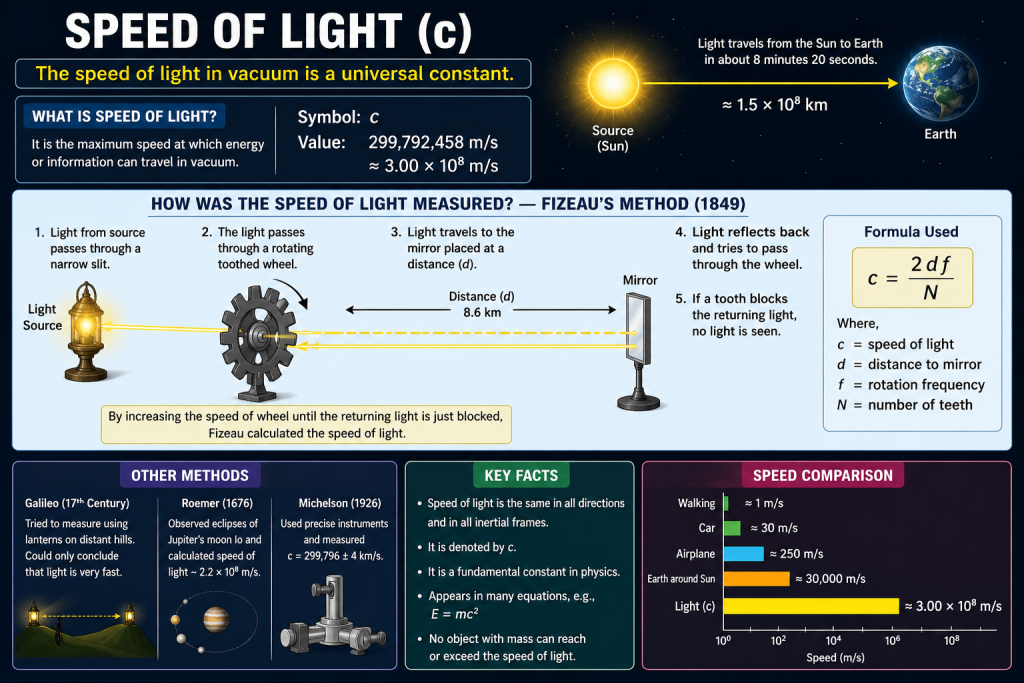
Scientists spent centuries trying to determine whether light traveled instantly or at a finite speed.
Ole Rømer’s Discovery
In 1676, Ole Rømer made the first successful estimate of its while studying Jupiter’s moon Io.
He noticed that eclipses of Io appeared later when Earth moved farther from Jupiter. He concluded that light required time to travel the increasing distance.
This became the first evidence that light does not travel instantaneously.
Bradley’s Stellar Aberration
In 1728, James Bradley used stellar aberration to improve the estimate of light speed.
His measurements produced a value close to:
3.01 x 10⁸m/s
Fizeau and Foucault Experiments
Later, Hippolyte Fizeau and Léon Foucault developed terrestrial experiments using rotating wheels and mirrors to measure the light speed more accurately.
These experiments significantly improved precision and paved the way for modern optical physics.
Modern Definition
Today, the light speed is defined exactly as:
c = 299,792,458 m/s
The meter itself is now defined using the speed of light.
According to NIST – Fundamental Constants, it is one of the most precisely defined constants in science.
Einstein and the Speed of Light
Its became even more important after Albert Einstein published the theory of special relativity in 1905.
Einstein proposed that:
One of the most famous equations in physics emerged from this theory:
E = m c2
This equation shows that mass and energy are equivalent, with the light speed squared acting as the conversion factor.
According to MIT OpenCourseWare – Relativity, Einstein’s work revolutionized modern physics and transformed our understanding of space and time.
Speed of Light and Relativity
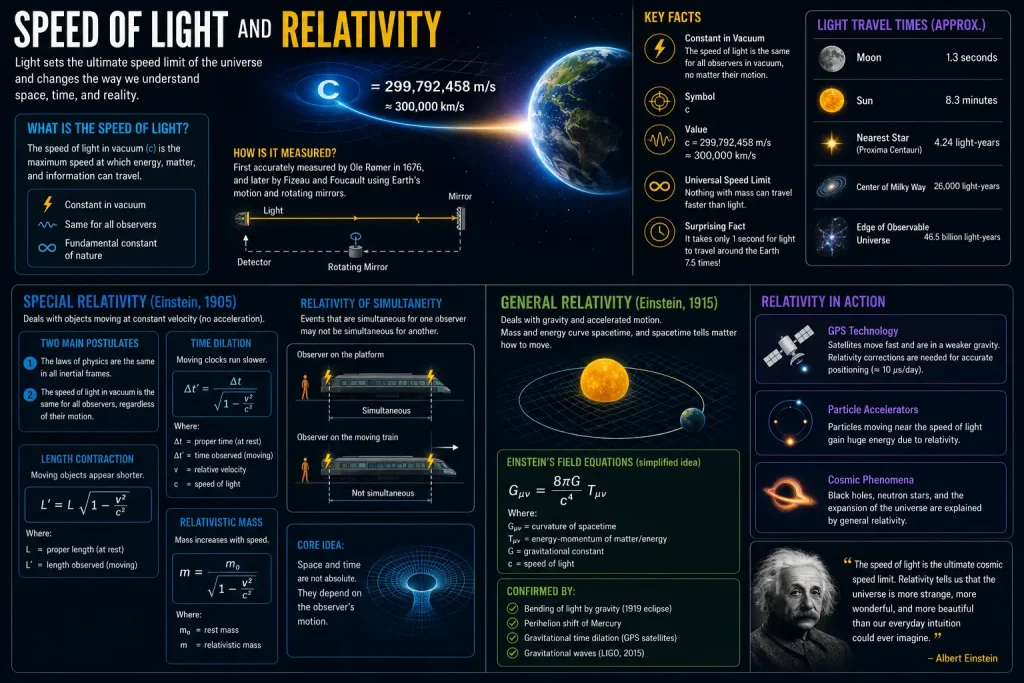
Special relativity explains that as objects move close to the speed of light:
This phenomenon is known as time dilation.
For example, astronauts traveling at extremely high speeds would experience time more slowly compared to people on Earth.
Although humans cannot currently travel near the speed of light, these effects have been confirmed experimentally using high-speed particles and atomic clocks.
Why Is the Speed of Light Constant for All Observers?
One of the most astonishing discoveries in physics is that it remains the same for all observers, regardless of their motion.
This idea became the foundation of special relativity.
The famous Michelson–Morley experiment attempted to detect changes in light speed caused by Earth moving through the hypothetical ether. Surprisingly, no difference was found.
Later, Albert Einstein proposed that the speed of light in vacuum is constant for every inertial observer.
According to MIT OpenCourseWare – Relativity, this single idea led to revolutionary concepts such as:
Relativistic Velocity Addition
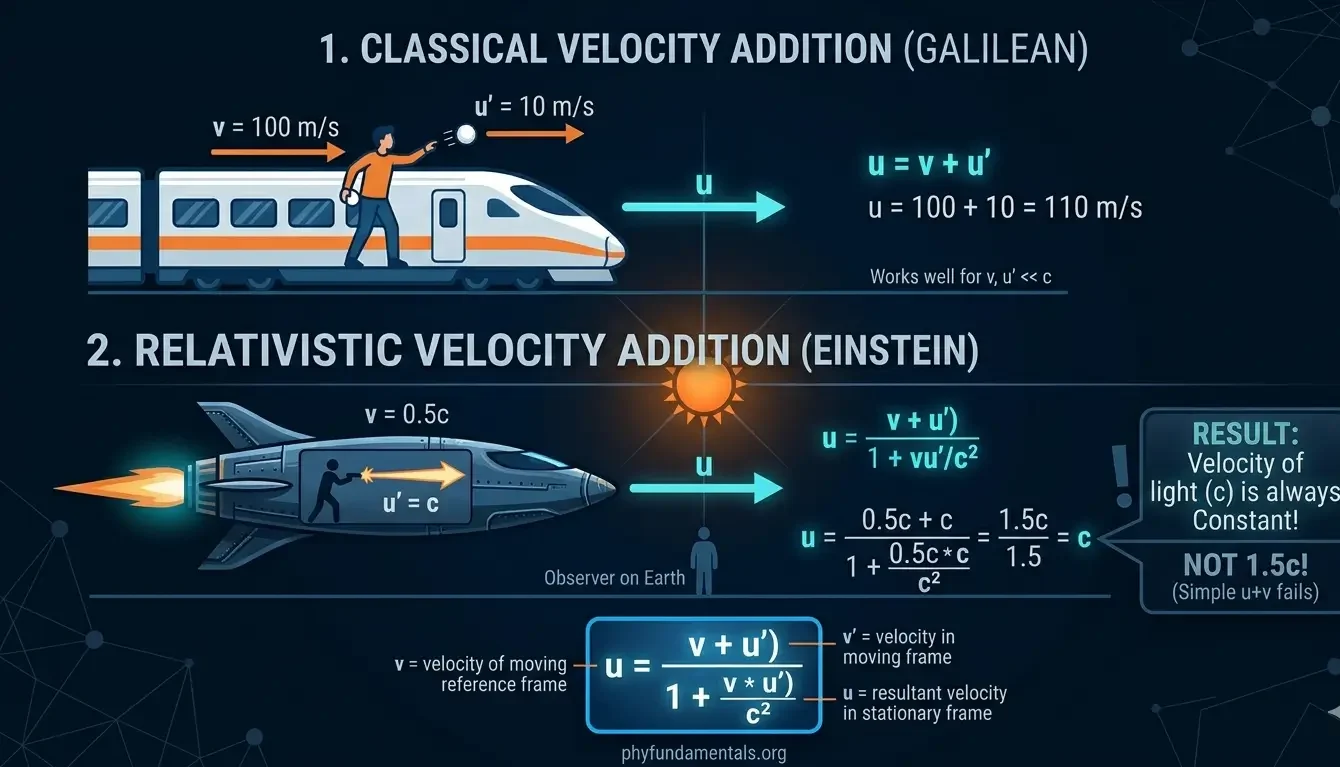
In classical mechanics, velocities simply add together. However, relativity changes this rule.
The relativistic velocity addition formula is:
v = (v₁ + v₂) / (1 + (v₁v₂ / c²)
This equation guarantees that no combination of velocities can exceed the light speed.
For example, if a spacecraft moves at 0.8c and emits a laser beam forward, the light still travels at exactly c rather than 1.8c.
Can Anything Travel Faster Than Light?
According to current physics, no object with mass can exceed the universal cosmic speed limit.
As an object approaches the light speed:
Therefore, traveling faster than light is considered impossible based on modern scientific understanding.
However, scientists continue exploring theoretical concepts such as:
These remain speculative and have not been experimentally achieved.
Why Can Nothing Travel Faster Than Light?
According to Einstein’s theory of relativity, any object with mass would require infinite energy to reach its.
The relativistic energy relationship is:
KE = (γ-1) m c2
where:
γ = 1 / √(1 v²/c²)
As velocity approaches c, the Lorentz factor γ approaches infinity.
This means:
Photons, however, are massless and naturally travel at c.
Can Anything Appear to Travel Faster Than Light?
Some phenomena may seem faster than light, but they do not violate relativity.
Examples include:
Although distant galaxies can recede faster than light because space itself expands, no local object or information travels faster than c.
According to Khan Academy – Special Relativity, relativity still preserves the universal speed limit for information transfer.
Real-Life Applications
It is essential in many technologies used every day.
Major Applications
Fiber optic cables use light pulses to transmit enormous amounts of information at incredible speeds across the world.
GPS systems also rely on accurate timing corrections involving relativity and light-speed calculations.
Speed of Light in Astronomy
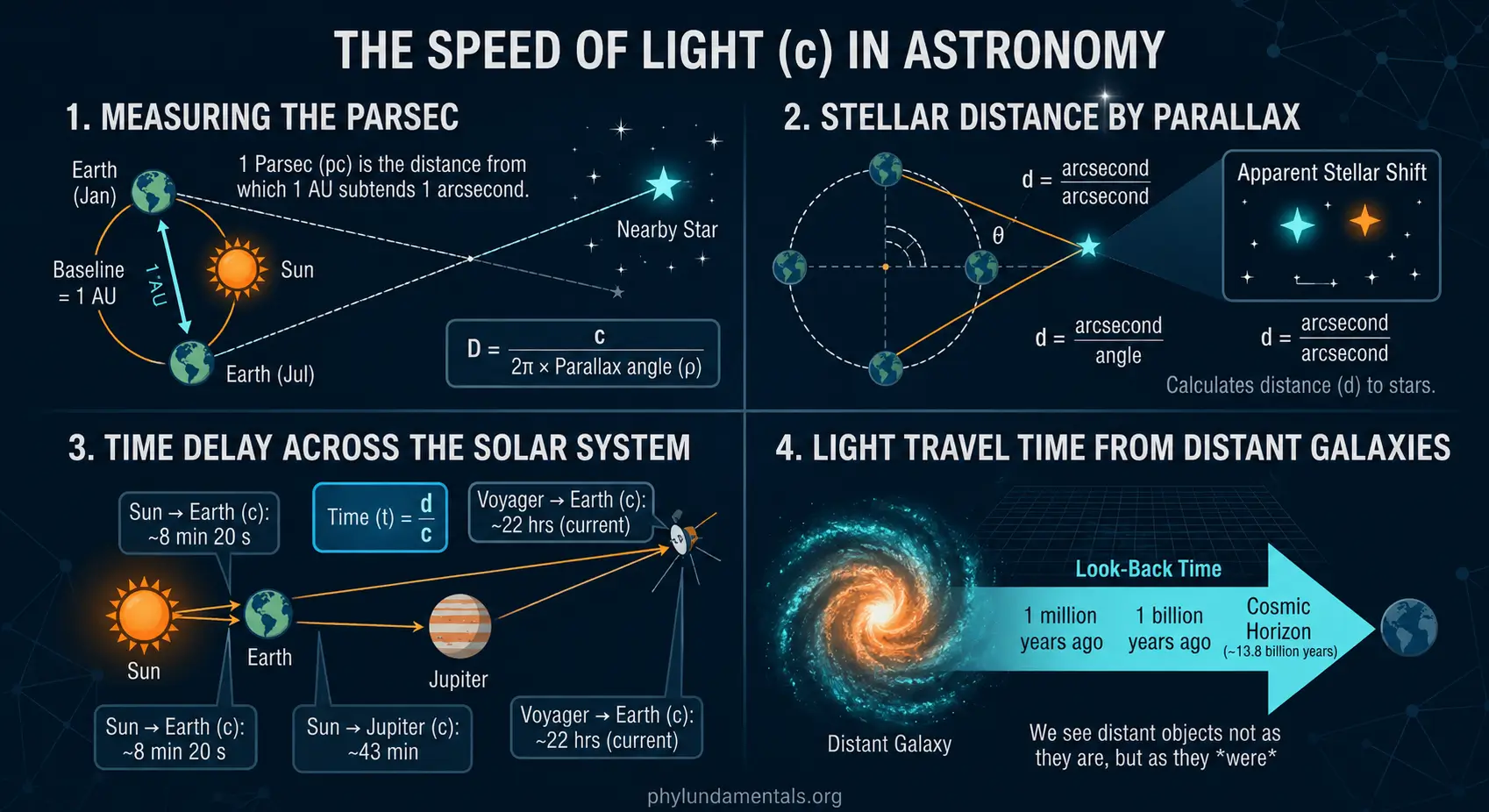
Astronomers use its to measure enormous cosmic distances.
Because light takes time to travel, observing distant objects means looking into the past.
For example:
This is why astronomers say telescopes act like time machines.
The distance light travels in one year is called a light-year:
1 Light-Year≈9.46 x 10¹⁵m
Light-years are widely used to measure distances between stars and galaxies.
According to NASA Space Place, a light-year measures distance rather than time.
Interesting Facts About the Speed of Light
Final Thoughts
The speed of light is far more than just a number in physics. It is one of the fundamental building blocks of the universe and shapes our understanding of space, time, energy, and motion.
From Einstein’s theory of relativity to modern internet communication and deep-space astronomy, Its influences nearly every branch of science and technology. Understanding this universal constant helps explain how the cosmos works and why the universe behaves the way it does.