Electromagnetism

  • Newton’s Second Law

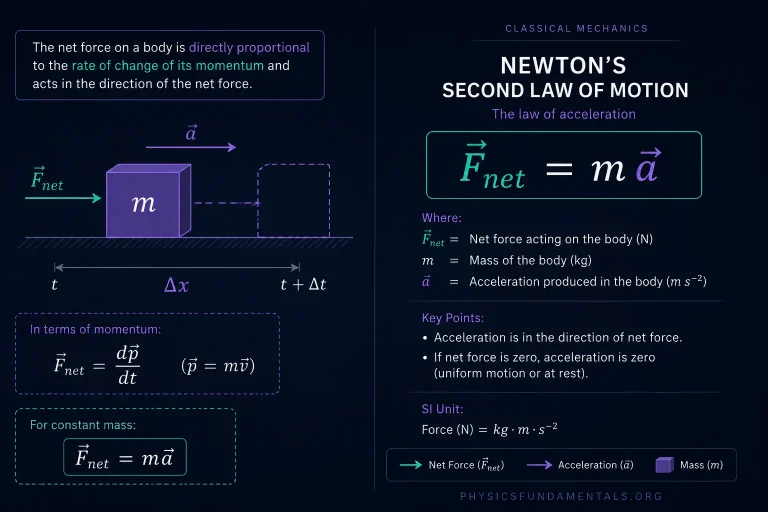
    Newton’s Second Law of Motion states that the acceleration of an object is directly proportional to the net force acting on it and inversely proportional to its mass. In simple terms, stronger forces produce greater acceleration, while heavier objects resist changes in motion more strongly. This relationship is expressed through one of the most famous…

  • Coulomb’s Law

    Electric Charge and Coulomb’s Law are two of the most important ideas in physics because they explain how objects become electrically charged and how charged particles push or pull each other. Every spark, lightning strike, electric field, atom, circuit, and electronic device depends on the behavior of electric charge. When two charged objects come close,…

  • Speed of Light

    The speed of light is the speed at which light waves travel through various materials. In a vacuum, the speed of light is defined as exactly 299,792,458 meters per second. The speed of light is one of the most fundamental constants in physics and represents the fastest speed at which energy, matter, and information can…