

Projectile motion is the motion of an object launched into the air that moves only under the influence of gravity. A basketball shot, a football kick, a cannonball, or even water spraying from a fountain all follow the same graceful curved path through the air. Under the influence of gravity alone, this trajectory becomes a parabola.
But why does the path of a launched object form a parabola specifically? Why not a circle, ellipse, or some irregular curve?
The answer lies in one of the most important principles in classical physics: horizontal motion and vertical motion behave independently. Horizontally, an object travels with nearly constant velocity, while vertically it accelerates downward because of gravity. When these two motions combine mathematically, the resulting flight path becomes a parabola.
This curved airborne trajectory is one of the clearest demonstrations of Newton’s laws of motion and forms the foundation of sports physics, ballistics, engineering, astronomy, and orbital mechanics.
According to Khan Academy – Projectile Motion, motion under gravity is one of the most important examples of two-dimensional motion in physics.
Key Takeaways
What Is Projectile Motion?
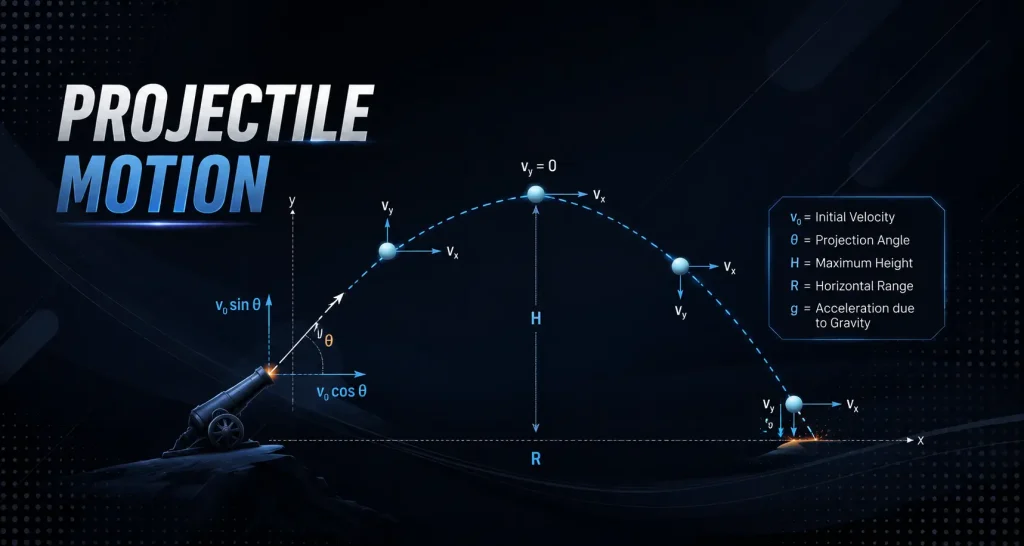
Projectile motion is the motion of an object launched into the air that moves only under the influence of gravity.
Common examples include:
In ideal conditions:
Under these assumptions, the object follows a perfectly curved parabolic path.
This type of airborne motion is studied extensively because it combines:
Understanding how these independent motions interact, explains why the trajectory curves naturally.
What Is a Parabola in Physics?
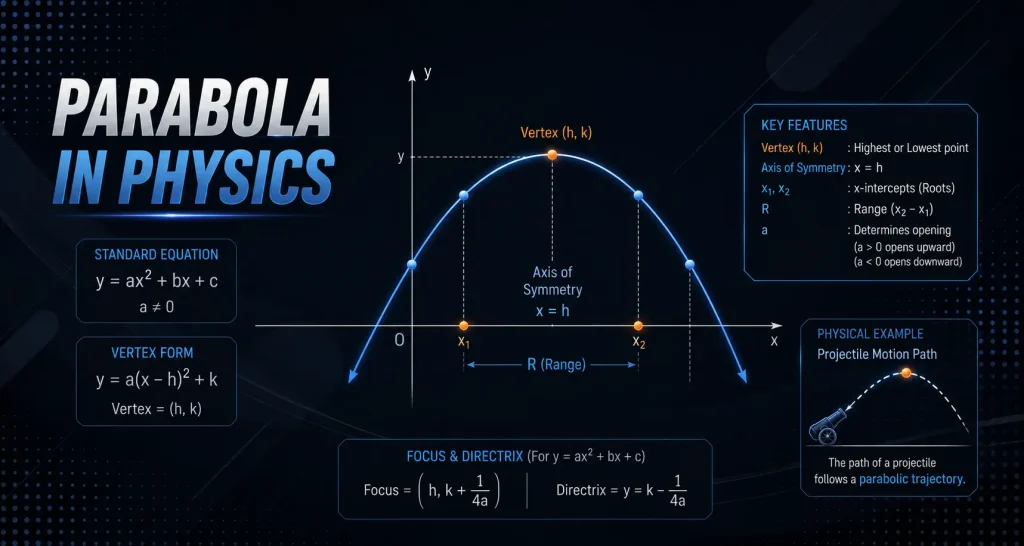
A parabola is a curved shape represented mathematically by a quadratic equation.
The standard form is:
y=ax2+bx+c
where:
The graph forms a smooth U-shaped curve.
In the motion of a launched object, the parabola opens downward because gravity pulls the object toward Earth.
The highest point of the arc is called the vertex, representing the maximum height reached during flight.
Parabolas appear throughout science and engineering, including:
According to Britannica – Parabola, the parabola is one of the most important conic sections in mathematics and physics.
Why Motion Through the Air Has Two Independent Components
The key idea behind projectile motion is that horizontal and vertical components act independently of each other.
This principle comes directly from Newton’s laws of motion.
Horizontal Motion of a Launched Object
Horizontally, there is no force acting on the object if air resistance is ignored.
Therefore:
This means the object covers equal horizontal distances during equal time intervals.
The horizontal velocity is:
vx= v0 cos θ
where:
Because no horizontal force acts, this component remains unchanged throughout the flight.
Vertical Motion Under Gravity
Vertically, gravity acts downward with constant acceleration:
g ≈9.8 m /s2
The vertical component of velocity is:
vy= v0 sin θ
Gravity continuously changes this vertical velocity:
This constant downward acceleration bends the path into a parabola.
Why Does the Trajectory Become a Parabola?
The path becomes parabolic because:
This is the central idea behind the physics of airborne trajectories.
The horizontal position changes as:
x ∝t
while the vertical position changes as:
x ∝t2
When time is eliminated from these equations, the relationship between “x” and “y” becomes quadratic. And every quadratic equation produces a parabola.
This is why the motion of a launched object naturally forms a curved parabolic arc.
Derivation of the Trajectory Equation
Consider an object launched from the origin with:
The initial velocity components are:
vx= v0 cos θ
and
vy= v0 sin θ
Horizontal Position Equation
Since horizontal velocity remains constant:
x= v0 cos θ. t
This equation shows that horizontal displacement changes linearly with time.
Vertical Position Equation
Vertical motion experiences gravitational acceleration:
y = v0 sin θ.t-1/2 gt2
This equation contains the squared time term responsible for the curved flight path.
Eliminating Time from the Equations
From the horizontal equation:
t= x/v0 cosθ
Substituting this into the vertical equation gives:
y=x tanθ- gx22 v02 cos2θ
This is the trajectory equation for motion under gravity.
Because the equation contains:
it is a quadratic equation.
A quadratic equation in two variables always represents a parabola.
This mathematical derivation directly explains the parabolic trajectory observed in ideal conditions.
Why Gravity Creates a Curved Flight Path
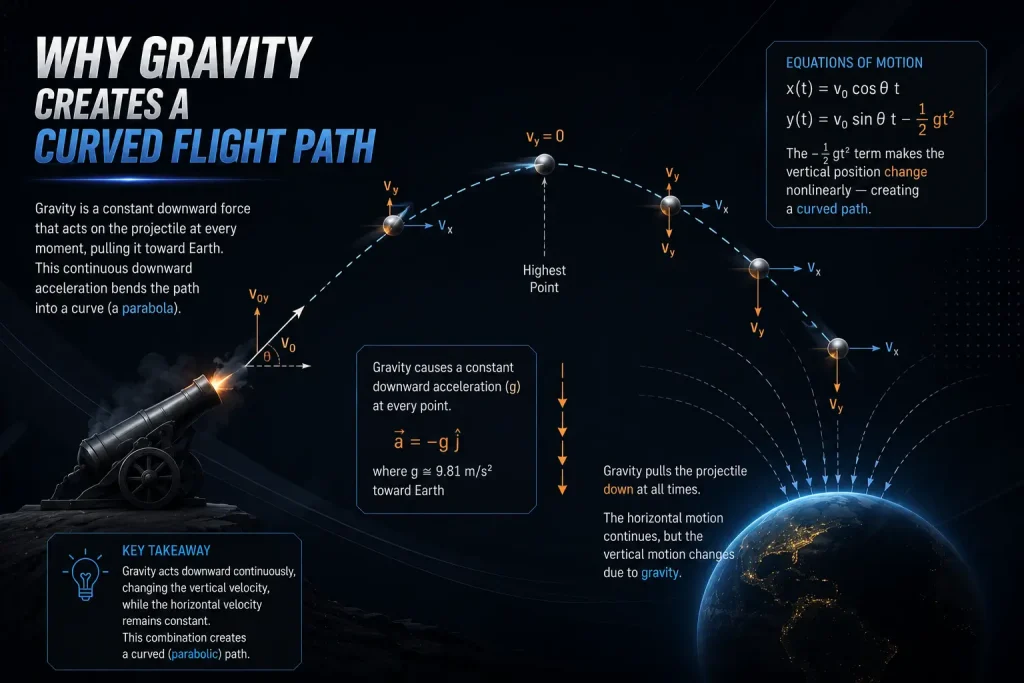
Gravity is the fundamental reason airborne motion curves downward.
Without gravity:
With gravity:
This explains why:
The curve exists because gravity constantly changes vertical motion while leaving horizontal motion almost unchanged.
Is the Path Always a Perfect Parabola?
No. Real-world trajectories are only approximately parabolic.
A perfect parabola occurs only when:
In reality:
For example:
These effects distort the ideal parabolic trajectory.
However, for short distances and moderate speeds, the parabolic approximation remains extremely accurate.
Important Equations for Motion Under Gravity
This type of two-dimensional motion produces several important equations used throughout physics and engineering.
Maximum Height Formula
The maximum height reached during flight is:
H = v02 sin2θ/2g
This occurs when vertical velocity becomes zero.
Time of Flight Formula
The total time the object remains airborne is:
T = 2 v0 sinθ/g
This assumes the object lands at the same vertical height from which it was launched.
Horizontal Range Formula
The horizontal distance covered is:
R = v20 sin(2θ)/g
This equation reveals several elegant properties of ballistic trajectories.
Why Does 45° Give Maximum Range?
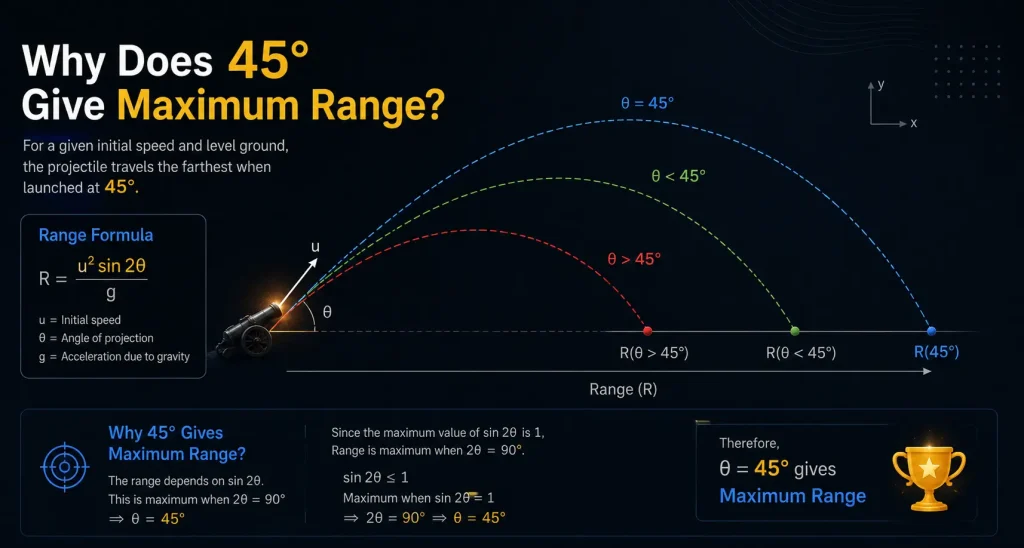
The range equation contains:
sin(2θ)
The sine function reaches its maximum value when:
2θ= 90o
Therefore:
θ= 45o
This means a launch angle of 45° produces the maximum horizontal distance under ideal conditions.
Interestingly:
This symmetry is one of the most beautiful features of parabolic motion.
Real-Life Applications of Parabolic Motion
The curved trajectory of launched objects is essential in many scientific and engineering fields.
Sports Physics
This motion explains:
Athletes and coaches study launch angle, speed, and spin to maximize performance.
A basketball player, for example, adjusts the release angle to improve shooting accuracy.
Ballistics and Military Science
Ballistic trajectories form the foundation of:
Modern ballistics also considers:
Even advanced missile guidance systems begin with classical motion-under-gravity equations.
Engineering and Architecture
Engineers use parabolic motion in:
One of the most visible examples is fountain engineering. The graceful arcs seen in fountains are carefully designed using projectile equations to ensure symmetry, aesthetic beauty, and controlled water flow.
Water jet systems in amusement parks and public spaces also depend on trajectory calculations. Engineers determine the required speed and angle to make water streams land precisely at desired locations. Roller coasters similarly use principles related to gravitational motion and curved trajectories to create safe yet thrilling rides.
Hydraulic systems and irrigation equipment frequently involve fluid streams following predictable parabolic paths. Agricultural irrigation sprinklers, for instance, are designed to maximize coverage while minimizing water waste.
Parabolic shapes also appear naturally in architecture and structural engineering. Suspension bridge cables under uniform load often resemble parabolic curves. Reflective surfaces such as satellite dishes and telescope mirrors use parabolic geometry because it efficiently focuses waves and signals to a single point.
Thus, the mathematics of projectile motion extends far beyond moving objects and deeply influences modern engineering design.
Space Science and Astronomy
The motion of launched objects also connects directly to astronomy and space exploration. In many ways, orbital motion is simply an advanced form of projectile motion extended to enormous scales.
According to NASA Glenn Research Center, an orbit can be understood as continuous free-flight motion around Earth. A satellite is constantly falling toward Earth due to gravity, but its forward speed is so great that Earth curves away beneath it at the same rate.
This remarkable idea helped transform humanity’s understanding of planetary motion and space travel. Modern satellites, space probes, and interplanetary missions all rely on trajectory calculations rooted in classical mechanics.
Astronomers also study the paths of comets, asteroids, and meteors using the same principles. Depending on their energy and speed, these objects may follow:
Understanding these trajectories is essential for predicting planetary motion, planning satellite launches, and even defending Earth from potentially hazardous asteroids.
Connection Between Projectile motion and Orbits
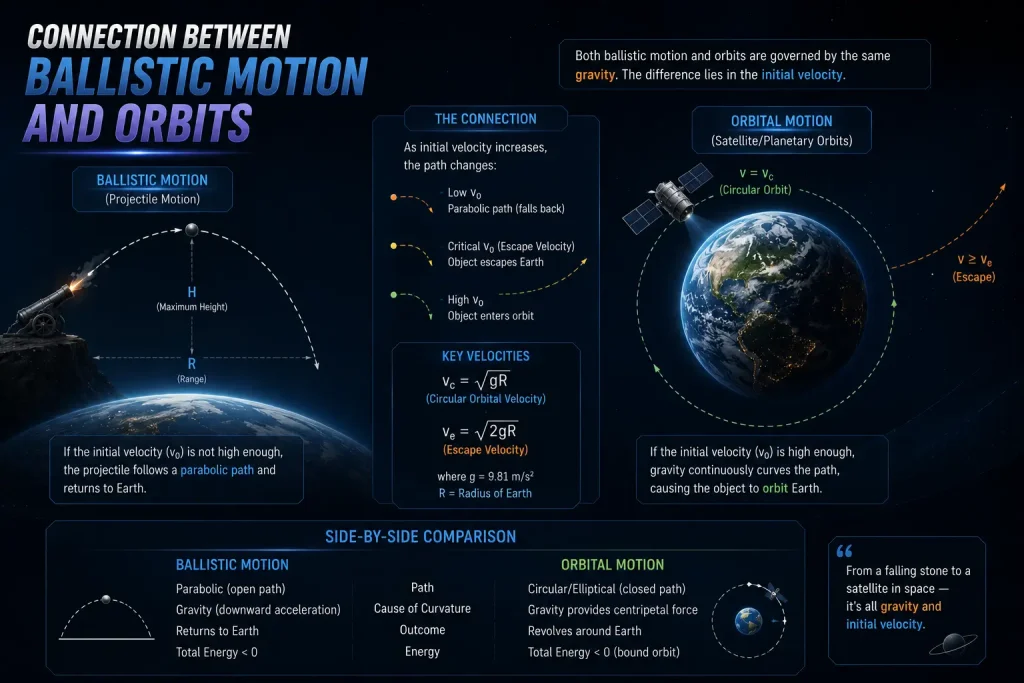
Isaac Newton imagined firing a cannonball horizontally from a high mountain.
If fired slowly:
If fired fast enough:
This idea became the foundation of orbital mechanics.
Near Earth’s surface:
In space:
- gravity follows the inverse-square law
- paths become:
This remarkable connection links simple classroom physics to planetary motion and space exploration.
Conservation of Energy in Airborne Motion
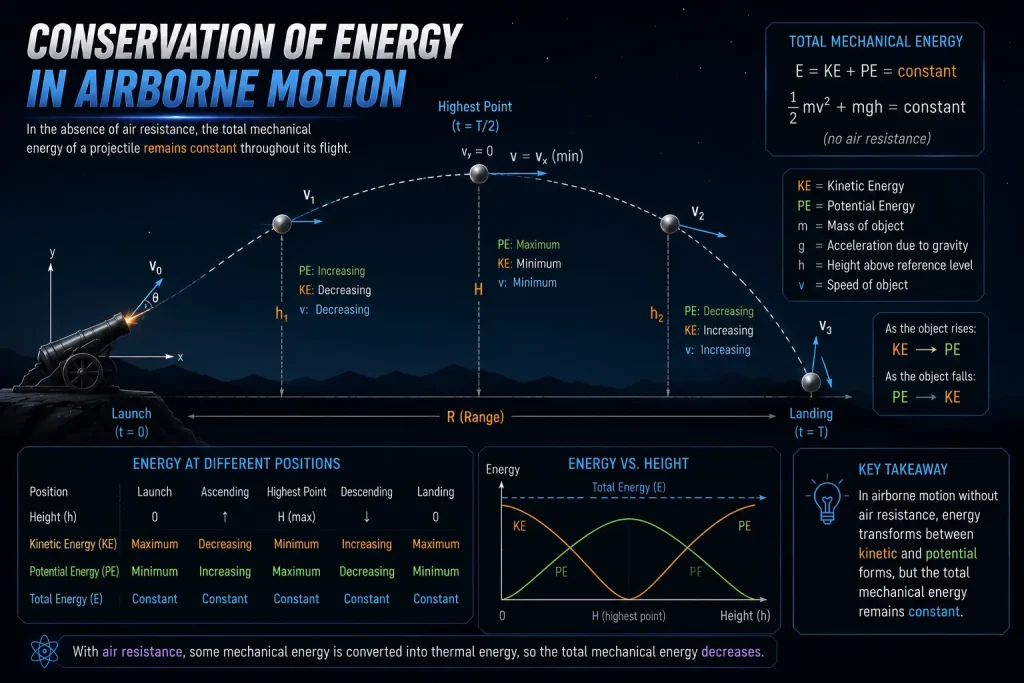
The flight of a launched object is also one of the clearest demonstrations of conservation of mechanical energy.
At the moment of launch:
As the object rises:
At the highest point:
As the object falls back downward:
Ignoring air resistance, the total mechanical energy remains constant throughout the entire motion. Energy simply changes form between kinetic and potential energy.
This principle explains why objects speed up while falling and slow down while rising. It also demonstrates the deep relationship between motion, gravity, and energy conservation.
According to MIT OpenCourseWare – Classical Mechanics, projectile trajectories provide one of the clearest and most intuitive examples of energy conservation in classical mechanics.
Connection Between Parabolas and Conic Sections
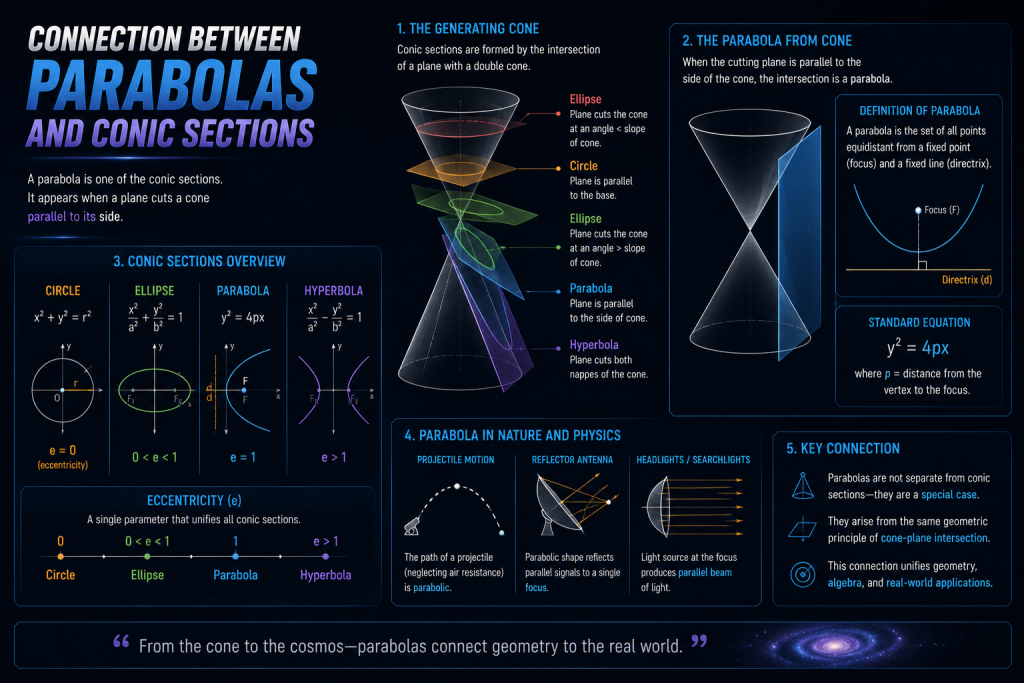
A parabola is one of the four fundamental conic sections:
These curves are formed by slicing a cone at different angles. Although they originate from geometry, conic sections play a major role in physics and astronomy.
Near Earth’s surface, motion under nearly constant gravity produces a parabolic trajectory. However, in full gravitational physics governed by Newton’s law of gravitation, objects may follow different conic paths depending on their total energy.
For example:
Comets entering the solar system may follow highly elongated elliptical paths, while some interstellar objects move along hyperbolic trajectories and never return.
This makes the parabola one of the most physically important curves in mechanics. It acts as the boundary between bound and unbound motion in gravitational systems and links simple projectile motion to the large-scale structure of the universe itself.
Worked Problems on Projectile Motion
Problem 1 on projectile motion: Finding Maximum Height, Time of Flight, and Range
A ball is launched with an initial speed of 20 m/s at an angle of 45° above the horizontal. Ignore air resistance.
Find:
Take:
g = 9.8 m / s2
Step 1: Resolve the Initial Velocity
The horizontal and vertical components are:
vx= v0 cos θ
and
vy= v0 sin θ
Substitute the values:
vx= 20 cos 45o ≈14.14 m/s
vy= 20 sin 45o ≈14.14 m/s
Step 2: Calculate Maximum Height
Use the formula:
H = v02 sin2θ/2g
Substituting:
H = 202x (sin 45o)2/2(9.8)
H = 400 x 0.5/19.6
H ≈10.2 m
Answer:
The maximum height is approximately 10.2 m.
Step 3: Calculate Time of Flight
Use:
T = 2 v0 sinθ/g
Substitute values:
T = 2(20) sin45o/9.8
T = 40 (0.707)/9.8
T ≈2.89 s Answer
Answer:
The ball remains in the air for approximately 2.89 s.
Step 4: Calculate Horizontal Range
Use:
R = v02 sin(2θ)/g
Substitute values:
R = 202 sin90o/9.8
R = 400 (1)/9.8
R 40.8 m
Answer:
The horizontal range is approximately 40.8 m.
Problem 2 on projectile motion: Projectile Launched Horizontally
A ball rolls off a cliff horizontally with a speed of 15 m/s. The cliff is 45 m high.
Find:
Ignore air resistance.
Step 1: Analyze Vertical Motion
The initial vertical velocity is zero because the ball leaves horizontally.
Use the vertical displacement equation:
y = 1/2 gt2
Substitute:
45 = y = 1/2 (9.8)t2
45 = 4.9 t2
t2 = 45/4.9
t2≈9.18
t ≈3.03 s
Answer:
The ball hits the ground after approximately 3.03 s.
Step 2: Calculate Horizontal Distance
Horizontal velocity remains constant:
x = v t
Substitute:
x = 15(3.03)
x 45.5 m
Answer:
The ball travels approximately 45.5 m horizontally before hitting the ground.
Final Thoughts
The curved path followed by a launched object is one of the most elegant examples of how mathematics and physics work together. A simple combination of constant horizontal velocity and gravitational acceleration naturally produces a parabola — one of the most important curves in science.
Understanding why this airborne trajectory becomes parabolic not only explains sports, fountains, fireworks, and ballistics, but also opens the door to deeper ideas in mechanics, orbital motion, and gravitational physics. From a thrown ball to a satellite orbiting Earth, the same physical principles govern motion throughout the universe.


