
Angular momentum is the quantity of rotational motion possessed by a rotating object around an axis. It describes how strongly an object continues spinning and depends on the object’s mass, shape, and rotational speed. In physics, this is one of the most important conserved quantities and is represented by the equation:
L = I ω
where:
A simple and fascinating example of angular momentum can be seen in figure skating. When a skater stretches the arms outward, the spin becomes slower. But the moment the skater pulls the arms inward, the spinning speed increases dramatically. This happens because the moment of inertia decreases, so angular velocity increases to conserve momentum of angular. The same physical law explains why planets move faster when closer to the Sun, why spinning tops remain stable, and how galaxies rotate in space.
From bicycle wheels and gyroscopes to black holes and quantum particles, angular momentum governs rotational motion throughout the universe. Understanding angular momentum is essential in mechanics, astronomy, engineering, and modern physics because it explains how rotating systems behave when forces and torques act on them.
What Is Angular Momentum?
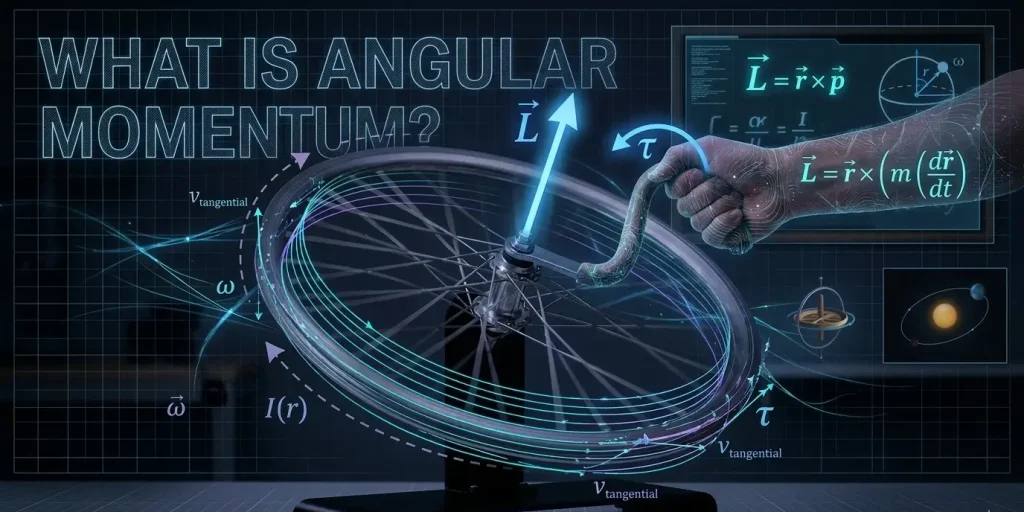
The quantity of rotational motion possessed by an object rotating around a point or axis. It depends on both the mass of the object and how fast it rotates. Objects with larger mass or higher rotational speed have greater angular momentum.
It is strongly influenced by how mass is distributed around the axis of rotation. When more mass is located farther from the axis, the moment of inertia increases, making it harder for the object to spin rapidly. This is why a spinning skater rotates slower when extending the arms outward and faster when pulling them inward. As the skater pulls the arms closer to the body, the moment of inertia decreases, so the angular velocity increases to conserve angular momentum.
It is a vector quantity, meaning it has both magnitude and direction. Its direction is determined using the right-hand rule:
Angular Momentum Formula
Its formula depends on the type of motion involved.
Point Mass
For a particle moving around a point;
L = m v r
where:
More generally:
L = m v r sinθ
where “θ” is the angle between the position vector and velocity vector.
This form is widely used in orbital mechanics and planetary motion.
SI Unit
The SI unit is :
kg·m²/s
Its dimensional formula is:
[M L² T⁻¹]
Rotating Body
For a rotating rigid body:
L = I ω
where:
This is the most commonly used equation in rotational dynamics.
Moment of Inertia
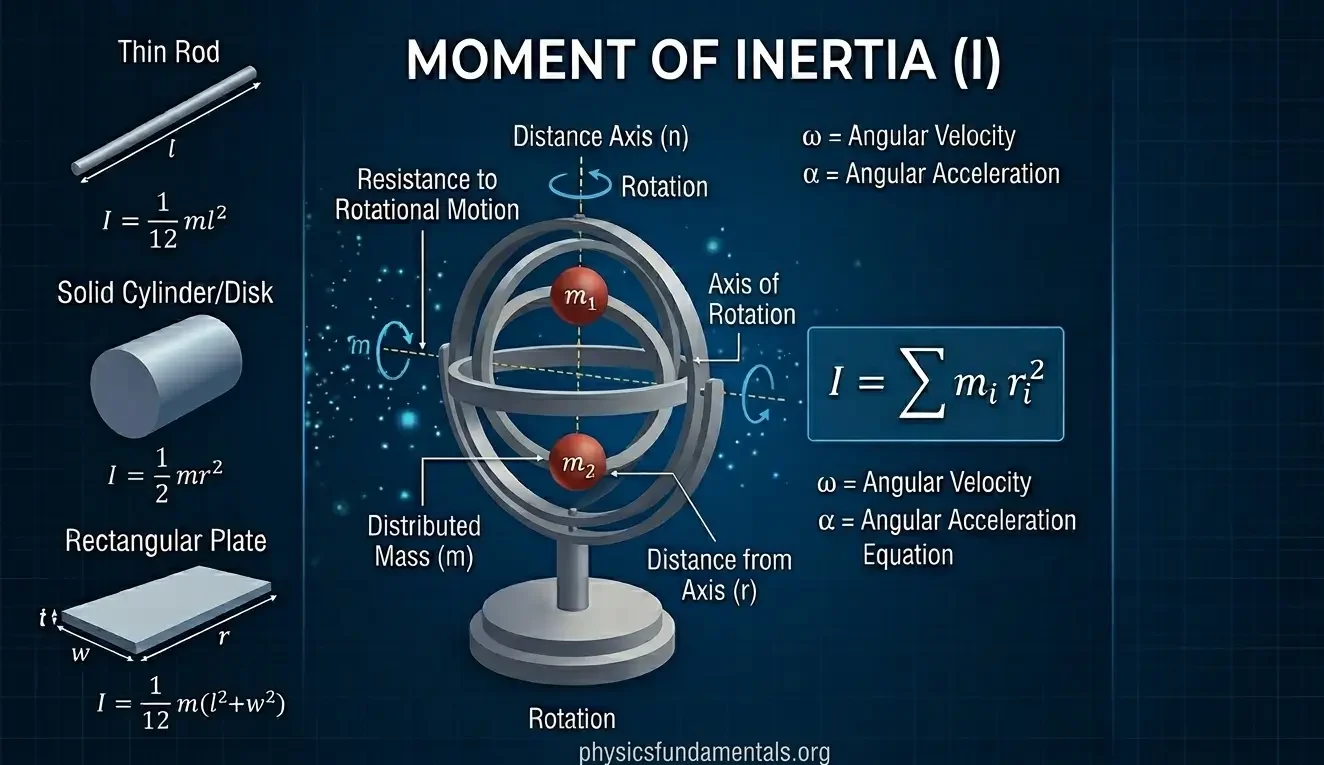
The moment of inertia is the rotational equivalent of mass. It measures how strongly an object resists changes in rotational motion. The farther the mass is distributed from the axis, the greater the moment of inertia.
The general formula is:
I = ∑mr2
Some common moments of inertia are listed below:
|
Object |
Moment of Inertia |
|---|---|
|
Point mass |
mr² |
|
Solid disc |
½mr² |
|
Hollow cylinder |
mr² |
|
Solid sphere |
⅖mr² |
|
Thin rod through center |
1/12 mL² |
A hollow cylinder has a larger moment of inertia than a solid cylinder of the same mass because more mass lies farther from the center.
Angular Momentum and Torque
Torque is the rotational equivalent of force. Just as force changes linear momentum, torque changes angular momentum.
The rotational form of Newton’s second law is:
τ= dL/dt
where:
If the moment of inertia remains constant:
τ=I α
where “α” is angular acceleration.
This equation is fundamental in rotational mechanics and engineering.
Conservation of Angular Momentum
As explained by Britannica’s Angular Momentum Guide, it remains constant when no external torque acts on a system. The law of conservation states that if no external torque acts on a system, the total rotational momentum remains constant.
Mathematically:
I1ω1 = I2ω2
This means:
This conservation law applies everywhere in nature, from spinning atoms to rotating galaxies.
Why Does a Skater Spin Faster?
One of the best examples of this conservation principle is a spinning ice skater.
When the skater extends the arms outward, the moment of inertia increases because more mass is farther from the axis. As a result, the spinning speed decreases.
When the skater pulls the arms inward, the moment of inertia decreases. Since its must remain constant, angular velocity increases automatically.
Suppose:
I1ω1 = I2ω2
This means:
This conservation law applies everywhere in nature, from spinning atoms to rotating galaxies.
Why Does a Skater Spin Faster?
One of the best examples of this conservation law is a spinning ice skater.
When the skater extends the arms outward, the moment of inertia increases because more mass is farther from the axis. As a result, the spinning speed decreases.
When the skater pulls the arms inward, the moment of inertia decreases. Since angular momentum must remain constant, angular velocity increases automatically.
Suppose:
Using conservation:
I1ω1 = I2ω2
Substituting values:
ω₂ = (4 × 2) / 1 = 8 rad/s
The skater spins four times faster after pulling the arms inward.
This same principle explains why collapsing stars rotate rapidly and why divers spin faster when tucking their bodies inward.
Angular Momentum in Planetary Motion
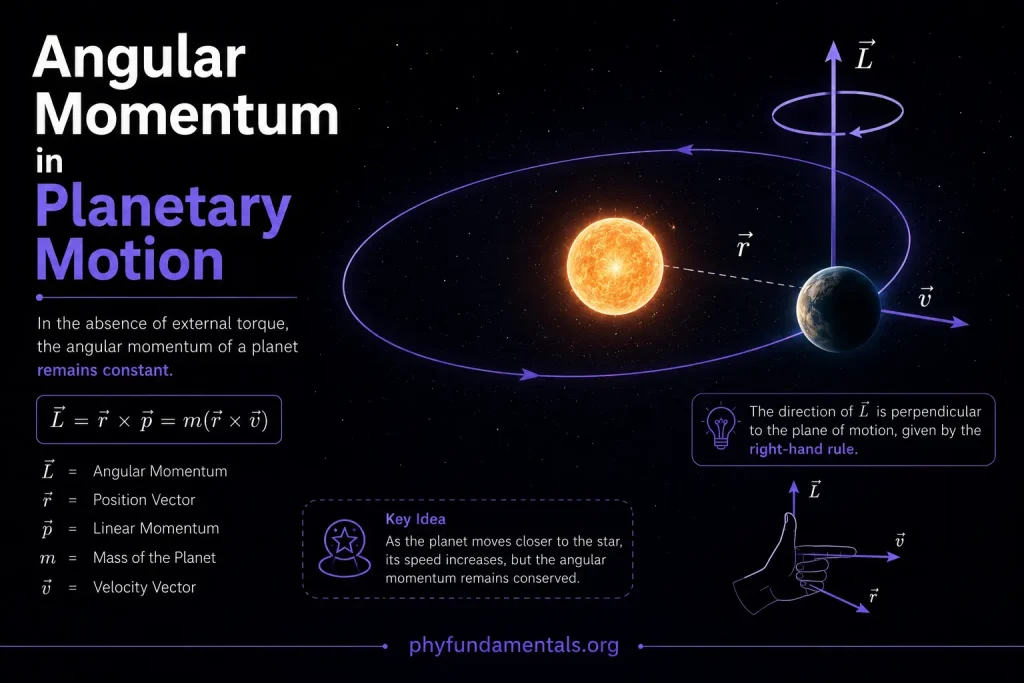
Its also explains the motion of planets around the Sun. According to NASA Solar System Exploration, planetary orbits follow conservation principles that explain why planets move faster when closer to the Sun.
As a planet moves closer to the Sun, its orbital radius decreases. To conserve angular momentum, its orbital speed increases. When the planet moves farther away, its speed decreases.
This behavior is described by:
L = m v r
Gravity acts toward the center of the orbit, producing almost zero external torque about the Sun. This is why angular momentum remains conserved in planetary systems.
This principle is also connected to Kepler’s second law, which states that planets sweep equal areas in equal times.
Angular Momentum vs Linear Momentum
Linear momentum describes motion in a straight line, while AM describes rotational motion around an axis.
|
Linear Momentum |
Angular Momentum |
|---|---|
|
p = mv |
Rotational motion |
|
Unit: kg·m/s |
Unit: kg·m²/s |
|
Depends on velocity |
Depends on angular velocity |
|
Conserved without external force |
Conserved without external torque |
Understanding this relationship helps students connect rotational mechanics with classical mechanics.
Rotational Kinetic Energy
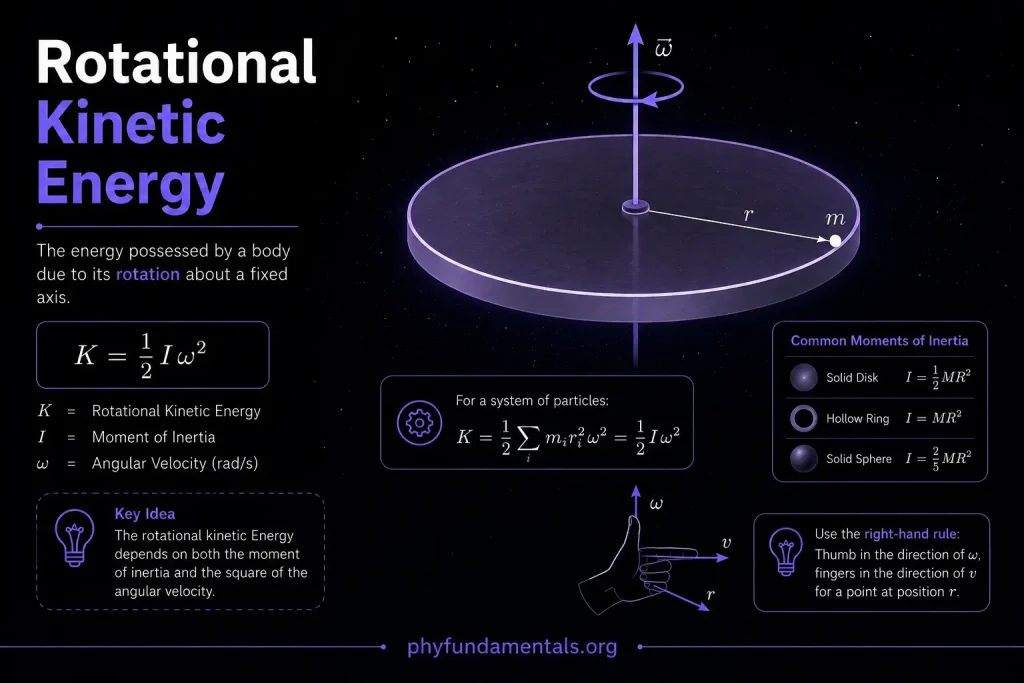
Rotating objects also possess rotational kinetic energy. The formula is:
K.E = 1/2I ω2
The formula is:
A spinning skater gains rotational kinetic energy while pulling the arms inward because work is done against the outward inertial tendency.
Although its remains constant, rotational kinetic energy can change if external work is performed.
Gyroscopes and Angular Momentum
Gyroscopes resist changes in orientation because spinning objects tend to maintain rotational stability.
When an external torque acts on a spinning gyroscope, it does not simply topple over. Instead, its axis slowly rotates in a motion called precession.
The precession angular velocity is:
Ω = M g r/I ω
where:
Faster spinning produces greater rotational stability and slower precession.
Gyroscopes are used in:
Angular Momentum in Quantum Mechanics
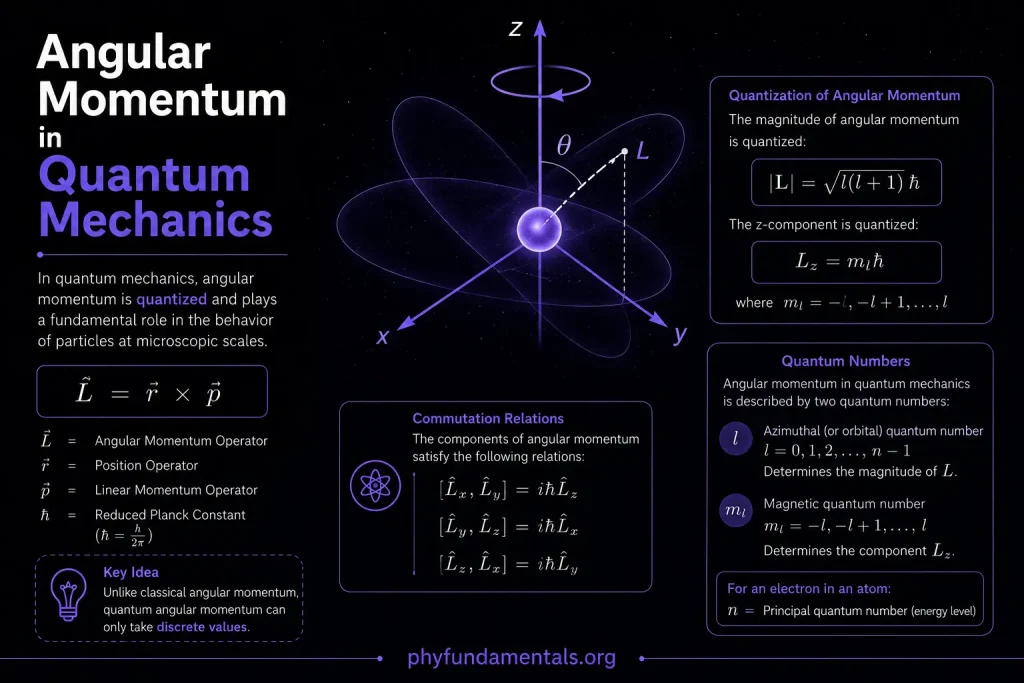
Angular momentum is also important in quantum physics.
Electrons in atoms possess quantized angular momentum, meaning they can only exist in certain allowed states. Electrons also possess intrinsic spin, which is a purely quantum property.
Quantum angular momentum is related to Planck’s constant:
ℏ = h / 2π
The conservation principle governs::
This makes it one of the most universal principles in modern physics
Real-Life Applications
It has many practical applications in science, engineering, astronomy, and everyday life.
Common examples include:
Engineers use these principles to design stable and efficient rotating systems.
Solved Example
A wheel has:
Find the angular momentum.
Using:
L = I ω
Substitute values:
L = 5 × 12
L = 60 kg·m²/s
Therefore, the angular momentum of the wheel is: 60 kg·m²/s
Why It Is Important
It is important because it explains rotational stability and motion throughout the universe.
Without this concept:
It is one of the fundamental conserved quantities in physics and plays a major role in mechanics, astronomy, engineering, and quantum science.
Final Thoughts
Angular momentum is a central concept in rotational dynamics and modern physics. Whether studying spinning tops, orbiting planets, gyroscopes, galaxies, or quantum particles, angular momentum provides a powerful framework for understanding rotational motion.
It explains countless natural phenomena and engineering systems. From sports and transportation to astronomy and quantum mechanics, this principle governs rotational motion across the universe.
By understanding its formulas, conservation laws, torque relationships, and real-world applications, students gain a deeper understanding of how rotational systems behave in both classical and modern physics.


